The red light on a broadcast camera never looks heavy until you realize what it is trying to hold.
Watch.
That tiny glowing bead on the top of a lens has turned public hangings in nineteenth-century town squares, courtroom trials, and midnight political rallies into shared national spectacles. When the topic is a military execution and whether a president or commander in chief will allow it to be livestreamed, the question sounds almost technical on the surface. A policy line. A broadcast rule. A headline you skim past while coffee cools on the kitchen counter.
Yet beneath that dry phrasing sits a collision between raw human mortality, constitutional order, and the modern hunger to watch everything happen in real time.
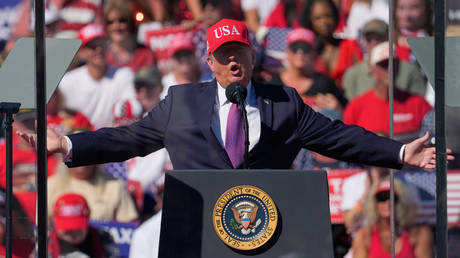
When Donald Trump stated that a military execution will not be livestreamed, the announcement closed a door that some corners of the internet were already rattling. In an era where almost any event can be beamed live into millions of pockets with a single tap, drawing a hard line against broadcasting lethal punishment is more than an administrative note. It is a statement about dignity, restraint, and what a state chooses to show its citizens when it exercises its most irreversible power.
Why the Camera Changes Everything in the Room
To understand why a livestream ban matters so deeply, picture a small, quiet room where a sentence is carried out. There is no crowd of thousands roaring from wooden bleachers. There is no festival atmosphere. Instead, there is a clock ticking against institutional formality, a handful of authorized witnesses whose faces are pale under fluorescent tubes, and legal paperwork that took years of appeals to reach a final page.
The following scenario is hypothetical, offered to show how an ordinary observer experiences the weight of that space. Imagine a young military paralegal—let's call her Hannah—assigned for the first time to sit in an observation room during a capital proceeding. Before she walks through the door, she has spent months reading transcripts, double-checking exhibit numbers, and hearing voices reduced to typewritten lines on blue-lined pads. Inside the room, the air smells faintly of floor wax and dry paper. Nobody speaks above a murmur. Every cough feels loud enough to echo down a hallway.
Now imagine adding a lens to that corner of the room.
Suddenly, Hannah is no longer just a witness bearing solemn duty under military law. Every person in that space is acting before an unseen audience of millions. A judge's posture, a chaplain's quiet prayer, a condemned person's last breath—all of it becomes content the moment a stream goes live. Clips get trimmed into ten-second loops. Screenshots circulate with captions stripped of context. Grief turns into argument in a comment thread before the body is even moved.
That is the real danger of turning lethal state action into a live broadcast. It strips away solemnity and replaces it with spectacle. Even people who strongly support capital punishment under the Uniform Code of Military Justice often draw a sharp line between lawful justice and public entertainment. Justice demands gravity. Livestreams reward noise.
A History Written in Public Squares and Closed Doors
I have spent years reporting on legal controversies and watching how public debates around punishment shift whenever technology changes how we see. One lesson repeats itself with unsettling regularity: whenever the public can watch death up close, the culture around it shifts in ways nobody fully predicts.
Historically, societies moved away from public executions precisely because crowds and spectacle warped the meaning of justice. In earlier centuries, executions drew massive gatherings that blurred solemn judgment with mob sensation, pickpocketing, and political theater. Over time, modern legal systems moved executions behind closed walls, limiting attendance to small groups of official witnesses so the act remained a somber legal duty rather than a mass attraction.
Think of a livestream as a glass wall built around a closed room. Physically, the doors stay shut. Digitally, the walls vanish.
You do not have to guess what happens when sensitive, high-stakes events enter live streaming ecosystems. We already see how algorithms reward outrage, shock, and extreme visuals. A livestream does not pause for nuance. It cannot carry the years of trial testimony, appellate review, or statutory rules that govern military justice. It only captures the final frame.
When Trump says a military execution will not be livestreamed, that refusal aligns with a long-standing instinct to keep the most extreme act of state authority out of the entertainment feed. Honestly, parts of this entire debate make me uneasy—not because the answer is hard to grasp on paper, but because our digital habits have conditioned so many of us to expect instant visual access to every dramatic moment in the news. Wanting to see everything is human. Recognizing what should not be broadcast is wisdom.
Law, Command, and the Limits of Spectacle
People often ask a straightforward question when a headline like this breaks: does military law even allow broadcasting an execution, or is a president simply stating a firm boundary?
Under U.S. law, the military justice system operates under the Uniform Code of Military Justice and the Manual for Courts-Martial, with strict procedures governing capital cases, appellate review, presidential approval where required, and execution protocols. Executions in the U.S. military are extraordinarily rare—none have been carried out since the early 1960s, even though capital punishment remains on the books for specific offenses and death sentences have been handed down in modern decades. Because actual executions happen so rarely, the rules around them often sit quiet in legal manuals until a political figure or public debate brings them back into focus.
A second question follows right behind the first: why would anyone push for a livestream in the first place?
Usually, the impulse comes from one of two places. Some people argue that radical transparency proves the government did what it claimed to do, leaving zero room for rumor or conspiracy theories. Others are swept up in pure sensationalism—the modern reflex to treat every high-stakes event as live television. Both impulses are easy to recognize, even when they pull in opposite directions. One looks for proof; the other looks for thrill.
Yet transparency does not require turning human death into a live stream. Official records, witness accounts, legal filings, and post-event verification serve accountability without broadcasting a person's final moments to the world. Keeping the camera off a military execution protects basic human dignity—including the dignity of victims' families who do not deserve to see their pain replayed endlessly as viral clips, and the basic restraint a constitutional system owes to itself.
What Stays Off Screen Matters Most
Consider what happens next if a society treats every threshold as something to be filmed.
First, empathy frays. When a human being's end becomes a shared online event, distance grows between the viewer and the reality of what a death sentence actually means. Second, trust erodes in a different way: when everything is framed as spectacle, serious legal questions get drowned out by slogans and hot takes.
There is a reason a courtroom or an execution chamber is quiet. Quiet gives room for conscience. It forces the people present—and the citizens represented by the law—to reckon with weight rather than rush past it in a scroll.
A policy saying a military execution will not be livestreamed draws a clear boundary in a noisy age. Not every moment belongs on a screen. Not every act of power should be staged for an audience.
Out in the dark outside that quiet room, millions of phones keep lighting up with the next alert, the next clip, the next urgent push for attention—while the hardest decisions still rest on what a society chooses not to show.