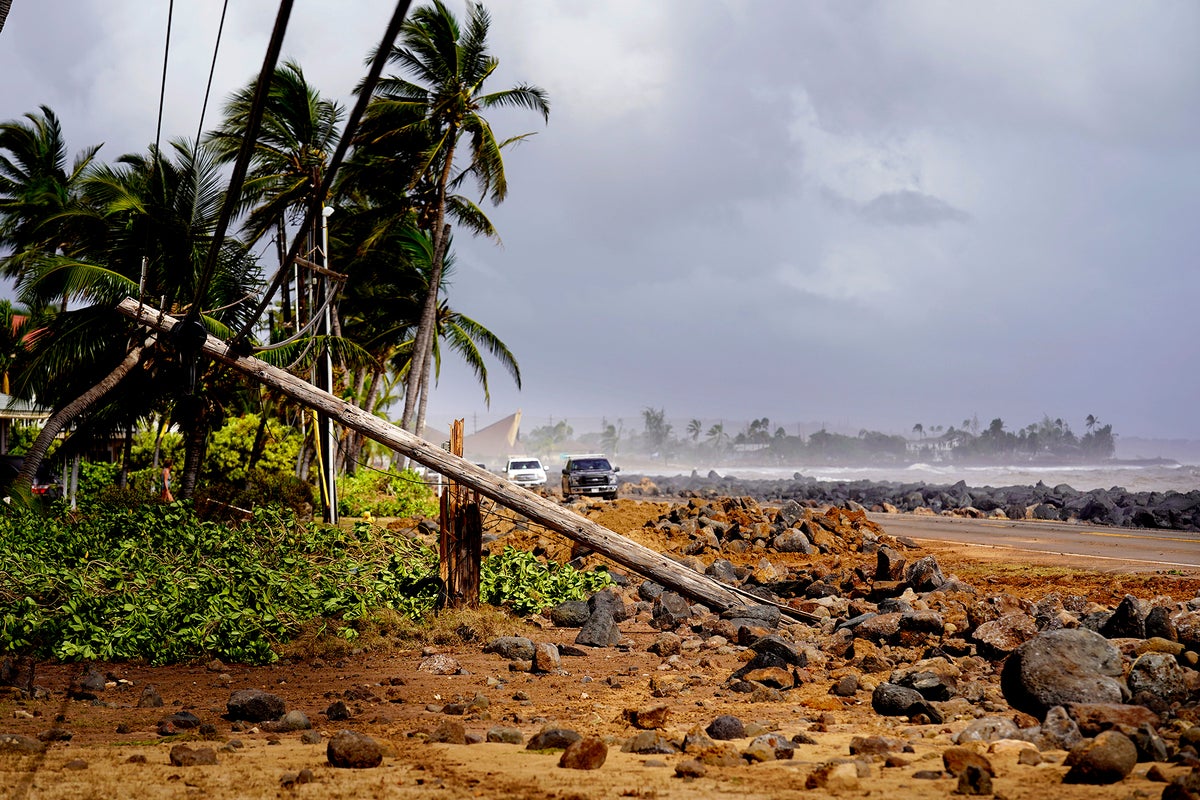
Power grids don't stand a chance when nature throws a Category 2 hurricane less than fifty miles off your coast. Hurricane Lowell proved that truth all over again when it tore past Hawaii's western islands, plunging nearly an entire county into darkness and leaving a trail of shattered roads, downed trees, and flooded highways.
If you are wondering how the islands handle a storm of this magnitude, the reality is messy, loud, and expensive. Let's look at what actually happened on the ground when Lowell made its closest approach, and why emergency services were pushed to their absolute limits.
The Kauai Blackout and the Reality on the Ground
Kauai took the absolute brunt of the system. The Kauai Island Utility Cooperative reported that nearly all of its roughly 35,000 members lost power as winds whipped past the island. That is a staggering 90% plus blackout rate for the county.
Sustained winds at Lihue Airport hovered just above 50 mph, while ferocious gusts touched an estimated 80 mph. Trees snapped like toothpicks. Power lines tangled across major roads.
Governor Josh Green didn't mince words, noting that damages could easily climb into the hundreds of millions. State and county offices, along with public schools across Kauai and Oahu, shut down entirely. Lihue Airport completely halted commercial flights as crews scrambled to assess safety hazards.
People living on the south and west shores faced voluntary evacuation advisories. Storm surge and brutal wave action didn't just cause minor inconveniences. They tore apart coastal roads, hurled sand and lava rocks into public parks, and devastated beachfront properties. Rochelle Ballard, a former professional surfer running a local surf school, watched waves rewrite the shoreline on Kauai's south coast, noting that friends lost homes completely while cleanup efforts are expected to take weeks.
Oahu and Beyond Feel the Ripple Effects
Storms of this size rarely isolate their chaos to just one spot. Over on Oahu, the state's most populated island, tropical-storm-force wind gusts knocked out power to more than 30,000 customers.
High surf pounded western Oahu, pushing water over coastal highways and forcing road crews to clear massive piles of sand, mud, and debris. Flash flooding and mudslide risks remained high even after the eye of the storm passed further north. Mountain elevations on Kauai absorbed over a foot of rain, while Oahu's Koolau range soaked up to nine inches.
Tragically, the storm also claimed a life. A tragic incident on Oahu involved a falling tree striking a tent housing a homeless individual, highlighting the brutal vulnerability of anyone caught outdoors during these extreme weather events.
Why the Central Pacific Is Cooking Up More Storms
You might wonder why a system like Lowell got this close and packed this kind of punch. It is not an isolated incident. The National Oceanic and Atmospheric Administration previously flagged that the Central Pacific could see up to 13 named storms this season, a massive jump from the typical average of five.
We are seeing warmer ocean waters and weaker upper-level winds create a breeding ground for tropical systems. Climate change continues to push baseline ocean temperatures higher, giving storms extra fuel just as they approach island chains that are fundamentally unprepared for direct or near-direct hits. Last month's Tropical Storm Lala already showed how fragile local infrastructure can be when it washed away homes and triggered devastating landslides.
What Residents and Travelers Must Do Now
Recovery takes time. If you are tracking these developments or planning travel to the region, you have to stay realistic about the aftermath.
- Stay off local roads: Emergency management and National Guard personnel need clear asphalt to operate heavy machinery, clear mudslides, and restore electrical grids to critical facilities like hospitals.
- Conserve water resources: Utility systems frequently suffer contamination or mechanical failure during massive power losses, making conservation vital.
- Verify flight schedules independently: Airports reopen only after structural and navigational safety checks clear, which can cause multi-day backlogs.
- Prepare an emergency kit ahead of time: Keep flashlights, portable chargers, non-perishable food, and at least a gallon of water per person per day ready before hurricane season peaks.
The cleanup on Kauai and Oahu will drag on for weeks. Respect the barricades, check on your neighbors, and stop treating tropical storm warnings like background noise.