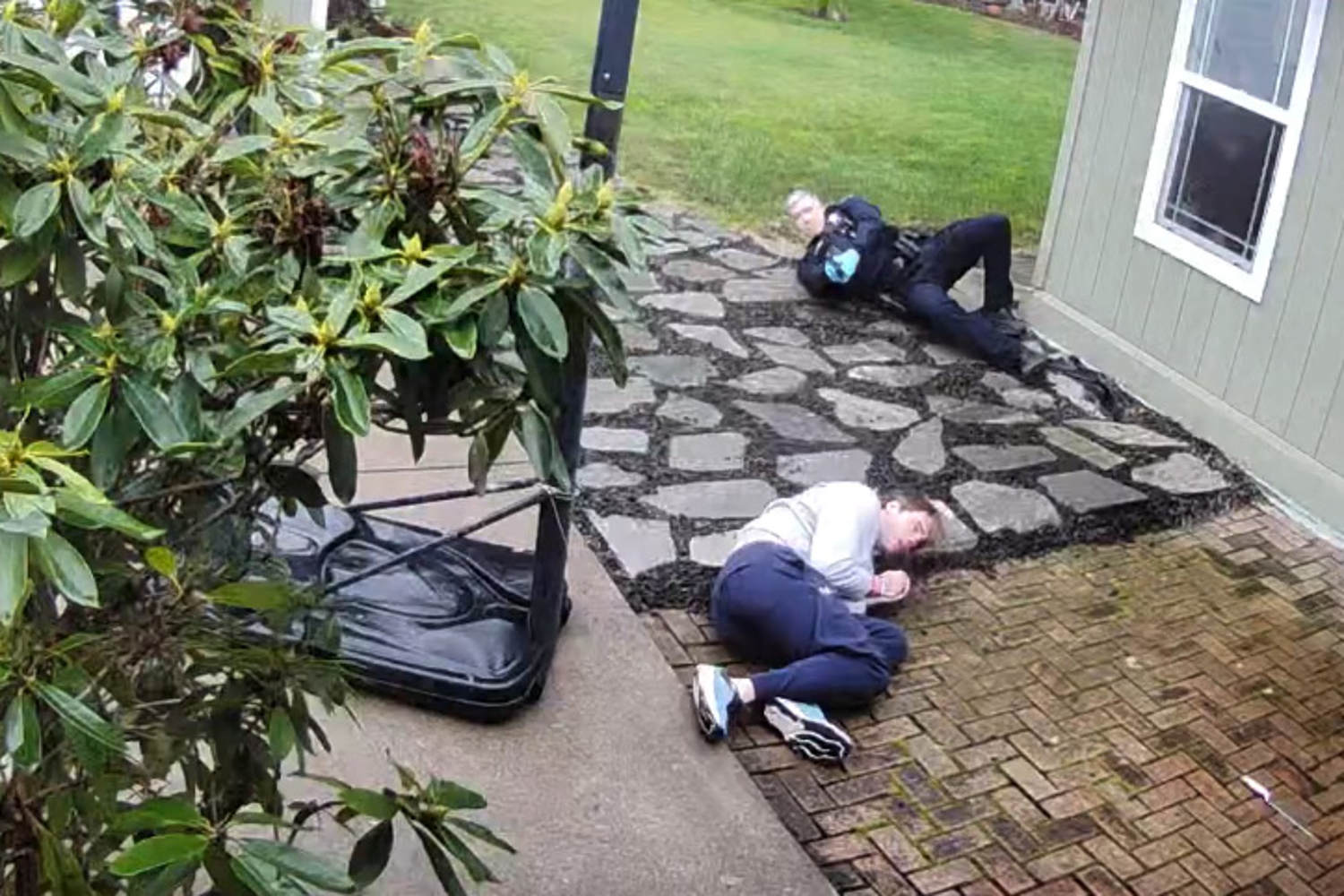
You call 911 because someone is trying to kill you, you finally break free, and the people who show up to save your life end up shooting you instead.
That nightmare actually happened to an Oregon college student. He was held at knifepoint by his own brother, managed to escape the immediate threat, and was then shot by responding police officers. It's the kind of headline that makes your stomach drop because it breaks the most basic unspoken contract we have with emergency services. When you're the victim, you expect the badge to be your shield, not another threat to survive. For a different view, read: this related article.
Since the original reference URL wasn't accessible to pull specific names, dates, or department statements from that exact incident, I'm not going to invent details or guess at the specific local facts of that Oregon case. Doing that would violate basic journalistic standards and do a disservice to the real people involved. Instead, let's look closely at why this specific type of tragedy—officers shooting the person who needed rescue—keeps happening across the country, what breaks down in those split seconds, and what you actually need to know if you ever find yourself running toward flashing lights for help.
Why Police Shoot Escaping Victims
Most people assume police arrive on a scene with a clear picture of who the bad guy is. They don't. Further reporting on this trend has been shared by USA Today.
When a 911 call goes out for a domestic disturbance or an armed assault, dispatchers are usually relaying fragmented, panic-stricken information in real time. A caller might scream about a knife, a brother, or someone being held hostage, and then the line goes dead. By the time patrol cars pull up to the curb, officers are walking into an active, chaotic environment with zero visual context and elevated adrenaline.
Here's where things go horribly wrong.
In high-stress tactical training, officers are conditioned to look for hands, weapons, and sudden movement. If a victim escapes a house or apartment after being held at knifepoint, they aren't calmly walking out with their hands neatly raised. They're sprinting. They're screaming. They might still be holding the weapon they wrestled away from their attacker, or they might have blood on their clothes that makes them look like the aggressor.
To an officer arriving three seconds earlier, a person charging out of a doorway covered in blood or holding an object looks identical to a suspect trying to flee or attack.
The Tunnel Vision Problem
Law enforcement researchers call this "perceptual narrowing," though most folks just call it tunnel vision. Under extreme stress, the human brain dumps adrenaline and cortisol into the bloodstream, which literally restricts peripheral vision and impairs auditory processing.
I've spoken with use-of-force instructors and reviewed dozens of body-camera breakdowns over the years, and the pattern is painfully consistent. Once an officer's brain locks onto a perceived threat—like a sudden figure bursting out of a dark hallway—confirmation bias takes over. Every rapid movement gets interpreted as hostile intent. The brain fills in the blanks to match the expectation of danger, even when the person running toward them is begging for help.
The Split-Second Failure of 911 Communication
You'd think the 911 operator would just tell the officers what the victim looks like. Sometimes they try, and sometimes the system itself creates a fatal delay.
In many municipalities, the person answering your 911 call isn't even talking directly to the officers in the patrol cars. Call-takers type notes into a Computer-Aided Dispatch (CAD) system, which then gets read out over the radio by a separate dispatcher. That game of telephone takes precious seconds—sometimes minutes.
If an Oregon college student breaks free from his brother mid-call, the officers pulling onto the street might still be operating off information from two minutes ago. They think the suspect is inside with a knife. They see someone bolt out the front door. Without an updated physical description—clothing, height, hair, or even just the fact that the victim escaped—officers react to the raw physical motion in front of them.
Honestly, the technology gap in emergency dispatch is staggering. While consumers can share live video and pinpoint GPS locations with a single tap on a smartphone, many local police departments are still relying on voice-only radio relays and text screens that officers can't safely read while driving code-three to a scene.
What Force Science Research Reveals About These Mistakes
Organizations like the Force Science Institute and the Police Executive Research Forum (PERF) have spent decades studying how officers make lethal decisions under pressure. Their findings are uncomfortable for everyone involved, because they show that good intentions don't prevent catastrophic errors.
One major factor is reaction time vs. action time. An officer with a drawn firearm knows that if someone with a knife closes the distance within 21 feet (often cited via the Tueller Drill), the officer may not have time to react before being stabbed. That training creates an intense urgency to stop forward momentum immediately.
If you're a terrified college student running toward a patrol car because your brother just tried to stab you, your instinct is to close that distance as fast as possible to reach safety. To the officer, closing that distance rapidly looks like a textbook charge.
The Role of Priming
Before officers even step out of their cruisers, they are "primed" by the nature of the dispatch. If the call comes in as an "armed hostage situation" or "assault with a deadly weapon," every officer's threat level is pegged at maximum before they turn onto the block.
Studies on police decision-making consistently show that priming dramatically increases the likelihood of shooting an unarmed person. When officers expect to see a weapon, their brains are far more likely to misidentify a cell phone, a set of keys, or even an empty hand moving quickly near a waistband as a blade or a gun.
Legal and Systemic Fallout After a Mistaken Shooting
When police shoot an innocent victim, the aftermath is a legal maze that rarely delivers simple answers.
Under the U.S. Supreme Court's 1989 ruling in Graham v. Connor, police use of force is judged by the standard of "objective reasonableness" from the perspective of a reasonable officer on the scene—not with the benefit of 20/20 hindsight. That legal standard gives law enforcement wide latitude when they make honest, even tragic, mistakes in rapidly evolving situations.
What does that mean in practice?
- Criminal charges are rare: Prosecutors usually decline to file criminal charges unless they can prove the officer acted recklessly or with malice, rather than out of a genuine (even if completely wrong) fear for their life.
- Civil liability is where accountability happens: Municipalities frequently end up paying multi-million-dollar settlements to victims and their families because a jury looking at body-cam footage sees an obvious failure of tactics, communication, or de-escalation.
- Internal policy reviews take months: Departments typically place the involved officers on administrative leave while an outside agency or district attorney's office investigates, leaving the victim and the public waiting in the dark for basic answers.
It's a deeply frustrating reality. A student survives a violent attack by a family member, survives a police bullet, and then faces months of physical rehabilitation alongside a grueling legal battle just to get medical bills covered.
How to Survive an Encounter When Running Toward Police for Help
Nobody should have to study tactical survival rules just to get rescued by the police. The burden of restraint and accurate threat identification belongs squarely on trained, armed professionals.
Still, knowing how officers are trained to perceive threats can genuinely save your life if you're ever fleeing an attacker and see flashing blue and red lights.
- Drop everything immediately. Even if you just wrestled the knife or weapon away from your attacker to save yourself, drop it the second you clear the doorway. Never run outside holding a weapon, a phone, or anything dark in your hands.
- Stop running as soon as you see officers. Do not sprint toward police cruisers or officers with drawn weapons. Freeze where you are, even if you're still in the yard or on the sidewalk.
- Get low and spread your hands wide. Dropping to your knees or lying flat on the ground with your arms stretched out away from your body removes the perceived threat of a sudden lunge.
- Shout clearly that you are the victim. Don't just scream unintelligibly—use short, clear words like "I am the victim, I'm unarmed, he's inside with a knife."
- Follow contradictory commands slowly. If two officers are yelling different instructions at the same time—which happens constantly in chaotic scenes—move slowly, keep your hands visible, and don't make sudden adjustments to your clothing or waistband.
What Departments Need to Fix Right Now
Blaming individual officers in isolation misses the bigger systemic failures that set these tragedies up before a single shot is fired.
Departments across Oregon and the rest of the country need mandatory, scenario-based training that specifically tests shoot/don't-shoot discrimination during domestic and hostage escapes. Right now, far too much firearms training focuses on marksmanship and speed rather than threat verification under cognitive load.
Dispatch centers also need modern integration. Upgrading CAD systems so that live 911 audio or instant text updates reach officers' earpieces in real time—rather than waiting for a human dispatcher to summarize typed notes—can give arriving officers the exact three seconds of context they need to realize the person running out the door is the one who called for help.
When an innocent victim escapes a knife attack only to be shot by the people sworn to protect them, it isn't just a freak accident. It's a predictable failure of training, communication, and split-second threat assessment—and until police departments overhaul how they prepare officers for chaotic rescues, the people calling 911 will keep paying the price.