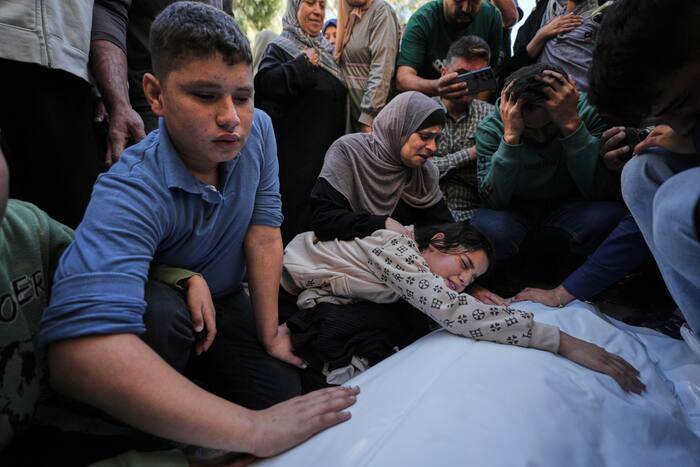
Two people dead in a pre-dawn strike. A quick roundup of regional friction. Another morning on the wire.
If you read standard Middle East roundups expecting clarity, you are getting sold a bill of goods. Wire-service digests treat asymmetric warfare like a weather report: a sudden storm in Gaza, scattered showers in neighboring capitals, and a neat little summary before lunch. That format is designed for speed, not comprehension. It flattens complex military, diplomatic, and informational dynamics into isolated snapshots.
When a pre-dawn strike hits an apartment in Gaza and gets bundled into a broader regional roundup, the lazy consensus is predictable. Readers assume either a routine escalation or a tidy cause-and-effect chain: strike happens, retaliation follows, diplomacy stalls. Both interpretations are too shallow to explain why the region stays locked in grinding cycles of violence and bargaining.
To understand what actually moves the needle in modern Middle East conflicts, you have to stop staring at the headline casualty count and start reading the underlying mechanics. A strike at 4:00 AM is rarely just a tactical move against an individual or a room. It is a signal sent across multiple frequencies at once—to adversaries on the ground, to regional patrons, to domestic audiences, and to foreign capitals trying to manage escalation without owning the mess.
The Wire-Service Trap
Roundup journalism has a structural flaw. By placing a targeted strike in Gaza alongside diplomatic cables, border incidents, or economic updates from elsewhere in the Middle East, it creates an illusion of a single unified storyline. Sometimes those threads genuinely connect. Often, they simply share a dateline.
Mixing distinct theaters into one breezy summary trains readers to think in headlines rather than systems. A strike in a dense urban environment involves intelligence lead times, targeting law,munitions selection, operational security, and political authorization that no two-sentence item can unpack. Meanwhile, regional news in neighboring states operates on its own incentives—regime survival, domestic inflation, patronage networks, and great-power hedging.
I have spent years watching analysts, media teams, and policy commentators burn credibility and millions of dollars in misallocated research because they treated wire roundups as deep intelligence. They build entire narratives around the latest tactical incident while ignoring the logistics, command structures, and political calendars that actually govern escalation. When the next move happens, they look shocked, even though the incentives were sitting right in front of them.
Let us define the terms cleanly so we stop talking past each other. Tactical precision refers to the ability of a strike to hit a specific aimpoint while limiting unintended damage. Strategic effect is whether that strike changes the adversary's calculus, degrades their capabilities over time, or alters the political bargaining space. Precision does not automatically produce strategic effect. A surgical hit can still trigger broad political backlash, while a low-casualty operation can carry massive operational consequences if it removes a key node or exposes a security breach.
Why Readers Ask the Wrong Questions
When a strike makes the news, people naturally rush to predictable questions. None of them get to the core of the problem.
"Does a targeted strike actually solve anything?"
That question assumes conflict works like a math problem where removing X equals solution Y. Asymmetric wars rarely work that way. Militant networks, state proxies, and entrenched political movements are built to absorb losses, promote deputies, and convert funerals into recruitment fuel.
A better question is: What specific constraint is the attacker trying to impose on the defender? Sometimes the goal is eliminating an operational planner before an attack launches. Sometimes it is forcing a rival into a costly posture—keeping commanders underground, severing communication lines, or burning through scarce resources. Measuring a strike against "solving the conflict" guarantees disappointment. Measuring it against specific operational friction gives you a much sharper read.
"Why does the violence keep spilling across borders?"
Blaming "ancient hatreds" or treating the entire Middle East as a single domino chain is lazy analysis. Spillover happens when actors share overlapping networks—weapons smuggling routes, financial conduits, media ecosystems, and ideological alignments—while pursuing separate survival goals.
What happens in Gaza does not automatically dictate what happens on a northern border or in a diplomatic capital hundreds of miles away. Each front has its own balance of deterrence, domestic pressure, and external backing. Linkages exist, especially when rival factions coordinate or when one side tests whether another front will open. Still, assuming automatic contagion leads to bad predictions. Each arena has to be audited on its own terms.
"Why doesn't outside diplomacy stop the cycle?"
Because external mediators often optimize for de-escalation optics rather than resolving the underlying security dilemma. A cease-fire headline looks great in a press briefing. If the core grievances, weapons flows, or unresolved political questions remain untouched, a pause is just a reloading period.
Diplomatic pressure also runs into a hard reality: outside powers rarely bear the daily security or political cost of a bad deal on the ground. Local actors know that. They will take diplomatic cover when it helps them and ignore it when survival or leverage is at stake.
What the Real Mechanics Look Like
Imagine a scenario where intelligence pinpoints a mid-level operative inside a residential building just before dawn. Choosing that window is deliberate. Pre-dawn hours reduce ambient movement, complicate visual verification, and test an adversary's alert posture. Yet operating inside a civilian apartment introduces severe legal, moral, and informational risks. Even if the target is hit, images of a damaged home and dead residents travel faster than any official statement.
That tension sits at the heart of modern urban warfare. Every strike is a trade-off between operational necessity and strategic optics.
| Analytical Lens | What Standard Roundups Emphasize | What Actually Drives Outcomes |
|---|---|---|
| Timing & Method | The hour of the strike and the immediate death toll | Intelligence confidence, risk mitigation, and signaling value |
| Regional Context | Grouping unrelated Mideast stories into one mood | Distinct front incentives, supply lines, and deterrence thresholds |
| Political Impact | Immediate statements from officials and pundits | Shifts in domestic legitimacy, command security, and bargaining leverage |
| Long-Term Trajectory | Whether calm holds for the next 24 hours | Structural changes in capability, alliances, and political endurance |
Serious conflict analysts—figures such as Lawrence Freedman on strategy, Eliot Cohen on modern warfare, and defense researchers at institutions like the Institute for the Study of War and the International Institute for Strategic Studies—have long emphasized that military force is only one lever inside a messy political system. Force can disrupt, deter, or punish, but it rarely substitutes for a coherent political end state.
The Honest Cost of Contrarian Thinking
There is a catch to stripping away headline sensationalism and looking at cold mechanics: it can make you sound detached from human loss. Every number in a casualty report is a life ended, a family shattered, and a community scarred. Ignoring that human reality to sound clever or analytical is a moral failure, not a mark of sophistication.
Contrarian analysis also carries intellectual risk. When you look for hidden motives and second-order effects everywhere, you can start seeing grand master plans where there was only friction, miscalculation, or bureaucratic inertia. Not every strike is a 4D chess move. Sometimes intelligence is flawed. Sometimes commanders misjudge risk. Admitting uncertainty is essential if you want credibility over the long haul.
How to Read the Next Alert Like an Insider
If you want to cut through the noise the next time a strike in Gaza and a batch of regional news hit your feed, change your checklist.
- Separate the datelines. Read the Gaza development on its own operational terms before connecting it to news from Beirut, Tehran, Cairo, Washington, or Gulf capitals. Prove the link; do not assume it.
- Track the second-order reaction. Watch who changes behavior over the next 72 hours—who moves assets, alters travel, tightens security, or shifts rhetoric—rather than relying on instant outrage.
- Ask who gains leverage. Look past the loudest statements and identify which actor's negotiating position, domestic standing, or operational freedom just expanded or shrank.
- Demand verification over speed. Early numbers in active conflict zones are routinely contested and incomplete. Treat initial figures as provisional until independent reporting, humanitarian assessments, or credible corroboration catches up.
Stop letting wire-service roundups do your thinking for you. Read the mechanics, question the framing, and watch what happens after the smoke clears.