The mud in eastern Ukraine does not merely stick. It swallows. It clings to combat boots, jams rifle bolts, and traps multi-ton military vehicles until they are nothing but stationary targets for hovering drones. To a soldier sitting in the treeline, the sound of an approaching engine isn't just transport. It is either a lifeline or a death sentence.
For months, the mechanical chorus of the frontline consisted of aging Soviet steel—BMPs and BTRs designed in an era when the threat of FPV drones and precision artillery belonged to science fiction. Those vehicles were built for speed across European plains, not for surviving a direct hit from a loitering munition packed with high explosives. When they crack, they crack spectacularly.
Then came a new sound. It was lower, a guttural growl that cut through the wet thud of distant mortars.
Out of the grey mist of the Donetsk region rolled the Wolf.
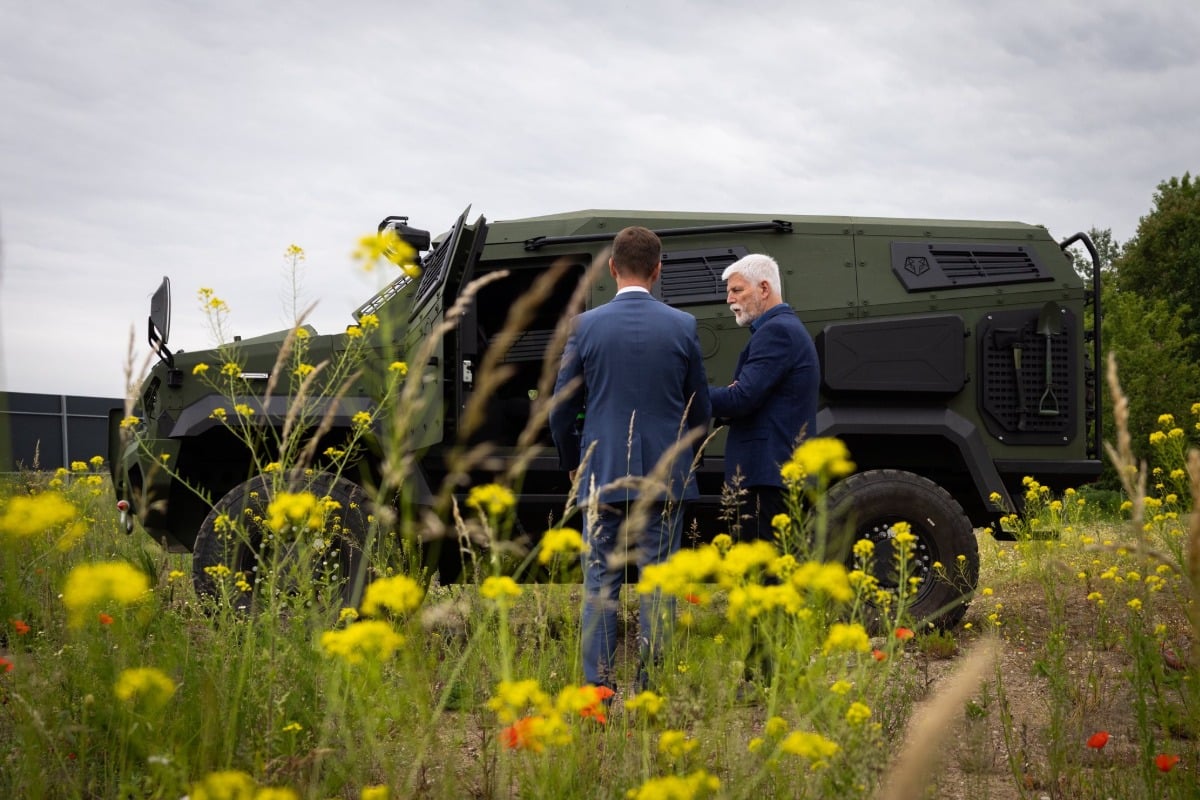
It did not look like the relics of the Cold War. It looked like a monolith. Heavily armored, riding high on massive, puncture-resistant tires, the Czech-backed tactical armored vehicle made its quiet debut in the hottest sectors of the combat zone. While analysts in distant capitals debate the macroeconomics of military aid packages, a handful of infantrymen in a frozen trench cared about only one thing.
Would the glass hold?
The Geography of Survival
To understand why a four-wheeled armored truck matters, you have to understand the modern infantryman's greatest nightmare: the last two miles.
Artillery can strike from twenty miles away. Drones can hunt from five. But the most dangerous moment of any operation is the logistical transit—moving fresh troops into a compromised position or pulling shredded bodies out of one. This is the gauntlet. The roads are mapped, zeroed in by enemy observers, and littered with the charred skeletons of previous attempts.
Consider a hypothetical medical evacuation team operating near the ruins of Avdiivka. Let us call the driver Dmytro.
In an older vehicle, Dmytro’s hands would shake on the steering wheel not just from adrenaline, but from the vibration of thin armor plating that could be pierced by a heavy machine gun or a nearby mortar splash. He would know that a single well-placed piece of shrapnel could slice through the engine block, leaving his crew stranded in the open.
The Wolf changes the math of the gauntlet.
Developed with significant Czech backing and tailored to the brutal realities of the Ukrainian theater, the vehicle is essentially a rolling fortress built on a highly adaptable chassis. It doesn't try to outrun the battlefield; it absorbs it. The hull is V-shaped, a design choice engineered specifically to deflect the upward blast of an anti-tank mine away from the crew compartment.
When a mine detonates under an old Soviet transport, the kinetic energy transfers directly through the floorboards, shattering the spines of everyone inside. When it detonates under a V-hull, the explosion is channeled outward.
Metal twists. Tires shred. The occupants bleed from the nose from the sheer pressure wave. But they walk away.
When Steel Meets Sovereign Need
The arrival of the Wolf on the Ukrainian frontline highlights a deeper, more profound shift in how the country is equipping its armed forces. In the early days of the full-scale invasion, the strategy was dictated by desperation. Anything that could hold a rifle or mount a machine gun was rushed to the front.
Years into the conflict, desperation has evolved into a sophisticated procurement strategy.
The Czech Republic has quietly established itself as one of Ukraine's most reliable industrial lifelines. This isn't just about shipping dusty crates of surplus ammunition from Cold War stockpiles. It is about co-development, rapid prototyping, and industrial synergy. Czech defense firms have provided the financial backing, engineering expertise, and manufacturing infrastructure to bring the Wolf to life, but the design iterations are forged by Ukrainian combat experience.
Feedback loops that used to take years in peacetime procurement cycles now happen in weeks.
A crew reports that a specific door handle jams when coated in Donbas clay? The next batch arrives modified. Soldiers find that they need better mounting points for electronic warfare jamming pods to knock down incoming drones? The roof configuration is altered on the assembly line.
This is not a static piece of military hardware. It is a living, evolving ecosystem of protection.
The vehicle boasts an impressive payload capacity, allowing it to be configured as a troop carrier, a command center, or a heavily protected ambulance. On the modern battlefield, versatility is synonymous with survival. A single platform that can fulfill multiple roles simplifies the nightmare of frontline logistics. Mechanics only need to learn one engine system; supply chains only need to hoard one type of spare axle.
The Unseen Shield
It is easy to get lost in the specifications. The thickness of the composite armor, the horsepower of the turbocharged engine, the run-flat capabilities of the tires. But the men who climb into the back of the Wolf do not talk in the language of brochures.
They talk about the smell of the interior—new rubber and industrial paint masking the scent of wet wool and sweat. They talk about the quietness inside the cabin, a relative silence that allows them to hear their own breathing over the roar of the landscape outside.
The true metric of an armored vehicle's success is not how many enemies it eliminates. It is how many fathers, sons, and daughters it brings back to the staging area at the end of a shift.
Imagine the sky turning black with the smoke of incoming Grad rockets. The ground violently shakes. Inside the Wolf, the infantrymen brace against their blast-attenuating seats. Shrapnel rains against the exterior like heavy hail on a tin roof.
The metal holds.
The driver slams the vehicle into reverse, the heavy-duty transmission engaging instantly, pulling the squad out of the kill zone. The tires, though torn by metal fragments, maintain their shape thanks to internal run-flat inserts designed to keep the vehicle moving even at zero pressure.
They escape.
The Weight of the Long War
There is an inherent honesty to steel. It does not care about political rhetoric, geopolitical grandstanding, or international treaties. It either stops the bullet or it doesn’t.
The presence of the Wolf in active combat sectors is a stark reminder that this war has entered an era of industrial endurance. The side that can continuously field protected mobility—vehicles that preserve their human capital while enduring the horrific attrition of modern artillery warfare—is the side that maintains the ability to fight tomorrow.
Every Wolf rolling through the shattered treelines of eastern Ukraine represents a bridge between Western industrial capacity and Ukrainian frontline grit. It is a tangible manifestation of a partnership that goes beyond signatures on a page in Brussels or Prague.
As night falls over the frontline, a Wolf pulls into a concealed position beneath a canopy of camouflage netting. The engine ticks softly as it cools in the damp air. The doors heavy-click open, and a group of exhausted soldiers step out into the mud. They are caked in dirt, their eyes wide with the hollow stare of those who have seen the horizon burn.
One of them turns back, slaps his palm against the muddy flank of the vehicle, and leaves a clean handprint on the dark green armor.
No words are spoken. None are needed. The metal did its job.