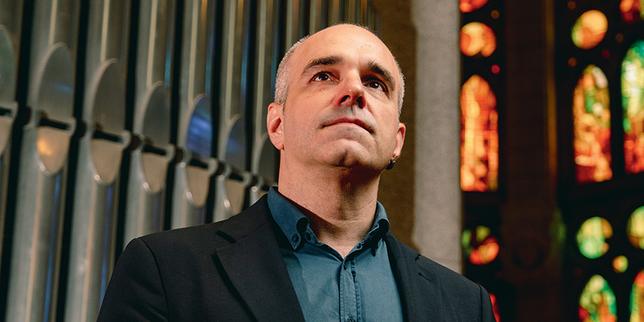
When Pope Leo XIV steps into Barcelona’s Sagrada Familia for the upcoming papal mass, the global audience will focus on the vestments, the liturgy, and the sheer scale of Antoni Gaudí’s unfinished masterpiece. Behind the scenes, a far more complex drama is playing out. The head organist of the Sagrada Familia has been tasked with anchoring a massive musical production under acoustic conditions that would make lesser musicians walk out. This is not just a high-profile religious gig. It is a high-stakes battle between centuries-old liturgical traditions and some of the most unforgiving architectural physics on the planet.
Most superficial coverage treats these papal events as seamless spectacles of faith and art. The reality is born of friction. For months, the musical director and engineering teams have been quietly restructuring how sound moves through a basilica that was never originally designed for the electronic amplification or the massive television broadcasts of the modern era. To understand the true achievement of this upcoming mass, one has to look past the incense and examine the concrete, the stone pipes, and the logistical nightmares hidden within the nave.
The Nightmare of Five Second Reverberation
Sound is a physical weapon inside a cavernous space. In the Sagrada Familia, a single sharp note can bounce off the hyper-hyperboloid vaults and hang in the air for up to five seconds.
For a regular concert hall, a reverberation time of two seconds is considered lush. Five seconds is chaos. If a choir sings a fast passage, the notes blur together into a thick, unintelligible mud. The head organist faces the monumental challenge of playing ahead of what he actually hears. Because sound travels at roughly 343 meters per second, the music coming from the organ pipes at one end of the basilica takes a noticeable fraction of a second to reach the choir at the other end.
If the organist plays to match the sound bouncing back from the walls, the entire performance slows down to a crawl. The musician must rely entirely on muscle memory and an internal metronome, completely ignoring the overwhelming sonic echo filling the space. It is a form of sensory deprivation disguised as a musical performance.
To mitigate this, the production team has quietly installed a network of directional microphones and localized monitors. This is the compromise that traditionalists hate. Purists argue that a papal mass should rely on the natural acoustics of the stone, just as it did in the Renaissance. But the Renaissance did not have to broadcast high-definition audio to hundreds of millions of viewers worldwide.
The Logistics of a Papal Score
Selecting the repertoire for Pope Leo XIV’s visit was not a matter of choosing favorite hymns. Every second of the liturgy is timed down to the millimeter.
The music must act as a elastic band. It needs to stretch if the papal procession slows down, and it must contract instantly if the liturgy moves faster than anticipated. The organist cannot simply stop playing mid-phrase; he must master the art of the infinite modulation, weaving classical motifs into improvised filler that sounds intentional to the untrained ear.
Repertoire Constraints for the Modern Papacy
- Vocal Balance: The choir must be split into smaller, distinct groups placed strategically throughout the transept to prevent the acoustic wash from swallowing the text.
- Tempo Restriction: Every piece selected must be performed at least ten beats per minute slower than its standard concert tempo to allow the stone vaults time to clear the previous chord.
- Instrumentation: Brass instruments are strictly limited. Their sharp transients can easily overload the microphones and trigger uncontrollable feedback loop issues in the broadcast mix.
The tension between the Vatican’s preferred liturgical pacing and the physical reality of the building is palpable. Roman liturgists often prefer a brisk, efficient ceremony. The architecture of Barcelona demands a slow, deliberate cadence. Something has to give, and usually, it is the tempo of the music.
The Instrument That Disappears Into the Architecture
The organ itself is an engineering anomaly. Unlike traditional cathedrals where the organ sits proudly in a rear loft, the main organ of the Sagrada Familia is split and integrated directly into the structural pillars and galleries.
This design was intentional, meant to keep the central nave completely clear for Gaudí’s vision of a stone forest bathed in natural light. But what works beautifully for the eyes creates an extraordinary challenge for the ears. The sound does not emanate from a single source. It surrounds the congregation from different heights and angles.
During the papal mass, the organist must manage multiple pipe chests scattered across the building from a single console. This requires an intricate digital switching system that synchronizes the air valves across hundreds of feet of tubing. A single millisecond of latency in the electronic relays can ruin the synchronization between the instrument and the choir.
Critics of the current setup point out that the basilica’s organ is still technically incomplete. The original plans called for a massive system of several thousand pipes spanning the entire interior to fully realize the "acoustic architecture" Gaudí envisioned. For this mass, the team is working with a scaled-back version of that dream, supplemented by sophisticated digital modeling to fill the acoustic gaps. It is a patchwork solution, hidden behind the spectacular stained glass and the solemnity of the ritual.
The Geopolitical Underside of a Papal Visit
A papal visit to Spain is never purely about theology. It is an exercise in cultural diplomacy. The choice of music, the language of the hymns—alternating between Latin, Catalan, and Spanish—is a delicate balancing act engineered to satisfy local pride while maintaining universal Catholic unity.
The local diocese wants to showcase Catalan musical heritage, highlighting composers who survived historical suppression. The Vatican bureaucracy prefers a more standardized, Roman repertoire that projects global continuity. The final music program is a document born of intense committee negotiations, where every single line item represents a compromise between Barcelona and Rome. The organist is ultimately the individual who must execute this political compromise under the eyes of the world.
The stakes are amplified by the ongoing construction itself. The Sagrada Familia is still an active building site. For the mass to occur, massive scaffolding towers must be secured, heavy machinery silenced, and dust minimized to protect both the delicate pipework of the organ and the health of the aging Pope. The transition from a noisy, dusty construction zone to a pristine, sacred television studio happens over a matter of days.
The true test will come during the Sanctus. As the choir lifts its voice and the organist opens the full stops of the instrument, the sound will rush toward the 60-meter-high vaults. Millions will hear a clean, pristine melody on their television screens and smartphones. They will not see the sound engineers tweaking digital delays in the side chapels, nor will they feel the intense physical exhaustion of an organist fighting against a five-second echo to keep a hundred singers in time. The illusion of effortless perfection is the hardest part of the job.
The success of the mass hinges entirely on this invisible labor. When the last note fades into the Catalan stone, the triumph will belong as much to the laws of acoustics and sheer human endurance as it does to the divine. Architectural genius means nothing if the space cannot find its voice when the world is listening.