You can hear them a full mile before you ever lay eyes on them. Their morning songs echo across the dry, sun-baked hills of the Santa Clarita Valley, sounding like a chaotic mix of police sirens, bird screeches, and echoing theatrical whoops.
Most drivers flying past Los Angeles on Interstate 5 have no idea that right here in Southern California sits the only institution on Earth dedicated to housing and breeding every single known genus of gibbon.
For half a century, the Gibbon Conservation Center has quietly operated on a dusty plot of land north of Los Angeles. It is a lifeline for some of the rarest, most critically endangered apes on the planet. If you care about wildlife conservation, understanding how this place survived fifty years against all odds changes how you view small animal sanctuaries forever.
How a House Painter Built a Global Primate Haven
The entire operation traces back to one man with zero formal scientific training. Back in 1976, Alan Mootnick answered a local newspaper classified ad selling a pet gibbon named Spanky. That single purchase completely hijacked his life.
Mootnick funded his growing obsession through a residential painting and remodeling business. By 1980, he used those earnings to purchase a dedicated ten-acre parcel in Saugus, turning his backyard rescue hobby into an organized nonprofit. He didn't wait for a grant from a major zoo or an endowment from an Ivy League university. He simply rolled up his sleeves, learned primatology through sheer grit, and began publishing peer-reviewed papers that earned the respect of scientists worldwide.
When Mootnick passed away unexpectedly in 2011, the sanctuary faced a massive crisis. Enter Gabi Skollar. She had moved from Hungary to California in 2005 specifically to learn from Mootnick. Instead of walking away after his death to pursue other academic ambitions, she took the helm. Today, she lives on-site, navigating extreme California heatwaves, tight budgets, and the daily chaos of managing roughly 40 vocal primates.
Inside the Daily Routine of Caring for 40 Endangered Apes
Gibbons aren't monkeys. They are small, slender, tailless apes built for acrobatic brachiation—swinging rapidly through dense rainforest canopies using only their long arms. Translating that rainforest agility into a dry Southern California facility takes relentless daily effort.
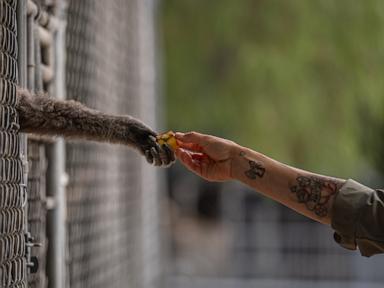
On any given morning, caretakers like Jodi Kleier arrive early with heavy buckets of washed lettuce, steamed sweet potatoes, and fresh bananas. The apes are fed five to six times a day. This matches their natural wild rhythm of continuous foraging, keeping their digestive systems and high-energy metabolisms stable.
Caretakers know every single resident by name and quirk. Pepper, a northern white-cheeked gibbon, usually kicks off the morning vocal chorus. Violet, a pileated gibbon, routinely finishes the duet alongside her partner Truman. Pierre, an adult rescue, notoriously dislikes men.
Hand-rearing happens when first-time mothers struggle with difficult births. Kleier once hand-raised a young gibbon named Rocky after rejection, an intensive commitment that earned her a tattoo of the animal on her leg. That personal devotion defines the culture here. Nobody works at this facility for the paycheck. They stay because the animals depend entirely on their presence.
Why Captive Breeding Programs Matter Right Now
Wild gibbons face staggering threats across Southeast Asia. Rampant deforestation clears out the tropical rainforests they call home. Meanwhile, the illegal pet trade steals infant gibbons from their mothers, leaving populations decimated. For certain species housed at the Santa Clarita facility, fewer than 2,000 individuals remain alive in the wild.
This is where the sanctuary transforms from a local rescue into a global safety net.
The center achieved history by becoming the first facility to successfully breed Javan gibbons, an endangered species native only to the Indonesian island of Java. In Javanese folklore, these creatures are viewed as forest spirits because of their haunting, ghostly calls. Today, maintaining genetic diversity requires carefully coordinated animal swaps with other accredited institutions globally—such as sending pairs to major destinations like the Pittsburgh Zoo or coordinating international placements in France and Cincinnati.
Researchers from UCLA and beyond rely on the center to study primate communication, behavioral ecology, and vocal patterns. What scientists discover here helps field conservationists protect wild populations before it is too late.
How You Can Support the Mission
Running a specialized primate sanctuary in Southern California isn't cheap. Specialized diets, medical care, and secure, expansive enclosures demand continuous funding. While weekend tours are open to the public by reservation, the facility relies heavily on direct public contributions and volunteers.
If you want to make a real difference, skip the generic wildlife charities. Go directly to the Gibbon Conservation Center website to sponsor a meal, buy enrichment items from their online gift store, or book a weekend tour to experience their incredible morning songs in person. Support a place that spent fifty years proving that one passionate person can change the fate of an entire species.