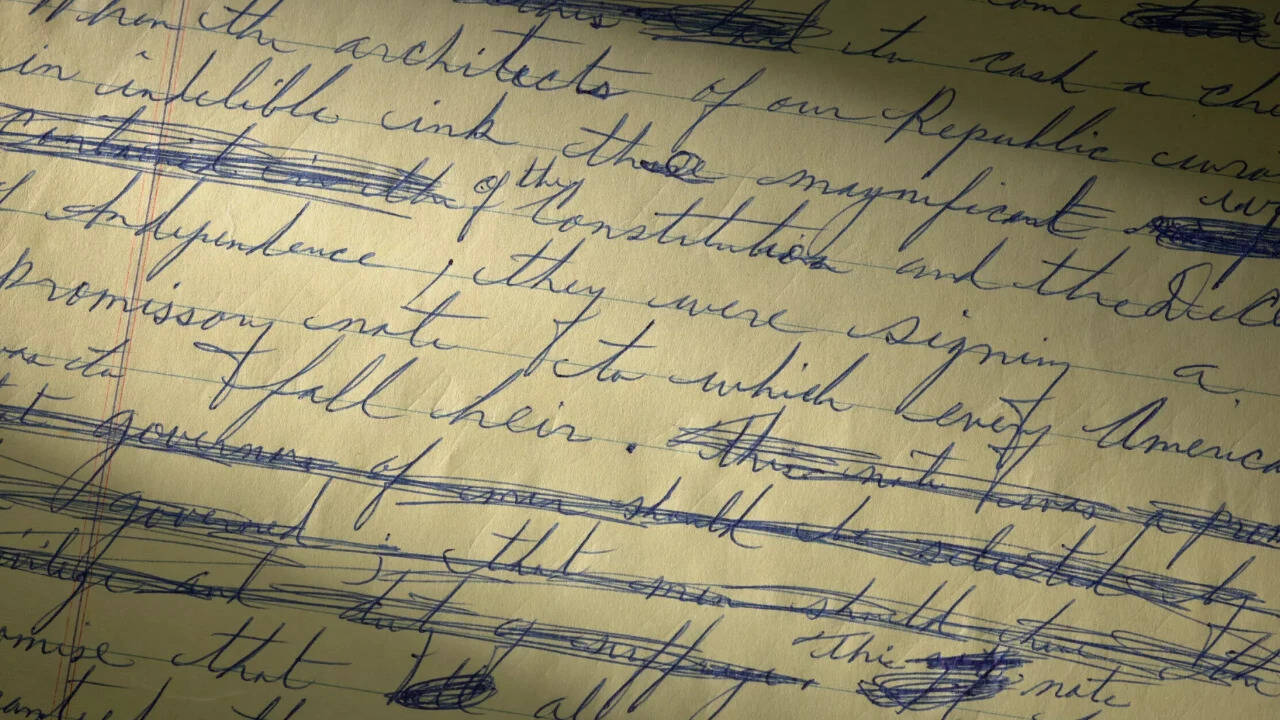
When an original draft of a speech by Martin Luther King Jr. hits the auction block, the bidding war that follows is rarely just about ink on paper. It is a collision of private wealth, institutional preservation, and the complicated legal reality of who actually owns the intellectual and physical artifacts of the American Civil Rights Movement. Collectors, museums, and universities routinely circle these sales, driving prices into the hundreds of thousands—and occasionally millions—of dollars for typewritten pages covered in King’s handwritten edits.
These documents are not static relics. They are working blueprints of rhetorical genius, showing the exact moments where King crossed out a safe, conventional phrase to insert the cadences that reshaped American law and conscience. Yet every time one of these drafts surfaces on the open market, it triggers an uncomfortable debate over whether foundational public history belongs in a climate-controlled private vault or a public archive.
How a Working Draft Becomes a Trophy Asset
To understand why a Martin Luther King Jr. speech draft commands astronomical sums at auction, you have to look at how King actually wrote. Unlike modern politicians who rely on teams of speechwriters to hand them a polished teleprompter script, King was a relentless editor of his own words. Even when collaborators like Clarence Jones, Stanley Levison, or Bayard Rustin contributed early outlines or research, King treated those pages as raw clay.
He worked with fountain pens and pencils, slashing through paragraphs, scribbling rhythmic additions in the margins, and testing how phrases sounded aloud. A surviving draft is essentially an X-ray of his mind under immense political pressure.
Auction houses classify these artifacts differently than signed letters or routine correspondence. A simple signature on a program might sell for a few thousand dollars. A working manuscript—especially one tied to a major milestone like the 1963 March on Washington, the 1965 Selma-to-Montgomery marches, or his 1967 opposition to the Vietnam War—sits at the absolute apex of historical Americana.
Three specific factors dictate the final hammer price of these manuscripts:
- Historical Proximity: A speech delivered during a flashpoint moment, such as the Montgomery Bus Boycott or the campaign for the Voting Rights Act, carries exponentially more weight than a routine fundraising address.
- Autograph Density: Collectors pay a steep premium for visible revisions. A clean typescript is valuable; a typescript covered in King’s unmistakable cursive corrections is priceless.
- Provenance Chain: Because the market for civil rights memorabilia has been plagued by disputes over ownership, an ironclad paper trail showing how the document left King’s hands is mandatory for top-tier institutional buyers.
The Provenance Minefield Behind Civil Rights Artifacts
The journey from a hotel desk in Atlanta or Birmingham to a velvet-lined display case in New York or London is almost always messy. During the height of the Civil Rights Movement, nobody was thinking about archival preservation. King and his inner circle at the Southern Christian Leadership Conference (SCLC) were moving constantly, sleeping in borrowed homes, working out of cramped offices, and dodging surveillance and violence.
Drafts were routinely left behind on podiums, handed to local organizers for mimeographing, or tucked into briefcases by aides. Decades later, those forgotten folders began emerging from attics and estate sales.
This casual history has created recurring legal battles. The Estate of Martin Luther King Jr. has spent decades aggressively policing the commercial use of King’s words, image, and physical papers. In the 1990s and 2000s, high-profile disputes erupted over everything from the copyright to the "I Have a Dream" speech to the ownership of King’s personal library and traveling briefcase.
Physical Ownership Versus Copyright
A common misconception among casual observers is that buying a physical speech draft gives the buyer the right to publish, reprint, or commercialize the text. It does not. Under U.S. copyright law, owning the physical paper is entirely separate from owning the intellectual property written on it.
When a private collector buys a King manuscript at auction, they acquire the physical object—the paper and the ink. They can hang it on their wall, loan it to a museum, or resell it later. They cannot legally print the text on posters, license it for documentaries, or publish it in a book without clearing the rights with the King estate. That legal wall keeps commercial exploitation in check, though it does nothing to stop the physical document from disappearing into private hands.
Who Actually Buys These Documents
When the gavel falls on a major civil rights manuscript, the buyer usually falls into one of three distinct camps, each driven by radically different motives.
The Trophy Collector
At the top end of the market sit ultra-high-net-worth individuals who treat historical manuscripts the way others treat post-war contemporary art. For these buyers, a King speech draft sits alongside letters from Abraham Lincoln, George Washington, and Albert Einstein. It is an asset class that holds value, projects intellectual gravitas, and offers immense personal prestige. Some of these collectors eventually donate their holdings to universities for substantial tax write-offs, while others keep them locked away for decades.
Institutional Consortia and Universities
Major research libraries—such as Boston University (where King earned his doctorate and which holds a massive archive of his early papers), Stanford University (home to the Martin Luther King, Jr. Research and Education Institute), and Morehouse College—desperately want these documents. However, university endowments rarely allow librarians to get into open-ended bidding wars against billionaires. When institutions win, it is usually because a wealthy alumnus steps in to fund the purchase specifically to donate it back to the school.
Cultural Preservation Funds
In several notable instances, civil rights organizations, corporate foundations, or philanthropic groups have pooled money to buy back King artifacts specifically to prevent them from being hidden from the public. In 2006, a consortium of civic leaders in Atlanta raised $32 million in a last-minute effort to acquire a massive collection of roughly 10,000 King documents just days before they were scheduled to be broken up and sold piece by piece at Sotheby's. That collection now resides at Morehouse College, intact and accessible to scholars.
The Privatization of Public Memory
The 2006 Atlanta rescue was a rare victory for public access. More often, individual drafts are sold off one by one, scattering a cohesive historical record across the globe.
Historians and archivists view this trend with quiet alarm. When a speech draft goes to an anonymous private buyer, scholars lose the ability to examine the physical paper, analyze the watermarks, compare the typewriter ribbon to other known SCLC documents, or study the exact sequence of edits. High-resolution scans printed in an auction catalog are a poor substitute for physical examination.
Worse, the sky-high prices realized at major auction houses create a financial incentive for families of former movement activists to sell off their archives piecemeal rather than donating them intact to public institutions. A family sitting on three letters, a program, and a rough speech draft might see a headline about a six-figure auction sale and decide to cash out, breaking up a collection that only makes complete historical sense when viewed together.
What Auction Catalogs Often Leave Out
Reading an auction house description of a Martin Luther King Jr. manuscript requires a skeptical eye. Auction specialists are master storytellers whose job is to maximize the emotional and historical resonance of a lot. They will rightly highlight every soaring phrase and connect the draft to the grand arc of American history.
What the glossy catalog footnotes often gloss over are the collaborative realities of the movement. King was the undisputed voice and moral center of the SCLC, yet his speeches were frequently forged in intense late-night sessions with trusted advisors. A draft bearing King’s handwriting might also contain structural suggestions from Bayard Rustin or biblical cadence ideas from Ralph Abernathy. Recognizing that collaborative ecosystem does not diminish King’s brilliance; it shows how a disciplined political movement operated under extreme pressure.
Catalogs also tend to downplay textual variations. In the heat of delivery, King frequently abandoned his prepared text entirely. The most famous example occurred at the March on Washington in August 1963, when gospel singer Mahalia Jackson called out from behind him, "Tell them about the dream, Martin!" King pushed his typed pages aside and improvised the entire "I Have a Dream" sequence from memory and sermonic instinct. A prepared draft shows what King intended to say before stepping up to the microphones, which makes comparing the text on the page to the recorded audio one of the most revealing exercises in American political history.
Authentication in a High-Value Market
Whenever prices climb into the six-figure range, forgeries inevitably follow. The market for civil rights memorabilia has seen its share of fabricated signatures, fake secretarial letters, and altered documents.
Reputable auction houses subject any purported King manuscript to rigorous forensic scrutiny before listing it. Experts examine the paper stock to confirm it dates to the 1950s or 1960s, test the ink composition, and compare the typeface against known machines used in SCLC offices. Handwriting analysts scrutinize the slant, pressure, and letter formations of the marginalia, looking for the subtle quirks that distinguish King’s rapid, decisive penmanship from a careful imitator.
Even with these safeguards, buyers at the top end demand ironclad provenance. A document passed down directly from a verified SCLC staffer, a host pastor, or a journalist who covered the event carries vastly more market confidence than a piece that surfaced anonymously at an estate sale without supporting documentation.
The Fragile Economics of Keeping History Public
There is no legal mechanism in the United States to stop a private citizen from buying a foundational document of the Civil Rights Movement and locking it in a basement safe. Unlike several European nations that enforce strict cultural patrimony laws preventing the export or private hoarding of national treasures, the American system treats historical manuscripts strictly as private property.
This leaves public access entirely dependent on the generosity of wealthy donors and the fundraising agility of museums and universities. When a major draft goes up for bid, institutions are forced into a reactive scramble, begging philanthropists to write emergency checks to keep a piece of shared national history within reach of students and researchers.
Until public institutions possess dedicated acquisition funds capable of competing directly in the open market, every major auction remains a gamble. The gavel falls, the check clears, and another primary source of American democracy either enters a public reading room or vanishes behind a private door for a generation.