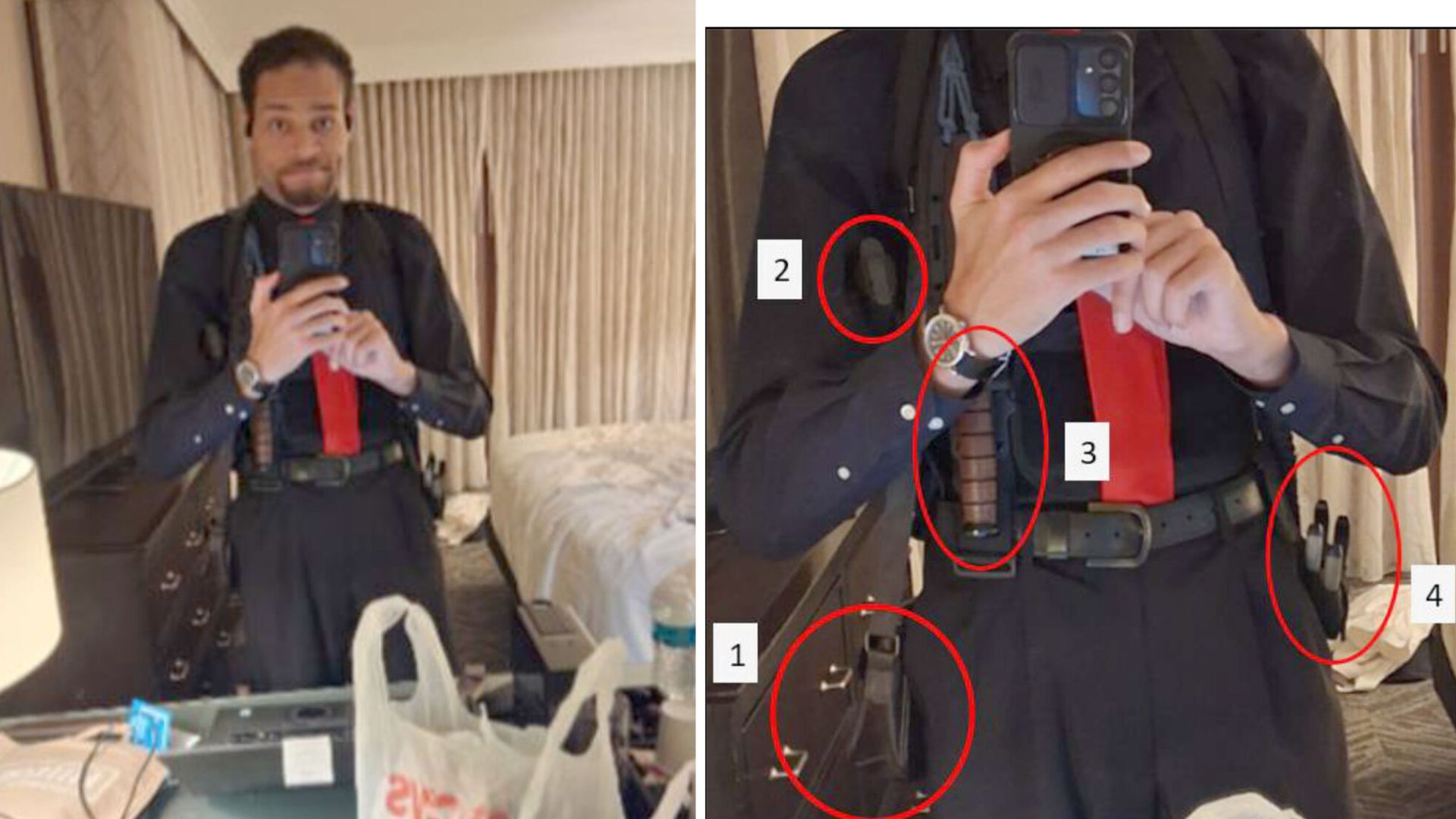
The light from a smartphone screen is a cold, clinical thing. It doesn’t glow like a hearth; it pierces like a needle. On a humid night in Washington, D.C., as the city’s elite polished their cufflinks and adjusted their silk ties for the White House Correspondents' Dinner, that specific blue light was reflecting off the eyes of a man who saw the world through a viewfinder of his own making.
He wasn't looking at the architecture of the Washington Hilton. He wasn't looking at the protesters lining the sidewalks or the security details whispering into their sleeves. He was looking at himself.
Click.
A selfie.
In the photograph, his face is a mask of mundane vanity. There is no tremor in his hand, no sweat on his brow to suggest that, within minutes, he would draw a weapon and shatter the choreographed peace of the evening. This is the modern face of chaos: not a hooded shadow in an alleyway, but a man preoccupied with his own lighting.
We often think of violence as a sudden rupture, a volcanic eruption of long-simmering rage. But as the investigation into this shooting unfolds, we see something far more chilling. We see a performance. This wasn't just a crime; it was a content strategy.
The Mechanics of the Modern Outcast
To understand why a man stops to document his own presence before opening fire, we have to look at the psychological architecture of the digital age. We live in a society that has commodified attention. If a tree falls in the forest and no one likes the post, did it even make a sound?
For the Suspect—let’s call him Elias for the sake of this narrative, though his real name is etched into court documents—the answer was a resounding no.
Elias represents a specific, terrifying evolution of the lonely man. In decades past, the disenfranchised might have written a manifesto and mailed it to a newspaper, hoping for a brief mention in the morning edition. Today, the manifesto is the act itself, broadcasted and curated in real-time. The selfies weren't a lapse in judgment or a moment of hesitation. They were the preamble. They were the proof that he existed in the same physical space as the people he felt had ignored him his entire life.
Consider the geography of that night. You have the "Nerd Prom," an event defined by proximity to power. Inside the ballroom, the most influential people in the world are clinking glasses. Outside, the barricades create a literal and figurative divide. Elias stood in that gap. He wasn't invited in, but he could see the flashbulbs. By taking his own photos, he was forcing himself into the narrative. He was saying, I am here, and soon, you will have no choice but to look at me.
The Ghost in the Feed
There is a hollow ache that comes from being digitally invisible.
We’ve all felt a shadow of it. That tiny ping of anxiety when a post doesn't get the engagement we expected. That strange, floating sense of unreality when we experience something beautiful but fail to capture it on camera. Now, take that social itch and amplify it by a thousand. Mix it with the toxic cocktail of isolation and radicalization found in the darker corners of the internet.
The result is a person who no longer views other human beings as people, but as props in a personal drama.
When Elias looked at his phone, he didn't see a tool for communication. He saw a mirror. This is the "Main Character Syndrome" taken to its most violent extreme. In his mind, the reporters, the politicians, and the bystanders were merely extras. Their lives were secondary to his "moment."
The data backs this up. Criminal psychologists have noted a rising trend in "performance crimes," where the perpetrator’s primary goal is the creation of a digital legacy. The violence is the means; the media footprint is the end. By taking those selfies, Elias was ensuring that even if he died or was captured, his image—his curated, controlled image—would be the one burned into the public consciousness.
The Invisible Stakes of the Barricade
Why does this matter to those of us who weren't there? Why should we care about the digital habits of a gunman?
Because Elias is a symptom of a fever we are all running.
We have built a world where the line between "private person" and "public figure" has been obliterated. We are encouraged to perform our lives 24/7. This creates a dangerous hierarchy of visibility. If you aren't being seen, you don't exist. And for a certain type of fragile ego, the only way to become visible is to tear a hole in the fabric of the everyday.
The security at the Hilton was, by all accounts, "robust." That's the word the officials used. But how do you secure against a man who looks exactly like every other tourist? How do you profile a person whose only distinguishing characteristic is that he’s taking a selfie?
The answer is, you can’t.
The terror of the White House Correspondents' Dinner shooting wasn't just the gunfire. It was the realization that the threat was camouflaged by normalcy. He was part of the crowd until he wasn't. He was a digital citizen until he became a physical threat.
A Disconnect in the Data
There is a recurring question that surfaces after every event like this: Did we miss the signs?
In the case of Elias, the signs were everywhere and nowhere. His social media was a graveyard of ignored rants and reposted conspiracies. It was the digital equivalent of shouting into a void. But in a sea of millions of people shouting into voids, how do we distinguish the noise from the signal?
We tend to look for "red flags" as if they are bright, neon markers. We look for the purchase of body armor or the searching of "how to build a bomb." But we often overlook the most significant red flag of all: the total decoupling from reality.
When a person begins to treat their own life as a film and their peers as a backdrop, the moral compass doesn't just break; it disappears. The "selfie" is the ultimate symbol of this decoupling. It is an act of looking away from the world to look at the representation of the self.
The Echo Chamber of the Screen
The tragedy of the shooting is compounded by what happened after the first shot was fired.
As the crowd scattered and the Secret Service moved in, what was the first instinct of many of the bystanders? They pulled out their phones.
We have become a society of witnesses who view tragedy through a six-inch window. We film the chaos. We live-stream the fear. In doing so, we unwittingly provide the perpetrator with exactly what they want: a multi-angle broadcast of their work.
Elias took his selfies to start the show. The crowd finished it for him.
This isn't to blame the victims or the witnesses. It is a biological response in the 21st century. We process trauma through the lens. If we record it, it becomes "content," something we can distance ourselves from, something we can share and quantify. But this feedback loop is what fuels the next Elias. It creates a perverse incentive for the next person standing outside a barricade, feeling small, feeling forgotten, and holding a smartphone in one hand and a weapon in the other.
The Weight of the Silence Afterward
Imagine the silence in that hotel hallway after the sirens faded.
The carpet is stained. The gold leaf on the walls is chipped by a stray bullet. And somewhere, in an evidence locker, a smartphone sits. Its screen is likely cracked. But inside its memory, those selfies remain.
They are the most honest evidence we have. Not because they show a "monster," but because they show a man who was utterly convinced of his own importance and simultaneously terrified of his own insignificance.
He wanted to be a legend. He ended up as a data point in a tragic trend.
The real horror isn't the man with the gun. It’s the culture that convinced him that a selfie in front of a tragedy was the only way to truly be seen. We are all standing on that sidewalk in some way, navigating a world that demands our attention while offering very little in the way of connection.
The lights of the gala eventually came back on. The guests eventually went home. But the blue light of the screen continues to flicker in the pockets of millions, waiting for the next person to decide that their reflection is more important than the lives of the people standing right next to them.
The flash of the camera and the flash of the muzzle have become dangerously, inextricably linked. Until we find a way to value the human being over the human image, the barricades will never be high enough.