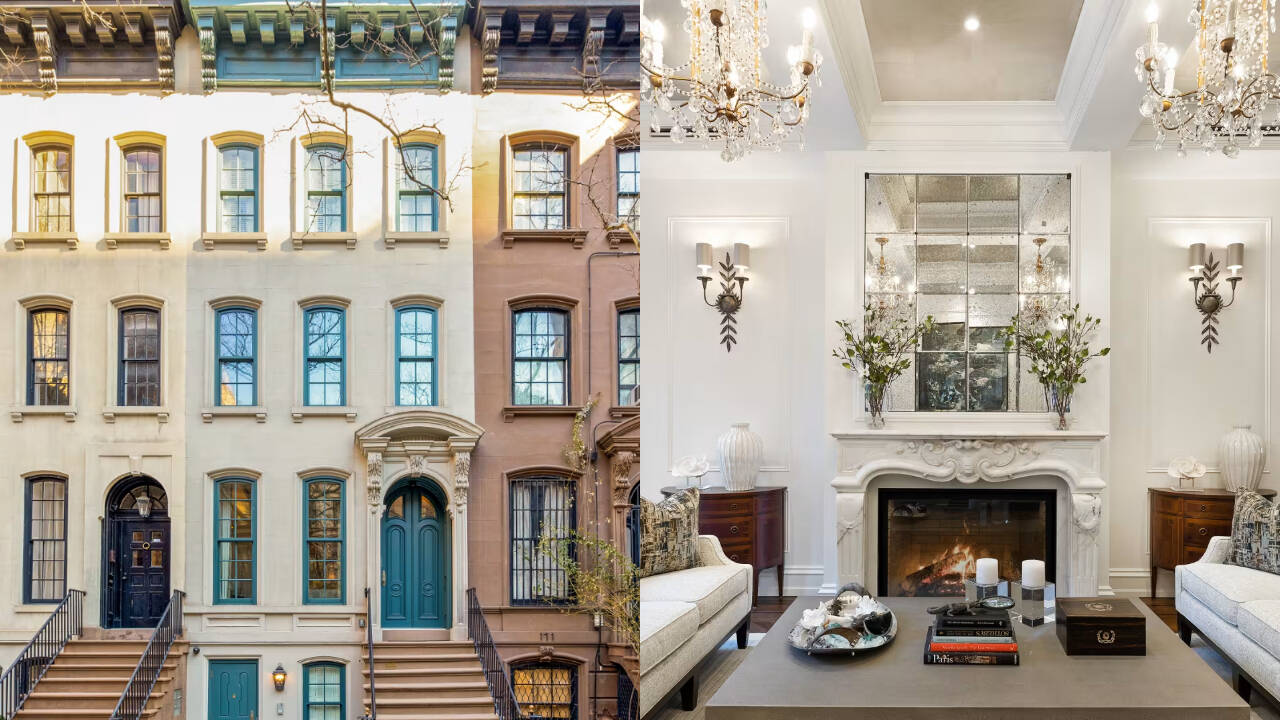
The Upper East Side townhouse made famous by Breakfast at Tiffany's closed at $11.5 million in November 2026, landing $3.5 million below its initial asking price. Fame does not guarantee a trophy premium in Manhattan real estate. Even when a brick Italianate facade carries six decades of cinema history, buyers still underwrite square footage, neighbor disputes, and carrying costs like cold-eyed accountants.
Located at 169 East 71st Street between Third and Lexington avenues, the 1866 rowhouse designed by architect John Sexton served as the exterior stand-in for Holly Golightly's residence in the 1961 classic starring Audrey Hepburn. Public records show an LLC bought the building in 2015 for $7.4 million, put it back on the market in 2025 at $15 million, entered contract in December 2025 at $12.5 million, and finalized the $11.5 million sale. After eleven years of ownership, major renovation work, and a hefty price cut, the numbers tell a much sharper story than a breathless celebrity headline ever will.
Why Cinema Nostalgia Hit a Wall at $15 Million
Brokers love selling a story. Buyers usually end up buying a balance sheet.
When the property listed at $15 million in 2025, the pitch leaned heavily on cultural cachet. Breakfast at Tiffany's remains one of New York's most recognizable cinematic touchstones, and the arched front doors and window frames still wear their signature robin's-egg hue. Yet cinema buffs rarely write eight-figure checks without checking comparable sales on the block, and 71st Street buyers measure value in light, layout, and legal cleanliness rather than movie trivia.
Consider a hypothetical example of how trophy pricing stalls in Manhattan. Imagine a prospective buyer compares a $15 million rowhouse with a 21-inch rear-wall overhang dispute against a similarly sized, dispute-free townhouse a few blocks away for $12 million. Even if the buyer loves vintage films, paying an extra $3 million for a contested footprint makes little financial sense when legal sign-offs remain unresolved.
That gap between romance and underwriting explains the trajectory of 169 East 71st Street. Starting at $15 million tested the upper limit of what nostalgia could stretch a mid-block Upper East Side address. Dropping to $12.5 million brought a contract late in 2025, and settling at $11.5 million reflected the hard reality of negotiating through a drawn-out transaction where listing agent Caroline Bass of Corcoran declined to comment on the deal timeline.
What Eleven Years of Ownership Actually Cost
A $4.1 million gross jump from $7.4 million in 2015 to $11.5 million in 2026 looks tidy on paper. Strip away the headline spread, and the real math gets far tighter.
Over more than a decade, an owner holding a Manhattan townhouse carries real estate taxes, insurance, utilities, maintenance, and financing costs year after year. Add a comprehensive gut-and-expansion renovation, and total capital deployed rises fast. The seller's overhaul added a basement wine cellar, a newly added top floor with a wet bar opening onto a rooftop terrace, a full-floor primary suite with a garden-facing terrace, parlor-level period millwork, antique mantels, oak floors, and a deck leading to a 30-foot garden.
High-end townhouse renovations in New York routinely run into millions of dollars, especially when structural additions and historic details are involved. Once construction costs, soft costs, carrying expenses, and transaction fees are tallied against an $11.5 million exit price, the net return looks modest compared with the splashy $15 million launch.
There is also a structural quirk baked into the floor plan. Listing details note that the building remains technically a two-unit property because the garden-level space has its own kitchen and street entrance, even though it can flow as a single-family home. For some buyers, rental flexibility or guest quarters are a perk. For others seeking a pure single-family townhouse experience, a dual-unit configuration adds one more nuance to weigh before signing a contract.
The 21-Inch Wall Clash That Raised Red Flags
Glamour fades fast in a Landmarks Preservation Commission hearing. In June 2026, Community Board 8's Landmarks Committee voted unanimously against legalizing a third-floor rear wall that extended roughly 21 inches past what the Landmarks Preservation Commission had approved back in 2016.
Neighbors at 167 East 71st Street told the committee that the extension had been built directly onto their property. While the community board vote was advisory and final authority rested with the Landmarks Preservation Commission, a public clash over an unapproved 21-inch encroachment is catnip for cautious real estate lawyers.
- Title and permit risk: Any buyer taking over a property with an unapproved rear extension faces potential remediation demands, legal fees, or delays in closing out permits.
- Neighbor friction: Buying a townhouse already involves sharing party walls and garden sightlines, so starting ownership amid a documented boundary dispute with next door creates immediate headaches.
- Valuation pressure: Even when a buyer believes the issue can eventually be resolved with regulators, unresolved landmark and neighbor objections give the buyer leverage to push the price down.
That tension underscores an overlooked truth about historic Manhattan townhomes. Preservation rules protect streetscapes, not renovation shortcuts. Every extra inch in a landmarked district carries regulatory teeth.
Hollywood Exteriors vs. Real Townhouse Living
Part of the enduring fascination with 169 East 71st Street comes from the contrast between screen myth and brick reality. In Breakfast at Tiffany's, the house's fame rests on its exterior appearance rather than interior filming, yet the facade alone turned an 1866 Italianate rowhouse built for an educator named Joseph Cremin and later divided into two residences by 1947 into a pilgrimage stop.
| Factor | Cinematic Appeal | Hard Real Estate Reality |
|---|---|---|
| Initial Asking Price | Anchored to iconic movie fame at $15M | Tested against comps and eventually cut to $11.5M |
| Renovation Scope | Rooftop terrace, wet bar, wine cellar, garden deck | Heavy upfront capital outlay over an 11-year hold |
| Regulatory Standing | Classic facade with painted blue trim | 21-inch third-floor rear-wall dispute and neighbor pushback |
| Building Layout | Flows as a grand residence with outdoor spaces | Technically two-unit with garden kitchen and street entry |
For the anonymous buyer who stepped in at $11.5 million, the reward is owning a piece of pop-culture history wrapped in a renovated Upper East Side shell with rare outdoor space. The trade-off is inheriting the paperwork, landmark scrutiny, and price history of a deal that took months to cross the finish line.
Anyone shopping for a landmarked New York townhouse should read the building department and landmark docket before falling for the front door.