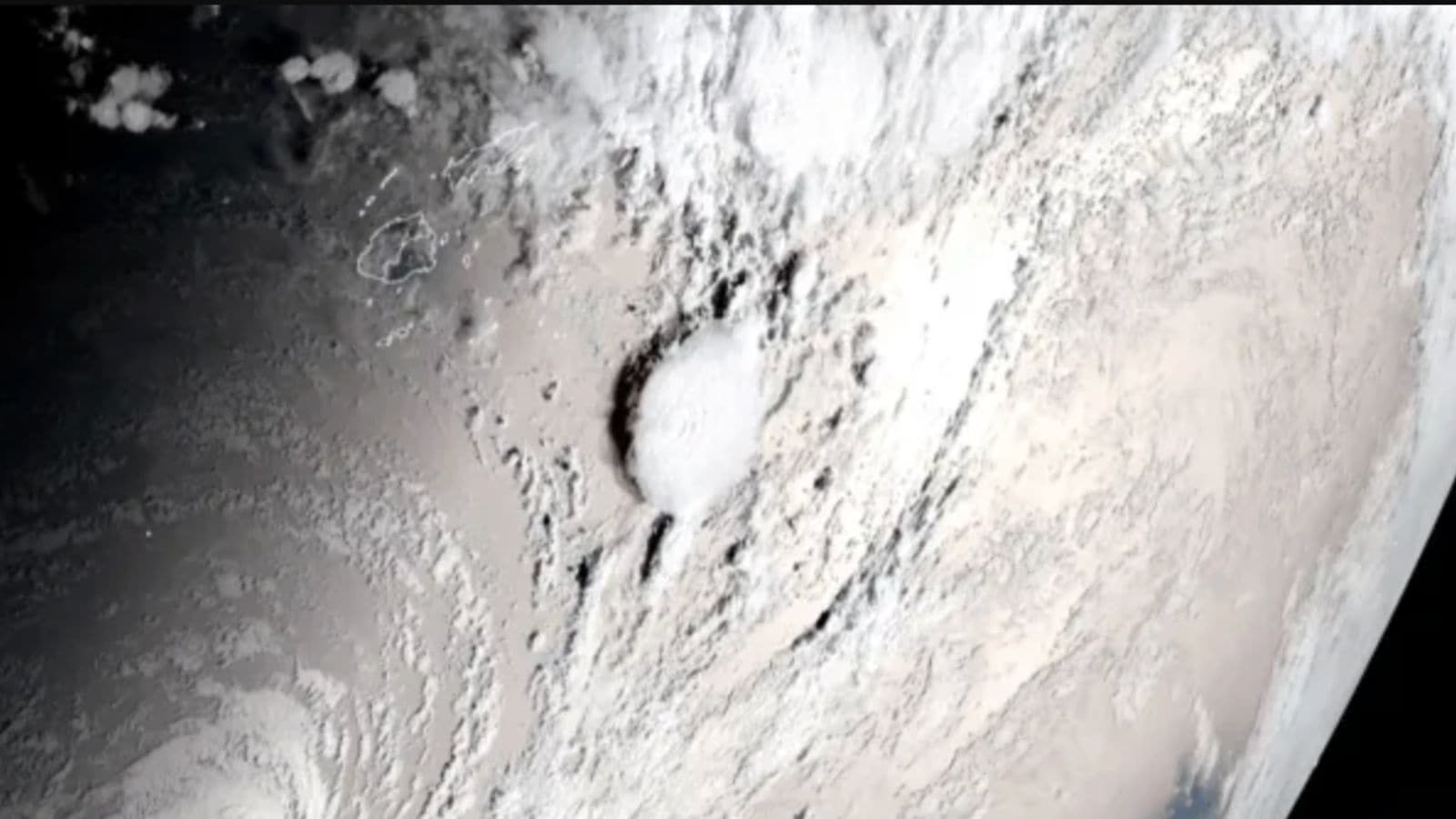
The 2022 eruption of the submarine volcano Hunga Tonga–Hunga Ha’apai injected approximately 300 gigagrams ($Gg$) of methane into the stratosphere—an emission footprint roughly equivalent to the annual output of two million cattle. Conventional atmospheric models dictate that this methane should persist for roughly a decade, gradually migrating through the troposphere while trapping thermal radiation at 80 times the potency of carbon dioxide over a 20-year timeline. However, high-resolution satellite data published in Nature Communications reveals a stark anomaly: the eruption simultaneously initiated a localized, high-velocity atmospheric sink that destroyed methane at a rate of 900 megagrams ($Mg$) per day.
This unexpected degradation loop challenges traditional global methane budget accounting. By dissecting the underlying chemical mechanics, atmospheric constraints, and validation frameworks of this event, we can map the precise limits of replicating this phenomenon as an engineered climate intervention.
The Three Pillars of Volcanic Methane Oxidation
The accelerated destruction of methane within the Hunga Tonga plume was not an accident of geography, but a consequence of a three-part physical system combining mineral catalysts, halogen salts, and solar radiation. Traditional tropospheric methane destruction relies primarily on the hydroxyl radical ($\cdot OH$), a slow process with a long spatial distribution. The Hunga Tonga plume bypassed this baseline by establishing an alternative pathway driven by highly reactive chlorine radicals ($\cdot Cl$).
[Volcanic Ash (Catalyst)] + [Salty Seawater (NaCl)] + [Stratospheric UV Sunlight]
                          │
                          ▼
              [Reactive Chlorine Radicals (•Cl)]
                          │
                          ▼
  [Methane (CH4) Destruction] ──► [Formaldehyde (HCHO) Intermediate]
1. The Particulate Catalyst Vector
Because Hunga Tonga was a submarine volcano, the explosive thermal energy did not merely vent internal magmatic gases; it pulverized and vaporized the surrounding marine environment. The resulting stratospheric plume contained a dense concentration of sub-micron volcanic ash. This particulate matter acted as a physical carrier and surface area matrix, allowing disparate chemical compounds to interface at high altitudes where the air density is otherwise too low to support rapid multi-phase reactions.
2. Halogen Salt Salination
The second variable was the mass injection of seawater into the upper atmosphere. Marine spray carried sodium chloride ($NaCl$) directly into the path of the eruptive column. Under extreme thermal duress and subsequent rapid cooling, the salt dissociated, embedding chlorine ions onto the surfaces of the airborne volcanic ash. This mirrored a tropospheric mechanism identified in 2023, where Saharan dust mixing with ocean spray generates iron salt aerosols over the Atlantic. The Hunga Tonga event proved that the stratosphere could host a parallel, albeit more violent, variant of this halogen-loading process.
3. Photolytic Activation
The final trigger was unattenuated stratospheric ultraviolet (UV) radiation. When sunlight hit the airborne mixture of ash and crystallized salts, it drove photolysis, cleaving the stable salt bonds and releasing free chlorine radicals. The reaction rate of methane with chlorine radicals is orders of magnitude faster than its reaction with standard hydroxyl radicals. This created a highly concentrated, self-sustaining chemical scrubbing zone that tracked across the South Pacific toward South America.
Quantifying the Plume Kinetic Pathway
The operational proof of this methane sink relies on an intermediate chemical marker: formaldehyde ($HCHO$). Because methane ($CH_4$) cannot be tracked directly via satellite with enough precision to measure real-time localized degradation, researchers shifted focus to its primary oxidation byproduct.
The kinetic path follows a multi-step sequence where a chlorine radical strips a hydrogen atom from methane, yielding hydrochloric acid ($HCl$) and a methyl radical ($\cdot CH_3$). This methyl radical rapidly reacts with ambient oxygen ($O_2$) to form formaldehyde:
$$CH_4 + \cdot Cl \rightarrow \cdot CH_3 + HCl$$
$$\cdot CH_3 + O_2 \rightarrow \rightarrow HCHO + \text{byproducts}$$
Formaldehyde has an atmospheric half-life of only a few hours before it is further broken down by solar radiation into carbon monoxide and water vapor. This brief survivability window makes $HCHO$ an exceptional real-time indicator of active methane destruction.
Data captured by the TROPOMI (Tropospheric Monitoring Instrument) aboard the European Space Agency’s Sentinel-5P satellite recorded record-high concentrations of stratospheric formaldehyde within the plume. The persistence of this $HCHO$ signal over a 10-day, multi-thousand-mile trajectory confirmed that methane was not merely diluted by stratospheric winds, but actively consumed by a continuous chemical reaction.
Engineering Limitations and Systemic Risks
The temptation for industrial engineers is to view the Hunga Tonga dataset as a scalable blueprint for Solar Radiation Management (SRM) or atmospheric greenhouse gas removal. Replicating an iron salt or chlorine aerosol delivery system to deliberately induce methane oxidation presents severe systemic bottlenecks and trade-offs.
- Ozone Depletion Footprint: The primary constraint of using chlorine chemistry to mitigate methane is the well-documented vulnerability of the stratospheric ozone layer. Free chlorine radicals do not selectively target methane; they participate in catalytic cycles that break down ozone ($O_3$) into oxygen molecules ($O_2$). The Hunga Tonga eruption caused a measurable, localized thinning of the Southern Hemisphere's ozone layer. Any deliberate geoengineering framework utilizing halogen aerosols would risk reversing decades of international ozone recovery efforts.
- Energy and Mass Scale Mismatch: The volcano achieved a 900 $Mg$/day destruction rate by leveraging a planetary-scale thermal explosion that lifted millions of tons of seawater and mineral ash 30 kilometers into the air. Replicating this mass injection via high-altitude aircraft or artillery would require a fuel and logistics infrastructure that could offset the carbon savings of the destroyed methane.
- Verification and Attribution Bottlenecks: While the TROPOMI satellite successfully verified the Hunga Tonga plume due to its extreme concentration, verifying lower-density, deliberately dispersed industrial aerosols over open oceans remains a significant measurement challenge. Differentiating engineered methane destruction from baseline tropospheric variance requires a higher density of orbital sensors than currently exists.
The Strategic Path for Methane Budget Calibration
The immediate value of the Hunga Tonga discovery lies in model optimization rather than active atmospheric manipulation. Current global methane budgets are fundamentally incomplete because they treat atmospheric dust and mineral particulates as chemically inert relative to greenhouse gases.
The empirical data gathered from this event establishes a mandate for carbon accounting firms, climate modelers, and atmospheric scientists to recalibrate the global methane sink variable. Volcanic dust events, desert dust storms, and marine aerosol interactions must be integrated into climate projection software as active variables that accelerate methane decay. By adjusting these baselines, organizations can more accurately map the warming trajectory of the planet and optimize the deployment of localized, land-based methane capture technologies where verification is absolute and risk-free.
The video below details the broader atmospheric impacts and unexpected discoveries observed by scientists tracking the aftermath of the 2022 South Pacific eruption.