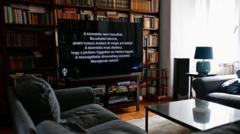
Imagine turning on your favorite national news channel and finding nothing but a stark black screen. No anchors, no slick graphics, no breaking tickers. Just white text staring back at you with a jaw-dropping confession: “Public media cannot lie. We apologize for doing so for many years.”
That is exactly what millions of Hungarians witnessed on Tuesday afternoon.
The main state television channel, M1, abruptly suspended its news broadcasts. Simultaneously, Kossuth Radio went completely silent before filling its frequencies with classical music by Béla Bartók. This was not a cyberattack or a technical glitch. It is the beginning of an aggressive, top-down purge of the state media apparatus built by former Prime Minister Viktor Orbán over a 16-year reign.
The Shock Treatment for State Media
The newly elected Prime Minister, Péter Magyar, wasted no time executing a campaign promise that many thought would take months, if not years, to pull off. Magyar, who pulled off a stunning landslide victory back in April by securing a two-thirds supermajority, has made the dismantling of Orbán’s "illiberal democracy" his top priority.
Public media should not lie. We are sorry for doing it for so long. Public media now will be reformed so it will be independent and trustworthy. Our news programme is currently suspended. Stay tuned!
That message, beamed into households across the country, represents a total capitulation of the old guard. The newly appointed interim CEO of the state media umbrella group MTVA, András Horváth, took the reins and immediately axed the news programming on his first day. Editors were fired on the spot. Websites went offline.
Magyar celebrated the move on Facebook, declaring it a historic day. He wrote that the state platforms lied at night, during the day, and on every wavelength. Now, he says, that era is finished.
For years, the international community watched Orbán weaponize public broadcasting. The Organisation for Security and Co-operation in Europe previously noted that MTVA coverage openly and disproportionately supported the ruling Fidesz party while systematically discrediting opposition figures. During the April campaign, state media ran constant hit pieces portraying Magyar as a puppet of Brussels and a traitor.
Now the tables have turned.
The Strategy Behind the Dead Air
Shutting down the news entirely is a radical move, but it highlights the sheer scale of the problem Magyar faced. You can't just tell a newsroom that has spent over a decade running state-directed propaganda to suddenly start being objective. The bias is baked into the walls, the hiring practices, and the daily routines.
By pulling the plug, the new administration is sending a clear psychological signal to the public. The parallel information reality that dominated Hungary—where the country plummeted from 23rd to 74th place on the Reporters Without Borders press freedom index—is being forcibly dismantled.
The strategy is simple but risky.
- A Clean Break: Suspending the news cuts off the old narrative instantly.
- Symbolic Cleansing: Replacing highly charged political talk radio with classical music acts as an audio palate cleanser for a polarized nation.
- Staff Purges: It gives the interim management team breathing room to vet employees, change editorial guidelines, and hire journalists who adhere to traditional reporting standards.
But this isn't just happening at public stations. Magyar’s government is also targeting private media networks owned by Orbán-allied oligarchs. Over at TV2, one of Hungary's largest private broadcasters, top news anchors and the news director have already been shown the door.
The Dangerous Precedent of Fixing the Press
While many celebrate the fall of a notorious propaganda machine, the method raises uncomfortable questions. Can you birth a truly independent public media through government decree and sudden blackouts?
Critics and remaining Orbán loyalists are already calling the moves an example of tyranny. They argue that replacing one government's loyalists with managers appointed by the next government doesn't create independence—it just changes who holds the leash.
If Magyar wants to prove his doubters wrong, he has to establish an independent funding model and an oversight board that his party cannot control. If the new news programming launches later this year and looks like an ongoing PR campaign for the Tisza party, then the black screens of Tuesday will have been nothing more than a change of regime branding.
True media independence is boring. It means the state broadcaster will eventually bite the hand of the person who freed it. Whether Magyar is actually prepared for that level of accountability remains to be seen.
If you want to track how this media experiment unfolds, watch what happens when M1 puts news back on the air. Look at who they hire as chief editors. Look at whether opposition voices get unedited, primetime slots. The black screen was the easy part; building a newsroom that citizens actually trust is the real climb.