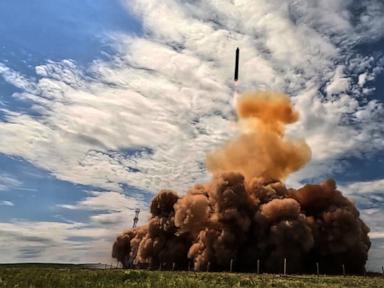
Russia launched nationwide maneuvers of its strategic nuclear forces on Tuesday, a massive three-day display of state power meant to project absolute deterrence. Yet this sudden mobilization of 64,000 troops, 200 missile launchers, and nuclear-armed submarines is not a standard demonstration of strength. It is a direct reaction to an asymmetric crisis. Cheap, mass-produced Ukrainian long-range strike drones are bypassing Russia's premium air defenses, striking industrial centers, and effectively tearing down the psychological wall that has shielded the Russian public from the daily costs of a war now stretching into its fifth year.
By threatening the unthinkable with ballistic and cruise missile drills, Moscow hopes to force Western policymakers to curb Kyiv's growing long-range campaign.
But the strategic math has permanently shifted.
The Kremlin can no longer rely on classic twentieth-century deterrence to stop a swarm of autonomous lawnmower-engined drones hitting an oil refinery in Yaroslavl or a suburb in Moscow.
The Mechanics of Asymmetric Panic
The sheer scale of the Russian exercise reveals the depth of Moscow's anxiety. According to the Russian Defense Ministry, the drills pull together 140 aircraft, 73 surface warships, and 13 submarines, including eight equipped with intercontinental ballistic missiles. Forces are practicing the rapid preparation and deployment of nuclear strikes under the theoretical backdrop of a foreign aggression threat. The maneuvers even extend to neighboring Belarus, where Russia has deployed elements of its newest intermediate-range Oreshnik missile systems.
This display unfolded exactly as President Vladimir Putin departed for a high-profile diplomatic visit to China, just days after he praised the successful test-firing of the new Sarmat ICBM.
The political theater is obvious. Moscow wants its global allies and adversaries to focus on its shiny new hypersonic capabilities.
Look closer at the domestic front, however, and a very different picture emerges. Over the weekend, a barrage of hundreds of Ukrainian drones targeted the Moscow region, breaching local defenses, killing civilians, and igniting fires at critical industrial facilities. Simultaneously, drone strikes targeted Russia’s oil-refining hub in Yaroslavl and border sites in Kursk and Rostov.
A multi-million-dollar S-400 anti-aircraft battery is an incredibly sophisticated piece of machinery. It is also completely cost-ineffective when tasked with hunting a wave of 500 low-flying carbon-fiber drones that cost less than a used sedan to manufacture.
When Ukraine launched almost 600 drones in a single overnight push, it proved that quantity possesses a quality all its own. Russian air defense crews must decide instantly whether to fire an irreplaceable interceptor missile at a decoy or save it for a high-value cruise missile. If they fire, they empty their magazines and expose their positions. If they hold back, the drone hits a multi-million-dollar cracking tower at a Rosneft refinery, immediately cutting regional fuel supplies and cutting into state export revenues.
The Melting Threshold of the Revised Nuclear Doctrine
To understand why Moscow is rolling out its strategic launchers to counter small drones, one must examine the legal and philosophical shifts inside the Kremlin. In late 2024, Putin formally updated Russia’s official nuclear doctrine. The revised text explicitly states that any conventional attack on Russian soil carried out by a non-nuclear state, but supported or enabled by a nuclear-armed power, will be viewed as a joint attack on the Russian Federation.
This clause was specifically written to target the United States and its European allies.
By blurring the lines between a conventional drone strike and a coordinated Western offensive, the Kremlin attempted to draw a hard line in the sand. The message was clear: if Western satellite intelligence, Western components, or Western funding assist Ukrainian strikes deep inside Russia, Moscow reserves the right to escalate all the way to nuclear weapons.
Yet, this doctrine has faced an immediate practical test. Ukraine is now manufacturing drones at an industrial pace, aiming for an output of millions of units annually. Many of these platforms utilize off-the-shelf commercial electronics, open-source machine vision algorithms, and domestic manufacturing chains that bypass Western export controls entirely. When a drone built in an abandoned warehouse in central Ukraine strikes a Russian military airfield, does it trigger the doctrine?
The ambiguity is paralyzing. If Russia treats every cross-border drone strike as a joint attack by NATO, it must retaliate against a Western capital, risking total annihilation over a shattered warehouse roof in Belgorod. If Russia does nothing, the deterrent threshold lowers by default, revealing the revised doctrine to be a paper tiger.
The Hawk Trap and the Temptation of European Factories
This paralysis has infuriated hardline nationalist voices within the Russian security apparatus. For months, prominent defense commentators and Kremlin hawks have publicly urged a conventional military response against European soil. Their argument rests on a gamble: if Russia carries out targeted conventional missile strikes against defense factories inside European NATO borders, the West will back down rather than risk World War III.
The Russian Defense Ministry laid the groundwork for this justification by publishing an explicit list of European manufacturing facilities. Moscow claims these sites produce drones and critical guidance components for the Ukrainian military. The ministry issued a stark warning that further strikes on Russian soil involving European-supplied hardware are fraught with unpredictable consequences.
A hypothetical scenario illustrates the extreme danger of this policy:
- Russia launches a conventional cruise missile from a submarine in the Baltic Sea, targeting a drone component assembly plant in eastern Poland.
- Moscow immediately declares that its nuclear forces are on highest alert to deter a NATO counter-attack.
- NATO faces an existential choice: activate Article 5 and launch a retaliatory campaign against Russian naval assets, or accept the strike to avoid escalation, effectively destroying the credibility of the Western alliance.
This is the exact fault line the Kremlin is probing with its current nuclear drills. The massive maneuvers are an attempt to convince Europe that the Russian leadership is crazy enough to execute that scenario if the drone strikes continue to disrupt daily life in Moscow.
Shaking the Domestic Social Contract
The true casualty of Ukraine's intensified drone campaign is not Russian military hardware; it is the domestic sense of security that the Kremlin has spent years cultivating. For the first several years of the invasion, the average resident of Moscow or St. Petersburg could easily treat the war as a distant, abstract geopolitical event happening on television. The state intentionally fostered an environment of quiet apolitical normalcy.
That insulation has shattered. When air raid sirens sound in the suburbs of the capital, when luxury high-rises are damaged by falling debris, and when regional governors have to report civilian casualties on Telegram, the conflict becomes unavoidable.
The social contract in modern Russia relies on an exchange: the populace surrenders political self-determination in exchange for the state guaranteeing domestic order and personal safety. By bringing the war home to the Russian heartland, the drone campaign forces a crack in that foundation. The massive nuclear drills are a desperate public relations counter-measure. They are designed to reassure a nervous domestic public that the state still possesses ultimate power, even if it cannot stop a swarm of small drones from disrupting the local power grid or setting a fuel depot on fire.
The strategic reality remains unyielding. Nuclear weapons are designed to deter massive armies, heavy bombers, and opposing missile silos. They are structurally useless against an decentralized network of autonomous, low-altitude flying platforms. As long as Ukraine can scale its domestic compute capabilities and manufacturing pipelines, a three-day exercise featuring intercontinental ballistic missiles will remain a loud, expensive distraction from a tactical problem Moscow has yet to solve.