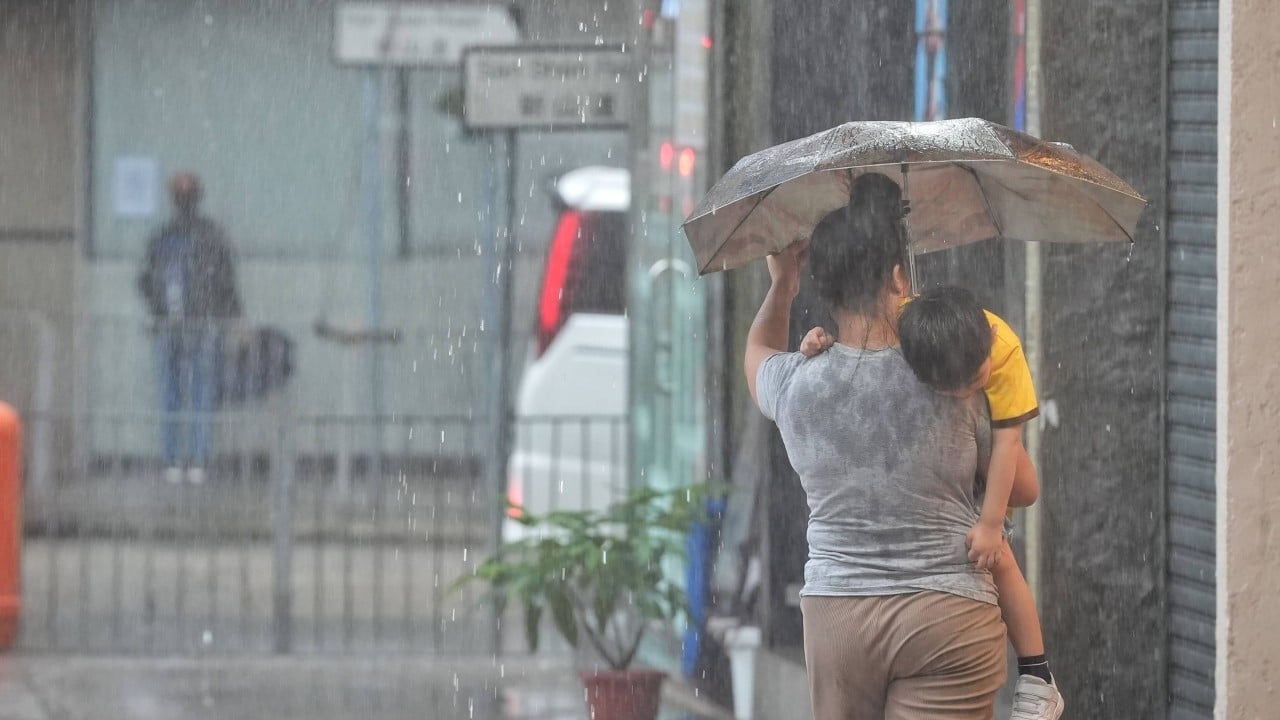
The sky above Hong Kong is a bruised, heavy purple, the color of a fresh welt. On the streets of Mong Kok, the neon signs are flickering back to life, their reflection shimmering in the shallow, oil-slicked puddles on the asphalt. To the casual observer, the worst has passed. The government’s mobile application has just chimed with a notification: the amber rainstorm warning, which indicates heavy rain falling across the territory, has been officially cancelled.
People step out from under the concrete awnings of high-rises. They shake out their umbrellas, spraying fine mists of water onto the pavement. There is a collective, sighing relief that ripples through the city of seven million.
But water does not care about official declarations.
While the city's urban core begins to dry, a silent, swelling crisis is moving through the New Territories. The danger of a rainstorm does not vanish when the clouds begin to part. It simply migrates. It flows downward, gathering mass, speed, and destructive power, long after the sirens have gone quiet.
To understand how a canceled warning can actually be the most dangerous moment of a storm, you have to look away from the glittering harbor. You have to travel north, toward the winding arteries of the Sheung Yue and Ng Tung rivers.
The Weight of Wet Earth
Imagine a sponge. A simple, kitchen sponge sitting on the edge of a sink.
If you pour a cup of water onto a dry sponge, it drinks the liquid greedily. It holds the weight. But if you keep pouring, cup after cup, there comes a moment of invisible transition. The sponge reaches its absolute limit. The next drop does not sink in; it immediately spills over the sides, slick and uncontrollable.
During a prolonged downpour, the vast, green hillsides of Hong Kong act exactly like that saturated sponge.
When the amber warning is active, the public is on high alert. The threat is visible. It is beating against the windowpanes. But when the rain stops, the earth does not suddenly dry out. Millions of tons of water are still trapped in the soil, slowly being pulled downward by gravity. This is the water that feeds the local rivers, transforming sleepy, concrete-channeled streams into churning, brown torrents.
Consider a resident like Mr. Chan. He lives in a small, low-lying village near Fanling. He is a hypothetical character, but his situation is shared by hundreds of real families in the rural northern districts every single year.
As the rain softens to a drizzle, Mr. Chan looks out his window. The amber warning is gone. The news anchor on the radio speaks of returning to normalcy. Naturally, he feels safe. He decides it is safe to walk down to his vegetable patch near the riverbank to check on his crops.
He does not see the water rising.
In the hills miles above him, the tributary streams are gorged. The water is rushing down the slopes, picking up mud, tree branches, and loose debris. By the time this massive volume of water reaches the lowlands, the rain has stopped completely where Mr. Chan stands. The sky is grey, but quiet.
Yet, within minutes, the dry path he walked on is swallowed by a foot of fast-moving, brown water.
This is the deadly paradox of river flooding. The threat is disconnected from the immediate weather above your head. It is an echo of a storm that has already passed, a ghost that arrives when you have dropped your guard.
When Infrastructure Meets the Limit
Hong Kong possesses some of the most advanced urban drainage systems in the entire world. Massive underground storm water storage tanks, giant drainage tunnels carved deep into the bedrock, and engineered river channels are designed to divert millions of gallons of water directly into the sea.
It is a marvel of human engineering. But even the finest engineering has a breaking point.
The engineered channels in the New Territories are designed to handle specific volumes of water. When the rain falls too fast and too heavily over a short period, these channels fill to the absolute brim. The water pressure builds.
Underneath the ground, the drainage pipes are backed up. Instead of carrying water away from the villages, the sheer volume of water in the main river channels can cause a reverse flow. Water begins to bubble up through drains and manholes in the middle of village squares, far from the riverbanks.
It is a bizarre, disorienting sight. The sky is empty of rain, yet the ground beneath your feet is erupting with water.
This is why the local observatory and emergency services urge extreme caution even after the signals are lowered. The cancellation of a warning is not a green light; it is merely a transition phase. The hazard has shifted from the atmosphere to the hydrosphere.
The Anatomy of the Aftermath
The real danger in the hours following a heavy storm lies in the sheer force of moving water.
It takes very little water to upend a life.
- Six inches of fast-moving water can knock an adult off their feet.
- Twelve inches of rushing water can easily sweep away a small car.
- Two feet of water will carry away most SUVs and trucks.
When a river breaches its banks, the water is not clean. It is a thick, turbulent soup of mud, sewage, displaced wildlife, and sharp debris. The ground beneath the water becomes invisible. A familiar path can hide washed-out sections, deep holes, or open drain covers that have been forced off by water pressure. One misstep can be fatal.
For those living in rural villages, the threat is compounded by landslides. The saturated soil on the steep slopes surrounding these communities becomes incredibly heavy and unstable. Long after the rain stops, the internal pressure within the soil continues to build until, without warning, an entire hillside can liquefy and slide downward, burying roads, blocking access paths, and crushing structures.
The road to recovery is long, and it begins while the ground is still wet.
Emergency crews must navigate these treacherous, flooded roads to reach isolated residents. Every unnecessary trip taken by a curious onlooker or a resident trying to salvage property puts additional strain on these vital resources. The urge to inspect the damage is strong, but the safest choice is always to stay on high ground and wait for the water levels to peak and begin their slow retreat.
The next time you see the storm clouds break and hear the comforting news that the weather warning has been lowered, do not immediately rush out.
Take a moment. Listen.
Somewhere in the distance, a river is still fighting to contain the mountain's heavy gift. The storm may have ended in the sky, but on the ground, the battle is still being fought. The true measure of safety is not found on a smartphone screen or a government broadcast. It is found in the quiet, patient respect we must pay to the immense, slow-moving power of the water beneath our feet.