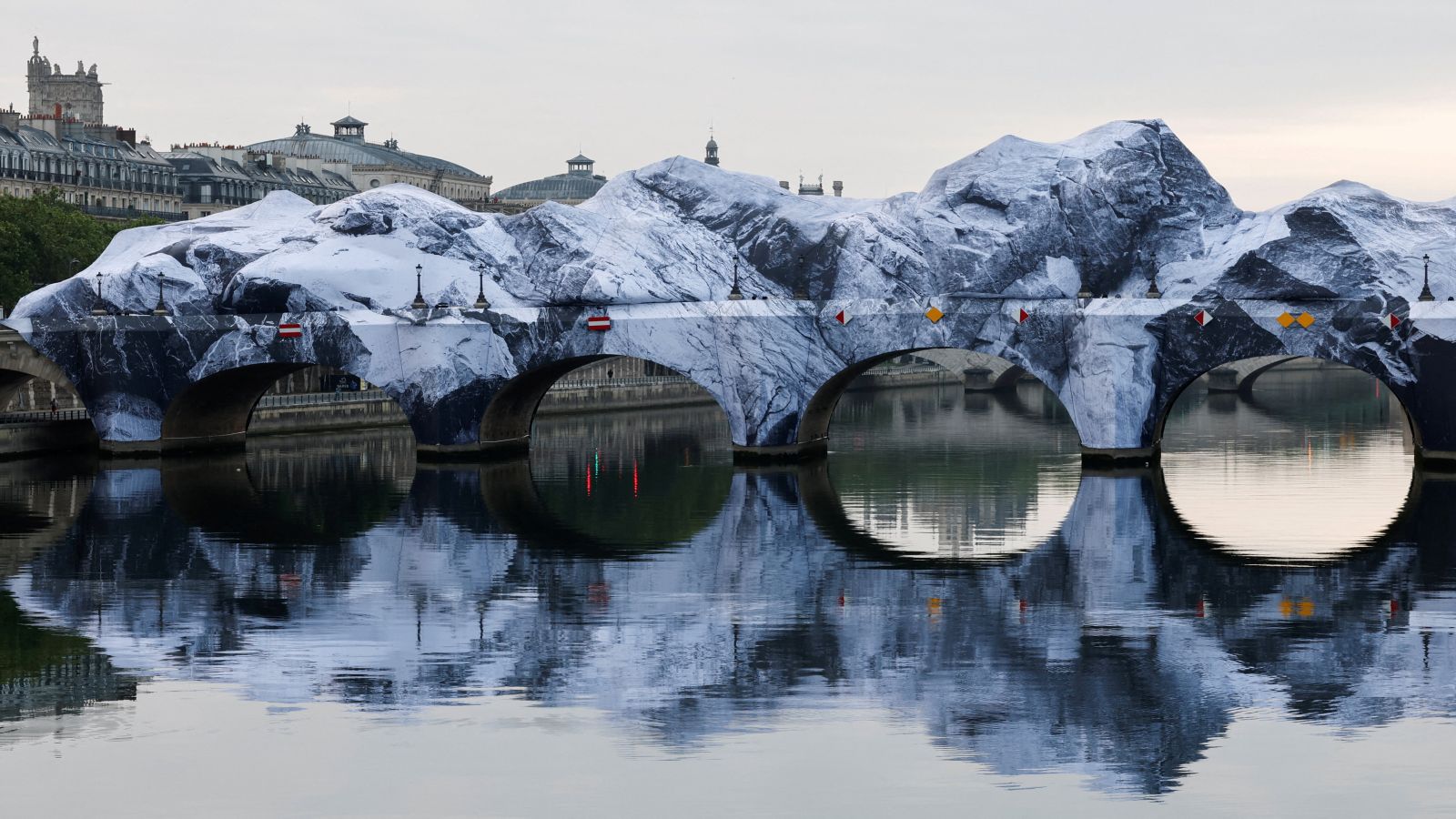
The French street artist JR temporary erased Paris’s oldest standing bridge, the Pont Neuf, by wrapping it in a massive photographic installation that mimicked a yawning, rocky cavern. While mainstream outlets treated the event as a mere photo opportunity or a whimsical visual trick, the project actually represents a high-stakes shift in how global cities use public spaces to generate cultural capital. By encasing a 400-year-old stone monument in a hyper-realistic optical illusion, the installation forced a collision between historic preservation and the modern appetite for viral, temporary spectacles.
The intervention did not just alter the Parisian skyline for a few weeks. It exposed the mechanics of modern civic branding. For an alternative look, check out: this related article.
The Logistics Behind the Illusion
Staging a massive art installation on a protected historical monument requires navigating a bureaucratic labyrinth. The Pont Neuf is not just an infrastructure asset; it is a UNESCO World Heritage site that has spanned the Seine since 1607. You do not simply show up with a truck full of paper and glue.
The project relied on a technique known as anamorphosis. JR’s team captured high-resolution photographs of a real quarry, printed the images onto hundreds of individual strips of material, and meticulously aligned them. When viewed from a specific vantage point on the right bank of the Seine, the perspective flattened, making the solid stone bridge appear to split open into a deep, hollow chasm. Similar coverage on the subject has been published by AFAR.
[Vantage Point] ----> [Flattened Perspective] ----> [Visual Cave Illusion]
                             |
                     [Aligned Prints]
                             |
                     [Pont Neuf Bridge]
Behind the visual magic lay a complex engineering operation. The team had to ensure the materials used would not degrade the centuries-old limestone. Traditional wheat paste, a staple of guerrilla street art, faces strict regulations when applied to protected heritage sites. The installation required a non-destructive mounting system that could withstand wind loads coming off the river without drilling a single anchor into the historic masonry.
The Commercial Engine of Temporary Urbanism
Cities like Paris are constantly fighting to maintain relevance in a global tourism market that increasingly values novelty over permanence. Historic monuments are static. They do not change from year to year, which poses a problem for tourism boards looking to encourage repeat visits.
Temporary large-scale art installations solve this problem by introducing scarcity.
The "now you see it, now you don't" nature of the Pont Neuf cave installation created an artificial expiration date. Tourists and locals alike rushed to the site because they knew the experience was fleeting. This urgency translates directly into economic activity. Hotels fill up, nearby cafes see a surge in foot traffic, and social media platforms are flooded with geo-tagged images that serve as free, highly effective marketing for the city.
However, this reliance on viral spectacles comes with a hidden cost. When public spaces are treated as backdrops for corporate-backed art events, the line between authentic public expression and calculated marketing blurs. JR's studio operates at a scale that resembles a mid-sized corporation, requiring major financial backing, corporate sponsorships, and high-level political approvals to execute projects of this magnitude. This is not the rebellious street art of the late 20th century. This is institutionalized cultural production.
The Preservationist Backlash
Not everyone views the temporary transformation of historic architecture as a net positive. Preservationists have quietly raised concerns about the growing trend of wrapping ancient structures in modern materials.
The primary argument centers on the commodification of history. Critics argue that a monument like the Pont Neuf possesses its own intrinsic aesthetic and historical value that should not need to be augmented by a contemporary optical illusion to attract attention. By covering the bridge, the installation momentarily stripped the site of its historical context, replacing centuries of architectural evolution with a highly consumable, digital-friendly image.
Furthermore, the environmental impact of these massive, short-lived installations is rarely scrutinized. Tons of printed material, scaffolding, and protective backings are manufactured, deployed for a matter of weeks, and then dismantled. While artists frequently promise that materials will be recycled or repurposed, the carbon footprint associated with the production, transport, and labor of such short-lived spectacles remains a glaring contradiction in an era where cities are supposedly striving for sustainability.
Beyond the Photo Op
To understand why this installation resonated so deeply, one must look past the surface of the image. The choice of a cave motif on a bridge over water is a deliberate inversion of architectural purpose. A bridge is built to conquer an obstacle, to connect two distinct landmasses, and to elevate travelers above the environment. A cave represents the exact opposite: an entry into the earth, a descent into darkness, and a symbol of natural confinement.
By superimposing a subterranean void onto an elevated thoroughfare, the artwork created a profound sense of architectural vertigo. It forced pedestrians to walk across what their eyes registered as an abyss.
This tension highlights the shifting role of the modern flâneur. In the 19th century, writers like Charles Baudelaire described the flâneur as a passionate observer who immersed themselves in the crowds and architecture of Paris. Today, that observation is mediated through a smartphone screen. The Pont Neuf installation was designed specifically for this mediated gaze. It was an artwork that achieved its optimal form not through physical exploration, but through a lens.
+-------------------------------------------------------------+
|   Traditional Flâneur (19th Century)                         |
|   Direct immersion -> Physical observation -> Reflection    |
+-------------------------------------------------------------+
                              vs.
+-------------------------------------------------------------+
|   Modern Observer (21st Century)                            |
|   Mediated lens -> Digital capture -> Algorithmic scale      |
+-------------------------------------------------------------+
The Blueprint for Future Civic Spaces
The success of the Pont Neuf project ensures that this model of urban intervention will be replicated across other global capitals. Municipal governments have noted how quickly a historic zone can be revitalized in the digital consciousness through a singular, large-scale visual disruption.
We are entering an era where cities will increasingly curate their historic cores as rotating galleries. Expect to see ancient Roman aqueducts wrapped in digital screens, gothic cathedrals utilized as canvases for projection mapping, and historic plazas transformed by temporary architectural interventions.
The challenge for urban planners and conservationists will be finding a balance between keeping a city vibrant and respecting the integrity of its past. If every historic monument becomes a blank canvas for the next viral art installation, the unique identity of these spaces risks being flattened into a homogenous global aesthetic designed primarily to satisfy the algorithms of social media platforms.
The real legacy of JR's disappearing bridge is not the image of the cave itself, but the realization that in the modern city, even the most permanent stone structures are now malleable backdrops for the attention economy.