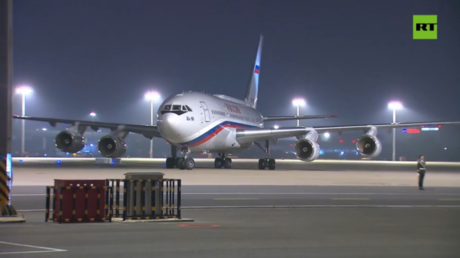
Vladimir Putin arrived in Beijing on Tuesday night, stepping off his aircraft into an elaborate display of diplomatic pageantry. The synchronized choreography of waving youths and high-level greetings by Foreign Minister Wang Yi provided the exact optical illusion the Kremlin requires, suggesting a powerful geopolitical alliance of equals. Yet the true narrative of this visit lies not in the superficial warmth of the red carpet, but in the reality of Russia's rapidly diminishing leverage. Stranded in an economic corner after four years of a grinding conflict in Ukraine, Moscow is learning that Beijing’s embrace is less an alliance and more a slow, calculated absorption.
The precision timing of this two-day state visit is no coincidence. Putin touches down in the capital a mere four days after U.S. President Donald Trump concluded his own high-stakes summit with Chinese leader Xi Jinping. By hosting the leaders of the world's two largest nuclear and economic counterweights within a single week, Beijing is deliberately showcasing its position as the ultimate gravity well of modern global diplomacy.
For the Kremlin, the visit is marketed as a celebratory milestone marking the 25th anniversary of the 2001 Sino-Russian Treaty of Friendship. For Zhongnanhai, it is an exercise in cold strategic balancing. Xi Jinping is playing a delicate double game, attempting to de-escalate trade frictions with Washington while quietly keeping Moscow on a tight, dependent leash as a reliable source of discounted energy and a buffer against Western influence.
The Asymmetry Behind the Forty Meetings
To understand the mechanics of the current Sino-Russian relationship, one must look past the superficial declarations of an "unprecedented level" of cooperation. This trip marks Putin’s 25th visit to China, and the two leaders have met face-to-face more than forty times. This frequency far outpaces Xi’s interactions with any Western counterpart. However, repetition does not equal parity.
When Russia launched its full-scale invasion of Ukraine in 2022, it gambled on the idea that Western economic isolation could be entirely offset by turning East. That turn has succeeded in keeping the Russian state solvent, but it has come at a steep sovereign cost. Russia has transformed from a strategic partner into an economic vassal.
The Trade Imbalance
Bilateral trade between the two nations has indeed soared, but the nature of this commerce reveals a striking vulnerability. Russia exports raw, unrefined commodities—primarily crude oil and natural gas—while importing high-value finished goods, machinery, and dual-use microelectronics necessary to sustain its domestic defense industry.
Currency Captivity
The Kremlin frequently boasts that bilateral settlements are now conducted almost exclusively in local currencies, bypassing the Western financial system. The unvarnished reality is that Russia is accumulating mountains of Chinese yuan that it can only spend on Chinese imports. This effectively locks the Russian economy into a closed loop controlled entirely by Beijing’s state banks.
The Pipeline Poker Game
The primary litmus test for the true health of this relationship remains the long-delayed Power of Siberia 2 pipeline. The proposed 1,600-mile conduit is designed to divert 50 billion cubic meters of natural gas annually from Russia’s northern Yamal Peninsula to northern China, effectively replacing the European market share that Moscow permanently lost.
Moscow desperately needs a definitive, binding signature on this project to prove its long-term economic viability. Beijing, conversely, feels absolutely no pressure to rush. The ongoing war in Iran and the persistent security threats closing the Strait of Hormuz have certainly heightened China’s anxiety over maritime energy routes, making overland Russian pipelines look more attractive. Yet Xi Jinping continues to treat the pipeline as a leverage point rather than a priority.
Beijing is currently deploying a classic diversification strategy, intentionally dragging out negotiations with Russia while simultaneously advancing parallel supply discussions with Turkmenistan. By maintaining alternative options, China forces Russian negotiators to accept bottom-barrel pricing.
Russia wants to sell its gas at prices comparable to what it once charged Europe; China is demanding steep, long-term discounts that would barely cover Russia's cost of extraction and transport. Putin may leave Beijing with vague memorandums of understanding regarding energy cooperation, but securing a profitable, binding commercial contract remains an uphill battle.
Reading the Post Trump Tea Leaves
A critical, unspoken objective of the Russian delegation’s itinerary is discovering exactly what occurred behind closed doors during the Trump-Xi summit last week. The Kremlin is deeply anxious that a potential trade truce or geopolitical understanding between Washington and Beijing could come at Moscow’s expense.
"The Trump visit was about stabilizing the world's most important bilateral relationship; the Putin visit is about reassuring a junior partner that it hasn't been bargained away."
Presidential aide Yuri Ushakov insisted to reporters that there is "no connection" between the successive visits, claiming Putin’s trip was scheduled far in advance. This is diplomatic fiction. China meticulously curated this back-to-back scheduling to maximize its own diplomatic leverage. By showing Trump that it possesses a loyal, nuclear-armed partner in Moscow, Beijing warns Washington against pushing too hard on trade tariffs or the Taiwan issue. By showing Putin that it can host an American president with full honors, Beijing warns Moscow not to take Chinese support for granted.
The Dual Use Tightrope
The military reality of the relationship is equally transactional. Western intelligence agencies continue to flag China's supply of dual-use components—including machine tools, semiconductors, and optical equipment—that feed directly into Russia's domestic drone and missile manufacturing plants.
Beijing denies providing lethal aid, maintaining a public stance of neutrality in the Ukraine conflict. This hair-splitting definition allows China to keep the Russian war machine functional while avoiding the catastrophic secondary sanctions that would trigger a mass flight of Western capital from its own struggling domestic economy.
Xi Jinping has no interest in seeing Putin suffer a decisive defeat that could lead to a pro-Western regime on China’s northern border. However, he has equally little interest in funding a total Russian victory that would permanently destabilize the European market, which remains a vital destination for Chinese exports. China's ideal scenario is a controlled, low-intensity stalemate that keeps Russia permanently dependent on Beijing for economic survival.
Domestic Fraying and the Need for Optics
This trip occurs at a particularly delicate moment for the Russian president domestically. The war in Ukraine has entered its fifth year with little substantial battlefield progress, and a series of sustained Ukrainian drone strikes deep inside Russian territory have systematically targeted oil refineries and disrupted civilian infrastructure in major urban hubs, including Moscow.
The strongman image that forms the bedrock of Putin's domestic authority is showing visible signs of strain. The Russian public is facing persistent inflation, rising interest rates, and the creeping militarization of daily life.
In this domestic context, the grand imagery of the Beijing summit becomes a critical piece of propaganda for consumption back home. The state-controlled television networks in Russia will spend days broadcasting footage of the honor guards, the ceremonial handshakes, and the declarations of a "multipolar world order." It is a carefully crafted narrative designed to convince the Russian populace that their country is not isolated, but is instead leading a global coalition alongside the world's rising superpower.
The reality on the ground in Chinese border towns tells a more grounded story. From sanctioned European cars smuggled through northern routes to Chinese beauty clinics catering to wealthy expatriates, Russian rubles are flowing into China, but the wealth generated by this axis is overwhelmingly moving in one direction. Moscow is selling its national resources at a discount to purchase Chinese consumer goods, sacrificing its long-term economic autonomy for short-term political survival.
Putin and Xi will likely conclude this summit by signing a sweeping, rhetorically grand joint declaration denouncing Western hegemony and pledging to construct a new global architecture. These documents make for compelling headlines, but they cannot alter the fundamental mathematics of the relationship. In the modern geopolitical landscape, a state with a nominal GDP smaller than that of a single Chinese province cannot dictate terms to the world's manufacturing capital. Putin arrived in Beijing seeking an equal partner; he will leave as an increasingly dependent client.