Geopolitics loves a flashy photo op, but the real shifts happen when nobody is looking.
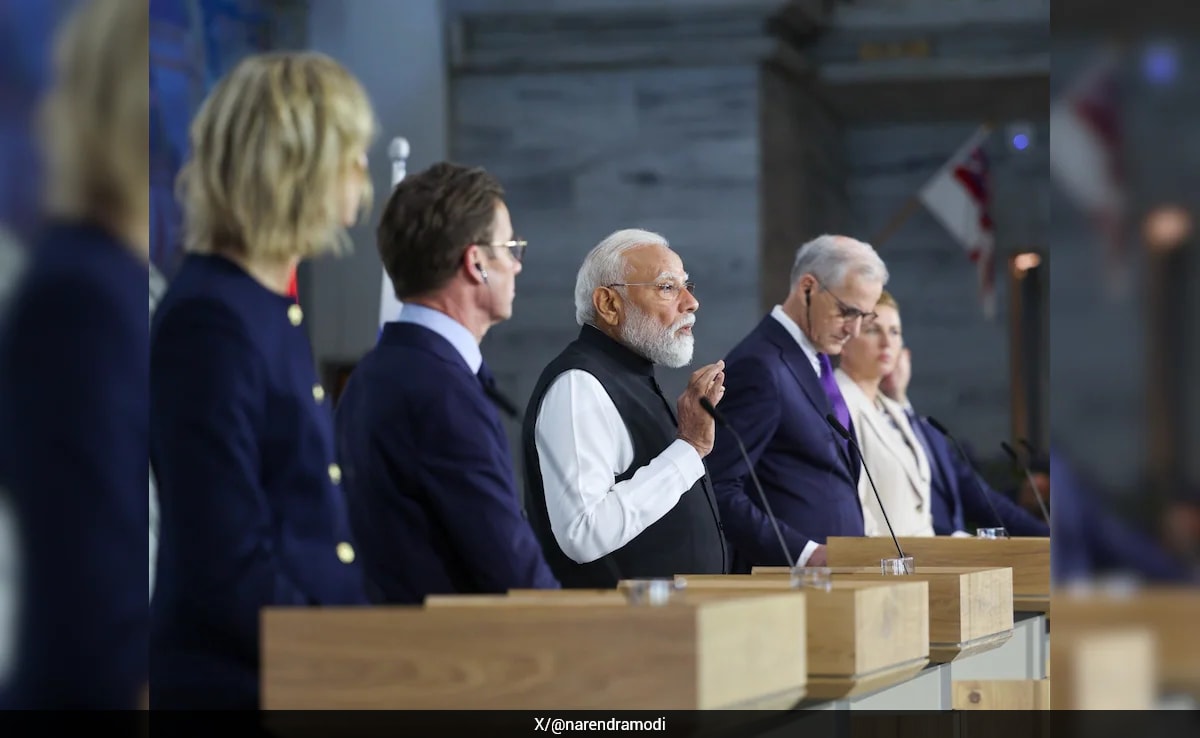
When Indian Prime Minister Narendra Modi stood in Oslo alongside the leaders of Denmark, Finland, Iceland, Norway, and Sweden, the headlines focused heavily on standard diplomatic jargon. Words like "shared commitment" and "multilateralism" dominated the airwaves. Modi explicitly stated that a mutual respect for democracy and the rule of law makes India and the Nordic countries natural partners.
But let’s look past the press releases. Why is a massive country of 1.4 billion people aggressively courting a cluster of five northern European nations with a combined population smaller than Texas?
It isn't just about sounding polite on the global stage. It’s about a massive economic calculation, a quiet scramble for the Arctic, and an attempt to find steady ground while the rest of the world fractures.
The Geopolitical Tension Under the Surface
Look at the global map right now. You have erratic shifts in Washington, grinding conflict in Ukraine, and massive instability across West Asia. In this climate, traditional alliances feel shaky.
The Nordic nations are heavily exposed to Russian aggression and deeply worried about global supply chains. India wants to ensure its economic rise doesn't get choked off by maritime blockades or sudden tariff wars. Norway’s Prime Minister Jonas Gahr Støre essentially admitted this during the summit, noting that the gathering is exactly what an unpredictable world needs. He talked about democracies working together despite massive differences in geography and size.
What he really meant is simple. When the Nordics band together, they hold a collective financial output of over $1.9 trillion. They act like a middle power. By locking arms with India, they create a counterweight to global chaos.
For India, this isn't just a friendly chat. This summit marks the first time an Indian prime minister has visited Norway in 43 years. The last one to do it was Indira Gandhi back in 1983. That gap tells you everything you need to know about how drastically priorities have shifted. New Delhi realizes it can no longer rely solely on its traditional partners.
The Trillion Dollar Green Trade Cache
If you think this is just a ideological club, check the math.
The biggest concrete outcome of this summit is the elevation of ties to a Green Technology and Innovation Strategic Partnership. That sounds fancy, but the mechanics are remarkably practical. The Nordics have the money and the tech. India has the sheer, unadulterated scale.
- Iceland: They lead the world in geothermal energy and carbon capture. India wants to deploy that tech to clean up its massive industrial sectors.
- Norway: They are the kings of the Blue Economy, green shipping, and deep-sea tunnel engineering.
- Finland and Sweden: They sit on next-generation digital tech, from 5G and 6G networks to quantum computing.
Think about what happens when you combine that specialized knowledge with India’s massive labor pool and manufacturing push. India’s trade with the Nordic region already crossed $19 billion in 2024. But the real catalyst is the recent Trade and Economic Partnership Agreement signed with the European Free Trade Association, alongside progress on the broader India-EU Free Trade Agreement.
We are talking about a framework projected to drive $100 billion in investment and create a million jobs over the next 15 years. This isn't vague diplomacy. It is a corporate pipeline.
The Arctic Factor Nobody Explains
Here is the part most mainstream media outlets gloss over entirely. Why does India care so much about northern polar research?
The Arctic Council is the premier forum for managing the North Pole, and all five Nordic countries are members. As the polar ice caps melt due to climate change, new shipping lanes are opening up. These routes drastically cut transit times between Asia and Europe, bypassing traditional chokepoints like the Malacca Strait or the Suez Canal.
Furthermore, the Arctic holds massive, untapped reserves of oil, natural gas, and rare earth minerals. India wants an anchor in this region, and it needs the Nordic countries to give it legitimacy. During the summit, Modi explicitly pushed for a dedicated India-Nordic Arctic mechanism to deepen polar research and maritime security. It is a long-term play for resources that will define the next fifty years of global energy consumption.
The Reality Check on Shared Values
We need to be honest here. The "natural partners" rhetoric sounds great, but these nations don't see eye-to-eye on everything.
The Nordic countries are fiercely critical of Russia over the Ukraine war. India, on the other hand, still buys billions of dollars of discounted Russian oil and maintains deep historical ties with Moscow. Støre hinted at these frictions, openly mentioning that while India and Norway have differences, they must still unite against nations that try to weaponize trade and technology.
There are domestic wrinkles too. Right as Modi arrived in Oslo, opposition leaders back home in India were making noise about Norway’s massive sovereign wealth fund dropping major Indian corporations like Adani Green from its portfolio over governance concerns.
These partnerships aren't seamless. They are transactional. India doesn't need the Nordics to agree with its entire foreign policy. It needs their capital, their engineering, and their votes in international forums. The Nordics don't need India to be a Western clone; they need access to the fastest-growing major economy on earth to keep their own wealthy societies afloat.
How to Track This Partnership Moving Forward
If you want to see if this summit actually matters or if it was just expensive political theater, stop reading the communiqués. Watch these three indicators instead.
- Watch the Sovereign Wealth Funds: Monitor whether Norway's massive government pension fund increases its direct investments into Indian green infrastructure and renewable projects over the next twelve months.
- Track the Arctic Research Stations: Look for an increase in joint scientific deployments between Indian researchers and Nordic institutes in Svalbard. Actual science funding is the truest sign of strategic alignment.
- Monitor Telecom Contracts: See if Indian telecom giants shift their next-generation 6G development contracts toward Finnish and Swedish firms like Nokia and Ericsson, rather than cheaper alternatives.
The speeches in Oslo are over, and Modi has already departed for his next diplomatic stop in Italy. The grand statements about democracy and the rule of law are safely filed away in government archives. Now, the real work falls to the mid-level bureaucrats and corporate executives who have to turn those lofty words into actual, profitable contracts.


