Ground shaking at 6:48 am isn't just a rude awakening; for the people of Ternate and Manado, it was a fight for survival. A powerful 7.4-magnitude earthquake ripped through the Molucca Sea on Thursday, April 2, 2026, proving once again that Indonesia’s "Ring of Fire" location isn't just a geological trivia point. It’s a constant, hovering threat.
The quake hit at a depth of 35 kilometers, with the epicenter located about 127 kilometers west-northwest of Ternate. While the magnitude was high enough to cause catastrophic damage, the depth and distance from major urban centers likely prevented a much higher death toll. Still, the reality on the ground is grim. One woman, 70, lost her life in Manado when a building collapsed. Several others are in the hospital.
If you’re wondering why a 7.4 quake only resulted in one confirmed death so far, it’s a mix of luck, geography, and some hard-learned lessons in infrastructure. But don't let the low initial number fool you—the psychological and structural impact on North Sulawesi and North Maluku is intense.
The Tsunami scare that froze the coast
Minutes after the shaking stopped, the Pacific Tsunami Warning Center flagged a terrifying possibility. They projected waves up to one meter high along Indonesian coasts, with potential impacts reaching as far as the Philippines and Malaysia.
Panic is the natural response. In Bitung and Ternate, people didn't wait for the official sirens. They saw the water receding or felt the sheer violence of the 20-second tremor and headed for the hills. Honestly, that’s the right move. In this part of the world, waiting for a text alert can be a fatal mistake.
The actual tsunami waves recorded were smaller than feared:
- North Minahasa: 75 centimeters (the highest recorded).
- Bitung and Ternate: Minor fluctuations.
By 9:00 am local time, the tsunami warning was lifted. But the danger hasn't vanished. Landslides and aftershocks are now the primary concern for rescue teams.
Structural failures in North Sulawesi
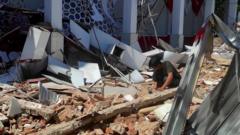
The damage reports coming out of Manado and Ternate show a disturbing pattern. It isn't just old shacks falling over. We're seeing "permanent" structures—churches, government offices, and multi-story homes—showing deep structural cracks or partial collapses.
Indonesia’s National Disaster Management Agency (BNPB) is currently focused on three main zones:
- Ternate City: Immediate reports of at least three injured and significant damage to a local church.
- Manado: The site of the only confirmed fatality so far, involving a building collapse under the local sports authority.
- Bitung: Strong shaking lasted nearly 20 seconds, leaving residents afraid to return to their homes.
The problem is that many buildings in these regions are built with "unreinforced masonry." This is basically a fancy way of saying bricks and mortar without enough steel to handle the side-to-side "shear" forces of a 7.4 quake. When the ground moves like a wave, these walls just crumble.
What the 2026 Molucca Sea quake tells us about the future
This isn't an isolated event. Indonesia averages about 7,000 earthquakes a year. What makes this 7.4 quake significant is where it happened. The Molucca Sea is a complex mess of micro-plates. You’ve got the Philippine Sea Plate, the Eurasian Plate, and the Australian Plate all grinding together.
Experts from the Meteorology, Climatology, and Geophysical Agency (BMKG) have already logged over 50 aftershocks, including one at a 5.5 magnitude. If you’re in a building that’s already cracked, a 5.5 aftershock is more than enough to finish the job.
People often ask if we can predict these. The short answer is no. We can map the faults—like the Molucca Sea Plate—but we can’t tell you the day or hour. What we can do is look at the data. The 2018 Palu quake was a 7.5 and killed thousands because of soil liquefaction and a localized tsunami. We dodged that bullet this time, but the margin was thin.
Survival steps for the next 48 hours
If you have family in the region or you're currently in North Sulawesi or Maluku, the "all clear" on the tsunami doesn't mean you're safe. Aftershocks are the silent killers of the recovery phase.
- Check your walls: If you see new diagonal cracks (especially near doors or windows), do not sleep in that room.
- Avoid the coast: Even without a tsunami, large aftershocks can cause localized landslides into the sea, creating "mini-tsunamis" that won't trigger a regional alarm.
- Clear the roads: Disaster teams in Manado and Bitung need the roads clear to reach inland villages that haven't checked in yet.
- Verify before sharing: WhatsApp is currently flooded with "old" videos of previous tsunamis. Stop sharing them. Stick to the official BMKG or BNPB channels for updates.
The 7.4 quake in the Molucca Sea is a reminder that in Indonesia, the ground is never truly still. One death is one too many, but the outcome could have been significantly worse if the tremor had lasted just ten seconds longer or hit ten kilometers shallower. Stay alert.