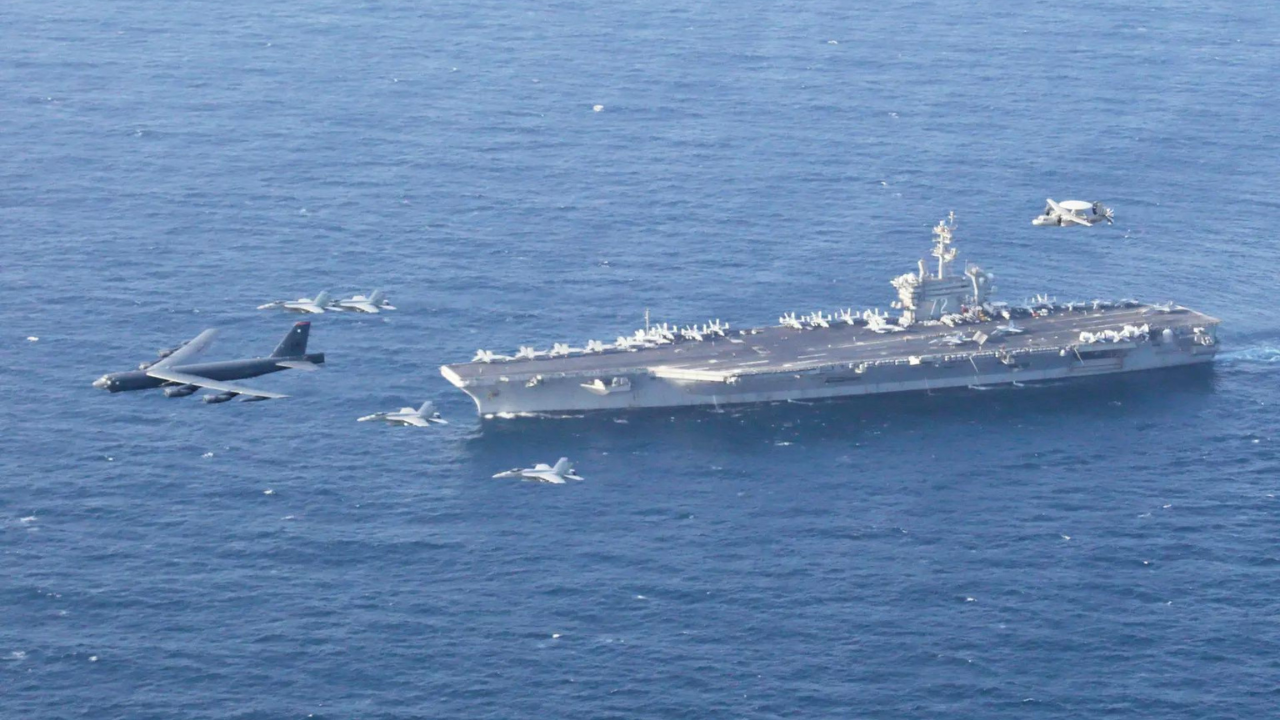
The strategic disconnect between Iranian claims of a successful strike on the USS Abraham Lincoln (CVN-72) and the operational reality of Carrier Strike Group (CSG) defense systems reveals a deepening schism in modern gray-zone conflict. While Houthi spokesmen and Iranian state media frame the event as a breach of American maritime hegemony, the physics of Integrated Air and Missile Defense (IAMD) suggests a different outcome. To understand why these claims failed to manifest as physical damage, one must analyze the three-layered attrition model that protects a U.S. supercarrier.
The Architecture of Interception
The defense of a Nimitz-class carrier is not a singular event but a tiered probability function. The Houthi attempt, reportedly involving cruise missiles and kamikaze drones, had to navigate a defensive envelope designed to minimize the "Leakage Rate"—the statistical probability of a single munition penetrating the final layer of defense.
1. The Outer Air Battle (OAB)
The first layer of defense is the E-2D Advanced Hawkeye, which acts as the "quarterback" for the strike group. By using Cooperative Engagement Capability (CEC), the Hawkeye transmits sensor data to F/A-18 Super Hornets and Aegis-equipped destroyers. This creates a "fused" picture, allowing the CSG to engage threats long before they reach the horizon. The Iranian narrative fails to account for the fact that a missile must first survive an encounter with an AIM-120 AMRAAM fired from a platform it cannot even detect.
2. The Area Defense Layer
Should a munition survive the OAB, it enters the engagement zone of the Arleigh Burke-class destroyers. These vessels utilize the Aegis Combat System, which is optimized for high-density raids. The logic of the Aegis system is built on the "detect-to-engage" sequence:
- AN/SPY-1 Radar: Provides 360-degree coverage, tracking hundreds of targets simultaneously.
- Standard Missile-2 (SM-2) and SM-6: These interceptors are designed for mid-course and terminal phase kills. The SM-6, in particular, is an over-the-horizon capability that renders "sea-skimming" profiles—the primary tactic of Iranian-made Noor or Quds missiles—increasingly ineffective.
3. The Point Defense Barrier
The final 5 miles of the carrier’s airspace are the most contested. This is the domain of the Evolved SeaSparrow Missile (ESSM) and the Phalanx Close-In Weapon System (CIWS). The CIWS functions as a high-speed, 20mm Gatling gun that creates a "wall of lead." If a missile had "struck" or even "come close" as claimed, the resulting kinetic impact or debris field would be visible via commercial satellite imagery or the inevitable thermal signatures of damage control efforts.
The Disparity of Kinetic Success vs. Information Operations
The Houthi claim of a strike serves a political function that is entirely independent of physical reality. In the logic of asymmetric warfare, the assertion of an attack carries more weight in regional optics than the success of the attack.
The Cost-Exchange Ratio
There is a fundamental economic imbalance in these engagements. A Houthi drone may cost $20,000 to $50,000, while an SM-2 interceptor costs approximately $2 million. Iran and its proxies are not necessarily trying to sink the USS Abraham Lincoln; they are trying to deplete the CSG’s magazine depth. The "win" for the Houthis is forcing the U.S. Navy to expend high-end interceptors against low-end threats, eventually necessitating a withdrawal to a port for rearming—a process known as "logistical culmination."
Signal vs. Noise in Damage Assessment
Battle Damage Assessment (BDA) in the modern era is transparent. If a 100,000-ton carrier is hit by a cruise missile carrying a 300kg warhead, the thermal signature would be detectable by infrared sensors on civilian and military satellites. The absence of "black holes" (areas of heat concentration) or changes in the vessel’s wake pattern (indicating propulsion issues) confirms that the Iranian claims remain in the realm of psychological operations rather than naval history.
Vulnerabilities in the Aegis Shield
While the U.S. dismissed the Houthi claims, the incident highlights three critical bottlenecks in carrier defense that military planners must address.
Saturation Limits
Every Aegis destroyer has a finite number of Vertical Launch System (VLS) cells. If a regional adversary launches a coordinated swarm of 50+ munitions simultaneously, the system faces a "computational and kinetic saturation" point. The goal of the attacker is to exceed the number of simultaneous target tracks the radar can process or the number of interceptors in the air.
Sensor Degradation
The Red Sea and the Gulf of Aden provide a complex electromagnetic environment. Thermal inversion layers and high humidity can affect radar propagation, creating "ducts" where low-flying missiles can hide from certain radar frequencies. While the E-2D Hawkeye mitigates this by looking down from altitude, the reliance on a single airborne node creates a high-value target for the adversary.
The "Lucky Shot" Variable
The U.S. Navy operates on a "Zero-Defect" requirement. To maintain the carrier’s status as a tool of deterrence, the defense must be 100% effective. The adversary only needs to be 1% effective. A single hit, even if it does not sink the ship, shatters the aura of invincibility that underpins U.S. naval strategy.
Tactical Evolution of the Proxy Strike
The munitions utilized in the reported attack on the USS Abraham Lincoln likely originated from the Iranian "Fateh" or "Quds" families. These systems have evolved from unguided rockets into precision-guided tools with GPS and terminal seekers.
- Guidance Systems: Modern Houthi missiles utilize Electro-Optical (EO) or Infrared (IR) seekers. This allows them to ignore traditional Electronic Countermeasures (ECM) that target radio frequencies.
- Trajectory Manipulation: Rather than flying a straight line, newer variants can perform "pop-up" maneuvers or high-G weaves in the terminal phase, specifically designed to confuse the lead-calculation logic of the CIWS.
- The Multi-Domain Approach: The reported attack was not just missiles; it included Unmanned Surface Vessels (USVs). By forcing the carrier’s escorts to look "down" at the water and "up" at the sky simultaneously, the Houthis attempt to split the focus of the Strike Group’s organic sensors.
Quantifying the Deterrence Gap
The U.S. Navy’s denial of the strike is supported by the lack of physical evidence, but the frequency of these attempts indicates a failure of deterrence. When a non-state actor feels empowered to target a nuclear-powered aircraft carrier, the "Fear Multiplier" of the carrier has reached a point of diminishing returns.
The strategic play is no longer about whether a missile hit the hull. It is about the "Sustainment Burden." Every day the USS Abraham Lincoln stays in the Red Sea, it consumes millions of dollars in fuel, maintenance, and munitions. By maintaining a constant threat of "near misses," Iran forces the U.S. into a defensive posture that prevents the carrier from projecting power elsewhere, such as the South China Sea or the North Atlantic.
The U.S. must transition from a reactive "Interception Economy" to a proactive "Platform Suppression" strategy. Instead of shooting down $50,000 drones with $2 million missiles, the operational focus must shift to the destruction of the "Launch-to-C2" (Command and Control) chain. This requires persistent loitering munitions over Houthi-controlled territory to strike launchers the moment they are moved from underground storage, rather than waiting for the munition to enter the carrier’s defensive envelope. Failure to change this cost-curve will result in a strategic "checkmate by exhaustion," regardless of whether a single Iranian missile ever touches a U.S. deck.