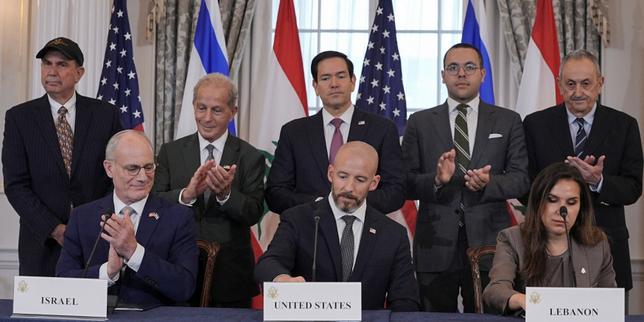
The sound of a pen sliding across a sheet of heavy paper does not carry far. It makes a faint, scratching rasp, easily drowned out by the hum of an air conditioner or the heavy click of a camera shutter. Yet, in the quiet rooms of diplomacy, that microscopic sound is sometimes expected to carry the weight of millions of lives.
For decades, the border between Israel and Lebanon has been defined not by lines on a map, but by smoke, the sudden thud of artillery, and the heavy silence of evacuated villages. It is a landscape where peace is not a memory, but a concept learned from books.
Then came a signature.
In a diplomatic environment often paralyzed by historical grievances, Israel and Lebanon recently signed a framework agreement mediated by the United States. US Secretary of State Marco Rubio called it a "first step" toward peace. To the global news cycle, it was a headline that flickered on screens for an afternoon before being replaced by market reports or celebrity drama. But to understand what actually happened, you have to look past the official press releases and into the spaces where the geopolitical meets the deeply personal.
Imagine a kitchen in a northern Israeli collective farm, or a concrete balcony in a southern Lebanese village. The distance between them is short enough that on a quiet night, you might hear a dog barking across the divide. For the people sitting in those rooms, a framework agreement is not an abstract triumph of international law. It is a calculation of safety. It is the difference between planting crops or packing a suitcase.
The geography of friction
Diplomacy often treats borders as neat, mathematical boundaries. The reality on the ground is entirely messy. The frontier between Israel and Lebanon has long been a fault line where regional ambitions and local survival collide.
Every treaty or framework agreement rests on a scaffolding of hidden stakes. On paper, this agreement establishes a structured pathway for negotiations, a formal mechanism to address disputes without immediately resorting to military mobilization. It creates a linguistic bridge over a chasm of distrust. The United States acts as the guarantor, the third party holding the tape measure while two rivals attempt to define the space between them.
But the real problem lies elsewhere. A framework is a skeleton. It lacks muscle, skin, and a heartbeat. It dictates how the parties will talk, but it cannot force them to agree on the hardest truths: water rights, maritime boundaries, security corridors, and the presence of non-state actors who do not answer to the governments signing the paper.
Consider what happens next when the cameras leave the room. The diplomats fly back to Washington, Jerusalem, and Beirut. The paper is filed into climate-controlled archives. On the ground, the soldiers remain in their outposts. The local populations look out their windows, watching for any sign that the rhetoric matches the reality.
Distrust is a heavy habit to break. When a generation grows up running to bomb shelters or listening for the drone of aircraft, peace feels less like a promise and more like a tactical pause. It is terrifying to trust a piece of paper when your entire history tells you that paper burns easily.
The anatomy of a first step
Marco Rubio’s characterization of the agreement as a "first step" is both a statement of fact and a shield against criticism. It acknowledges the fragility of the moment. In international relations, a first step is rarely a stride; it is a cautious, tentative testing of the ground to see if it will hold weight.
Why now? The timing of any diplomatic breakthrough is never accidental. It is driven by exhaustion, economic necessity, and shifting global alignments. Lebanon has faced years of profound economic stagnation, infrastructure collapse, and political gridlock. The country needs stability to rebuild its economy and attract international investment, particularly in the energy sector where offshore gas fields remain untapped due to border disputes. Israel, conversely, seeks to secure its northern frontier to focus on broader regional integration and mitigate the constant threat of a multi-front conflict.
The framework agreement addresses these pressures by creating a formalized venue for resource management and security coordination. It allows both nations to pursue pragmatic self-interest under the umbrella of international mediation, offering a rare moment where cooperation yields higher dividends than confrontation.
Yet, the mechanics of negotiation are incredibly delicate. If one side pushes too hard on a symbolic issue, the entire structure can collapse. The language of the agreement must be ambiguous enough to allow both governments to claim victory at home, yet precise enough to prevent misinterpretation on the border. It is a high-wire act performed in the dark.
The human ledger
We often speak of nations as single entities—"Israel decided," "Lebanon stated"—but nations are collections of individuals experiencing history in real time.
Think of a small business owner in a border town whose shop has been empty for months because tourists are afraid to visit. Think of a farmer whose orchards sit in a disputed zone, unable to harvest the fruit because the fields are laced with the memory of old munitions. For these individuals, the success or failure of Marco Rubio's "first step" is measured in daily survival.
The true cost of conflict is not just the destruction of property or the loss of life, though those are tragic beyond measure. It is the erosion of the future. It is the psychological tax paid by families who cannot plan five years ahead because they do not know if their homes will still be standing.
This agreement, minimal as it may seem to outsiders, represents a crack in the wall of inevitability. It suggests that the future does not have to look exactly like the past. It introduces the volatile, unsettling element of hope into a landscape that had grown accustomed to despair.
But hope is a dangerous commodity in the Middle East. If it is offered and then broken, the resulting cynicism can be more destructive than the original hostility. That is the invisible stake riding on every meeting, every memorandum, and every handshake.
The ink on the document is dry now. The press conferences have concluded, and the global news cycle has moved on to the next crisis. What remains is the slow, unglamorous work of turning a framework into a reality. It will require hundreds of smaller, quieter decisions—decisions made by border guards, local commanders, and mid-level bureaucrats—to ensure that this fragile consensus does not shatter at the first sign of tension.
The pen has done its job. Now the harder work begins on the hillsides and in the valleys where the line is drawn.