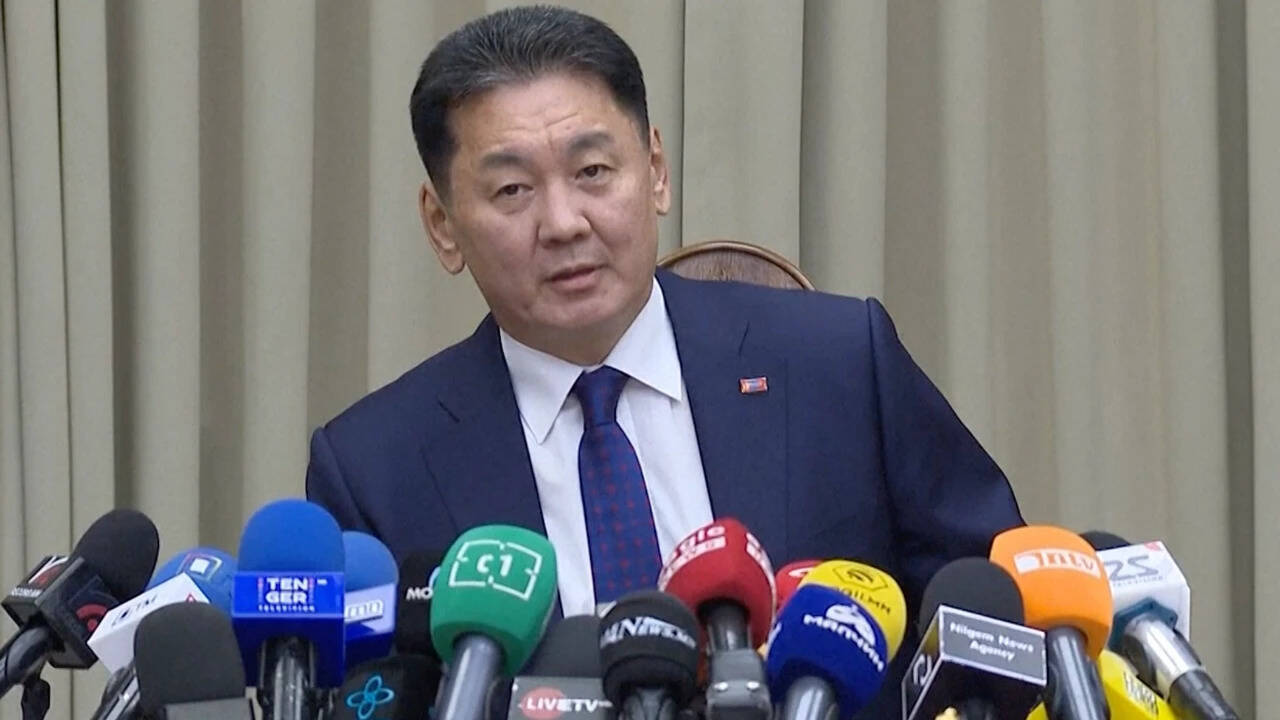
Mongolia's presidency just imploded under the weight of a $25 million bribery scandal, forcing an abrupt resignation that exposes the deep financial rot inside the nation's political establishment. While the headline figure of $25 million has captured international attention, the real story lies in how illicit capital moves through a resource-rich democracy caught between two authoritarian superpowers. This resignation is not an isolated moral failure by a single leader. It is the inevitable breakdown of a political system where state-backed mining contracts, opaque offshore shell companies, and campaign finance laws collide without meaningful oversight.
For years, observers of Central Asian politics treated Mongolia as a resilient democratic exception. Surrounded by Russia and China, Ulaanbaatar maintained competitive elections, a vocal press, and peaceful transfers of power. Yet beneath that democratic surface, an entrenched network of oligarchs and political brokers quietly turned public office into a clearinghouse for foreign and domestic bribes. When allegations surfaced linking the presidential office to $25 million in illicit payments, the public reaction was swift, furious, and unforgiving.
How $25 Million Moves Through Ulaanbaatar
To understand why a $25 million bribery allegation proved fatal to the presidency, you have to look at the mechanics of political corruption in resource-dependent economies. In a country whose gross domestic product hovers around $20 billion, $25 million is not merely a campaign slush fund. It is enough capital to buy entire factions of parliament, silence regulatory agencies, and tilt the outcome of national elections.
Corruption at this scale rarely involves briefcases of cash handed over in hotel lobbies. Instead, investigators and financial analysts recognize a familiar three-stage pipeline used across emerging mining economies.
First comes concession rigging. Mongolia sits on vast reserves of coking coal, copper, gold, and rare earth elements. Access to these deposits requires licenses, environmental clearances, and infrastructure permits controlled directly or indirectly by executive appointments. A $25 million bribe is typically structured as a "consulting fee" or "success commission" paid by a consortium seeking exclusive extraction rights or favorable tax stabilization agreements.
Second is offshore layering. Because domestic banking transactions of that magnitude would immediately trigger alerts within Mongolia's financial intelligence units, illicit funds are routed through transit jurisdictions. Shell companies registered in places like Hong Kong, Singapore, or the British Virgin Islands receive the initial wire transfers under the guise of logistics, equipment leasing, or legal advisory services.
Third is domestic repatriation. Once cleaned through layers of corporate secrecy, the money re-enters Mongolia. It arrives disguised as foreign direct investment, real estate purchases in Ulaanbaatar's luxury high-rises, or unsecured loans to politically exposed persons and their relatives. By the time prosecutors trace the paper trail back to the State Palace, the funds have already been dispersed across dozens of local bank accounts and political operatives.
The Anatomy of Public Fury
The resignation did not happen in a vacuum. Had these allegations surfaced during an economic boom, the political establishment might have weathered the storm through procedural delays and parliamentary stonewalling. Today, however, ordinary Mongolians are dealing with severe inflation, a weakened currency, and chronic air pollution in the capital.
When citizens struggle to afford basic winter heating fuel while news breaks of a $25 million presidential bribery scheme, anger turns into street mobilization. Protests in Sukhbaatar Square have repeatedly demonstrated that Mongolian voters possess a low tolerance for elite impunity once concrete numbers attach to rumors of graft.
Crucially, the anger was amplified by recent memories of other systemic thefts. Over the past decade, Mongolia has been rocked by scandals involving the looting of the Development Bank of Mongolia and the coal theft crisis, where billions of dollars worth of state-owned coal vanished across the southern border without customs records. To the public, the $25 million presidential scandal was simply the final piece of proof that the highest office in the land was operating by the same predatory rules as the ministries below it.
Why the Resignation Changes Less Than You Think
Political commentators often celebrate the resignation of a disgraced leader as a triumph of democratic accountability. That interpretation misses the structural reality of Mongolian politics. Removing the person at the top does not dismantle the machinery that put them there.
Consider the financing of Mongolian elections. Running a competitive national campaign in a sparsely populated country larger than Western Europe requires massive logistical spending. Candidates must fund travel across remote provinces, maintain local party offices, and pay for media coverage. Yet official campaign spending limits remain unrealistically low, and enforcement by the General Election Commission is historically weak.
This creates a structural trap. Honest candidates cannot raise enough legal money to compete, while ambitious politicians must strike bargains with mining tycoons and state enterprise directors to fund their campaigns. Once elected, those politicians owe favors that can only be repaid through state contracts, judicial interference, or regulatory blindness.
To illustrate how this trap operates, consider a hypothetical example of a newly elected official taking office with $10 million in unrecorded campaign debt owed to three domestic conglomerates. Within six months, one conglomerate demands a rail transport monopoly, another asks for a tax audit to be dropped, and the third seeks a board seat on a state-owned mining firm. Refusing them means political suicide when those backers leak the debt records to rival media outlets. Complying means becoming complicit in grand corruption.
Until Mongolia overhauls how political parties are funded and enforces strict asset declarations for every tier of public service, any new president will walk into the exact same set of compromises.
The Geopolitical Shadow Over the Scandal
A $25 million bribery crisis in Ulaanbaatar carries immediate consequences far beyond Mongolia's borders. Landlocked between Russia and China, Mongolia relies on a "Third Neighbor" foreign policy—cultivating strong diplomatic and economic ties with the United States, Japan, South Korea, and the European Union to balance the overwhelming influence of its two giant neighbors.
Western investors and development banks, however, are bound by strict anti-corruption statutes like the U.S. Foreign Corrupt Practices Act. Every major bribery scandal increases the compliance risk for legitimate international mining firms and green-energy developers considering projects in the Gobi Desert. When Western capital pulls back due to governance fears, a vacuum opens up.
That vacuum is inevitably filled by state-backed entities from neighboring powers that do not face the same shareholder scrutiny or anti-bribery enforcement at home. In effect, domestic corruption directly undermines Mongolia's strategic sovereignty. Every million dollars lost to bribery weakens the state's ability to negotiate on equal terms with foreign creditors and resource buyers.
Counter-Arguments and the Gray Areas of Anti-Corruption Purges
Veteran observers of Ulaanbaatar's power struggles know that anti-corruption campaigns in Mongolia rarely operate with pure motives. While the public demands justice, rival political factions frequently weaponize bribery investigations to eliminate competitors ahead of parliamentary or presidential cycles.
It is entirely possible that the timing of the $25 million leak was orchestrated by opposing elites within the ruling coalition or the opposition rather than by independent whistleblowers. In Mongolian politics, selective enforcement is an art form. The Independent Authority Against Corruption (IAAC) has long faced criticism for aggressively pursuing officials who have fallen out of favor while ignoring identical financial irregularities committed by figures currently holding power.
Furthermore, there is a distinct gray area between outright bribery and legal lobbying in emerging markets. Defense lawyers in high-profile Mongolian graft cases routinely argue that disputed transfers represent legitimate business investments, loan repayments, or campaign contributions made before an official assumed executive duties. Without transparent beneficial ownership registries and independent judicial review, distinguishing between a $25 million bribe and a complex corporate restructuring becomes a battle of political narratives rather than a straightforward legal proceeding.
Acknowledging this political weaponization does not excuse the underlying misconduct. If $25 million flowed into accounts tied to the presidency under questionable circumstances, the resignation was warranted. Still, voters should remain skeptical of whichever faction steps forward claiming to be the moral saviors of the republic.
What Real Reform Would Actually Require
If Mongolia wants to prevent another presidential collapse within the next five years, symbolic resignations and televised apologies will not suffice. Three concrete institutional changes are non-negotiable.
- Mandatory Beneficial Ownership Transparency: Every company bidding on state procurement contracts or holding mineral exploration licenses must be legally required to disclose its ultimate human owners, down to a five percent equity threshold. Anonymous offshore entities should be barred from holding Mongolian resource rights.
- Independent Prosecutorial Funding: The IAAC and the Prosecutor General's Office cannot remain dependent on executive appointments or parliamentary budget approvals controlled by the very politicians they are tasked with investigating. Leadership appointments must involve independent civil society and judicial panels with fixed, non-renewable terms.
- Real-Time Campaign Finance Auditing: All political donations above a minimal threshold must pass through a single, publicly visible escrow account monitored in real time by independent auditors, with automatic disqualification for candidates caught using off-book cash.
The Market Verdict on Political Instability
Financial markets hate uncertainty almost as much as they hate corruption. Following news of the resignation, sovereign bond yields and mining equities exposed to Mongolia face immediate pressure as institutional investors price in months of legislative paralysis.
Major infrastructure projects—including cross-border rail links, copper smelter expansions, and renewable energy grids—require consistent executive sign-off. With an interim administration focused on survival and political parties scrambling to position their next presidential contenders, crucial policy decisions will stall. Foreign lenders will pause disbursements until clarity returns to Ulaanbaatar.
For a nation trying to diversify its economy away from raw coal exports, losing another year to political crisis carries a steep economic price. The $25 million that triggered this downfall is a fraction of the billions in delayed investment and lost growth that the resulting instability will cost the country.
The Real Cost of Impunity
The fall of Mongolia's president proves that even entrenched leaders can be forced out when the scale of alleged greed collides with public frustration. Yet history across the region offers a sobering warning. When a political system treats high-level bribery as an occupational hazard rather than an existential crime, resignations merely reset the clock. The faces inside the State Palace change, the investigative committees issue stern reports, and the offshore wire transfers quietly resume under new corporate names.