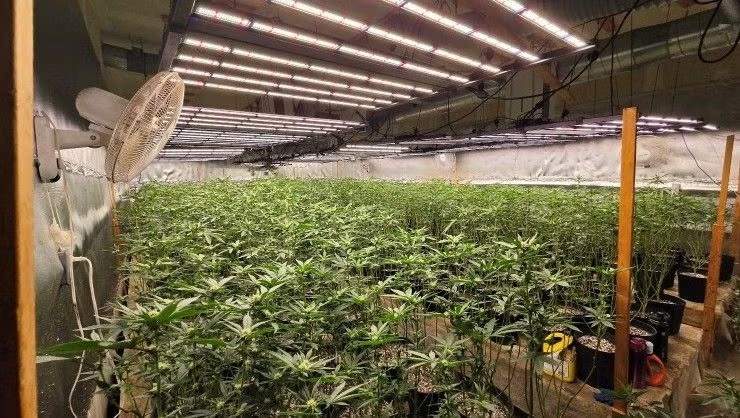
York Regional Police just pulled $7.5 million worth of illicit narcotics off the streets, arresting 23 people and laying 90 criminal charges in a sweep that stretched across the Greater Toronto Area. While local press releases celebrate the raw dollar value of the haul, the real story lies in the logistics. Suburban municipalities north of Toronto are no longer quiet bedroom communities insulated from organized crime; they have become critical warehousing and distribution hubs for transnational drug networks.
Press conferences after major takedowns follow a predictable script. Police line up bricks of white powder, stacks of seized cash, and an assortment of firearms on folding tables draped in departmental banners. Reporters jot down the street value, transcribe quotes about community safety, and file the copy before the afternoon deadline. That surface-level reporting misses the structural reality of how modern narcotics move through Southern Ontario. When 23 suspects face 90 charges simultaneously, you are not looking at a corner-store operation or a loose collection of street-level dealers. You are looking at an integrated corporate supply chain operating out of suburban garages, storage lockers, and residential basements.
The Geography of Suburban Narcotics
For decades, law enforcement treated drug trafficking in the Greater Toronto Area as a core-to-periphery problem. Product entered the downtown core, moved through dense urban housing corridors, and trickled outward to the suburbs in small, user-level quantities. That model is dead.
York Region sits directly astride Highway 400 and Highway 401, the primary arterial veins connecting the border crossings at Windsor, Sarnia, and Niagara to the rest of Eastern Canada. Traffickers figured out years ago that renting a detached home in Vaughan, Markham, or Richmond Hill offers far better operational security than operating out of a downtown condo with concierge desks and pervasive security cameras. In a quiet cul-de-sac, nobody notices a rotation of rental SUVs pulling into an attached garage at two in the morning. Neighbors keep to themselves. Municipal bylaws keep lawns manicured and eyes averted.
The $7.5 million valuation attached to this recent York Regional Police seizure tells a specific story about inventory management. Street-level crews do not hold seven figures of product in one place. Holding that kind of volume requires stash houses, repackaging facilities, and dedicated couriers who never interact directly with end users. By targeting the middle tier of the network—the stash house operators, the pill pressers, and the regional distributors—investigators disrupted a logistical node rather than just sweeping up replaceable street corners.
How Law Enforcement Counts to Seven Million
Public skepticism toward police drug valuations is entirely justified, and anyone covering crime beats for more than a week knows why. Law enforcement agencies calculate "street value" by taking the total weight of a bulk seizure and multiplying it by the highest possible retail price of a single gram sold on the street.
If police seize ten kilograms of cocaine, they rarely value it at its wholesale brick price—which fluctuates depending on purity and supply chain friction—but instead calculate what those ten thousand grams would fetch if broken down into individual point-gram baggies at a nightclub. This accounting method inflates the headline number. A wholesale load worth $500,000 in bulk cash suddenly becomes a multi-million-dollar victory on the evening news.
Does that mean the York Region bust was insignificant? Not at all. Even if you strip away the retail markup and calculate the wholesale replacement cost, losing millions of dollars in inventory creates a massive liquidity crisis for the syndicate behind it. Organized crime runs on credit. High-level importers front kilograms of cocaine, methamphetamine, or fentanyl to regional distributors on consignment, expecting payment once the product moves downstream. When police kick down the door and seize the inventory before it hits the street, the debt remains. The distributors on the hook for those 90 charges now owe money to people who do not accept bankruptcy filings.
The Anatomy of 90 Criminal Charges
Ninety charges spread across 23 individuals averages out to roughly four charges per suspect. In Canadian criminal law, that ratio points directly to possession for the purpose of trafficking, conspiracy, proceeds of crime, and weapons offenses.
A standard possession charge is simple to prove and easy to plead out. Conspiracy and trafficking charges require months of surveillance, judicial authorizations for wiretaps, and tracking devices slapped onto the undercarriages of suspect vehicles. You do not generate 90 charges from a lucky traffic stop on Highway 7. That volume of paperwork indicates a multi-month project—likely involving joint-forces operations with provincial or federal units—designed to map the entire hierarchy before making a single arrest.
The timing of these mass takedowns is always a delicate calculation for investigators. Wait too long, and a toxic batch of fentanyl hits the streets, killing dozens of users and turning a narcotics investigation into a homicide probe. Move too early, and you catch the runners with a few ounces while the financiers walk away untouched. Arresting 23 people simultaneously suggests police waited until a major shipment arrived at the stash houses, maximizing both the evidentiary haul and the disruption to the network's cash flow.
The Fentanyl and Synthetic Shift
To understand why suburban police forces are pouring millions of dollars into specialized intelligence units, you have to look at the changing chemistry of the drug trade. Traditional plant-based drugs like heroin and cocaine require massive agricultural footprints in South America or Asia, followed by complex maritime smuggling routes. Synthetic drugs—specifically fentanyl, crystal methamphetamine, and counterfeit prescription pills—have completely altered the economics of trafficking.
A single kilogram of pure fentanyl, easily concealed inside a standard courier parcel or a hidden vehicle compartment, can be cut with caffeine or benzodiazepines to produce hundreds of thousands of lethal doses. The profit margins are astronomical, and the physical footprint required to store the product is tiny. A suburban basement in York Region can house enough synthetic narcotics to supply an entire province for months.
This shift has also blurred the lines between traditional organized crime groups. Historically, territories in Ontario were divided along rigid ethnic or organizational boundaries. Today, profit overrides tribalism. Outlaw motorcycle gangs, street gangs from Toronto's inner suburbs, and transnational syndicates regularly share supply chains, money laundering networks, and stash houses. When 23 suspects are swept up in a single York Region project, the arrest roster rarely reflects a single monolithic gang; it usually reads like a cross-section of Southern Ontario's entire underworld ecosystem.
The Illusion of the Knockout Blow
Every major drug bust generates a brief surge of optimism among local politicians and residents. The press releases imply that cutting off a $7.5 million supply line will dry up the local market and drive down crime rates. History proves otherwise.
The illicit drug market operates with ruthless efficiency. Within 48 hours of a major police sweep, rival crews are already moving into the vacuum, texting the customer lists of the arrested dealers and offering discounted rates to capture market share. Wholesale suppliers in Montreal or Vancouver simply reroute their next shipment to a different set of couriers in a neighboring municipality—Peel, Durham, or Halton.
This is the fundamental contradiction of modern drug enforcement. Police forces are measuring success through supply-side metrics—kilograms seized, guns recovered, charges laid—while demand remains entirely untouched. Until addiction treatment, mental health infrastructure, and economic desperation are addressed with the same urgency and funding as tactical policing, tactical units will continue kicking down doors in quiet neighborhoods every six months.
What Happens Next in the Courts
Securing 90 charges is the easy part; getting convictions in Ontario's overburdened court system is another matter entirely. Under the Supreme Court of Canada's Jordan decision, criminal cases in superior courts must be resolved within 30 months from the time charges are laid to the end of the trial. If the prosecution drags its feet, defense attorneys will file motions to have the charges stayed entirely, allowing accused traffickers to walk free without a verdict.
Complex, multi-accused drug prosecutions are notorious for bogging down in pre-trial disclosure battles. Defense lawyers will scrutinize every warrant, every wiretap authorization, and every hour of police surveillance looking for Charter violations. If an investigator cut a corner while obtaining a search warrant for one of those York Region stash houses, a judge can exclude the physical evidence entirely. Without the drugs and the cash admitted into evidence, the Crown's case collapses.
Prosecutors will likely spend the next year sorting the 23 suspects into tiers. Low-level couriers and stash-house sitters will be offered plea deals in exchange for reduced sentences, clearing the docket so the Crown can focus its resources on the primary organizers. Some of the accused will post bail within days and return to the exact same networks, forced back into the trade to pay off the legal fees and the lost wholesale product owed to their suppliers.
The $7.5 million laid out on tables at York Regional Police headquarters represents months of meticulous detective work and real danger for the officers executing the warrants. It is a genuine operational victory. Yet anyone who believes it marks the end of suburban drug trafficking is ignoring the basic math of supply and demand. The houses in York Region are still quiet, the highways are still open, and another shipment is already on the road.