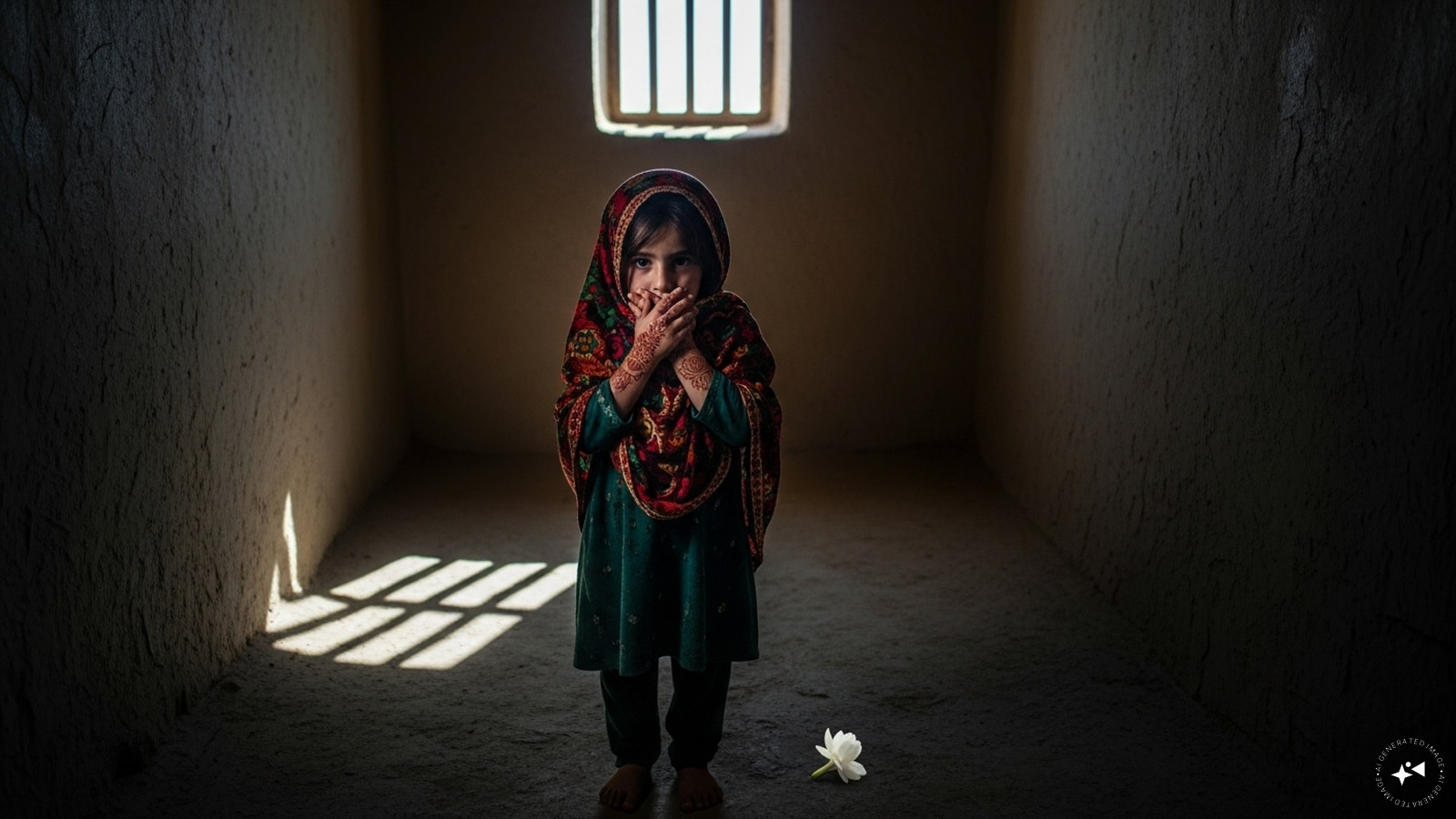
The Taliban government in Afghanistan has legally codified a new family law decree that effectively formalizes child marriage and systematically dismantles the remaining legal protections for women and girls. The 31-article document, titled the Principles of Separation Between Spouses, was signed into law by supreme leader Hibatullah Akhundzada and published via the official gazette. It strips away the country's historical minimum marriage age by linking marital readiness directly to puberty, establishing a framework where the silence of a virgin girl is legally interpreted as consent.
While international headlines focus on the surface-level shock of the text, the deeper reality reveals a calculated effort to institutionalize gender-based control while using traditional jurisprudence to insulate the regime from economic and diplomatic pressure. This is not merely a regression to medieval governance. It is a structured legal strategy designed to replace civil statutory rights with absolute judicial discretion, shifting power entirely to male guardians and Taliban-controlled religious courts.
The Strategy of Codified Coercion
For decades, Afghanistan’s 1977 Civil Code set the legal age of marriage at 16 for girls, while subsequent legislation criminalized the marriage of minors under 15. The new decree erases these numerical baselines completely. By replacing a fixed chronological age with the physiological milestone of puberty, the law permits the marriage of children as young as nine.
The most alarming mechanism within the text rests in Article 7, which dictates that the silence of a virgin girl after reaching puberty is sufficient to constitute legal consent to a marriage contract. Conversely, the law explicitly states that the silence of a boy or a previously married woman does not equal consent. In a societal structure where young girls are culturally conditioned not to speak back to male elders, interpreting silence as compliance acts as a legal rubber stamp for forced unions.
The law attempts to project an image of judicial fairness by maintaining the classical Islamic concept of khiyar al-bulugh, or the "option upon puberty." This mechanism theoretically allows a child whose marriage was arranged by relatives other than her father or grandfather to petition a court for an annulment once she matures.
The reality on the ground renders this protection hollow. To dissolve the union, the young girl must successfully navigate a state-run religious court staffed exclusively by Taliban judges. If she approaches a judge to demand a divorce and her husband objects, the law explicitly notes that without external witnesses, the husband's word carries ultimate legal validity. A child bride, isolated within a domestic household and stripped of mobility, faces an impossible evidentiary hurdle.
The Economic Necessity of Child Commodities
To understand why the Taliban is codifying these rules now, one must look at the collapsing Afghan economy rather than just its fundamentalist ideology. Since the withdrawal of foreign forces in 2021, the country has faced catastrophic poverty, hyperinflation, and the near-total withdrawal of international development aid.
Families are starving. In this environment, a daughter is increasingly viewed through a lens of economic survival. The traditional practice of toyana—a dowry or bride price paid by the groom’s family to the bride’s father—has transformed from a cultural custom into an emergency financial transaction.
The new law facilitates this economic safety valve for desperate patriarchs. It confirms that fathers and paternal grandfathers possess unilateral, sweeping authority to arrange the marriages of minors. While the text states that a marriage can be ruled invalid if a guardian gives a girl away without an appropriate dowry, this provision does not protect the child. It protects the financial interests of the male head of household, ensuring that daughters are not undervalued when exchanged.
By legally validating these transactions, the regime eases the extreme economic pressure on rural households without spending a single afghani from the state treasury. The systematic exclusion of girls from education beyond the sixth grade further accelerates this pipeline. With no classrooms to attend and no legal pathways to employment, adolescent girls are left idle at home, converting them from students into financial liabilities that families seek to offload as quickly as possible.
The Weaponization of Judicial Separation
The text of the decree focuses heavily on the "separation of spouses," yet its provisions create a deeply uneven legal landscape that traps women in abusive environments. The law grants Taliban judges wide latitude to intervene in marital disputes under rigid religious categories, utilizing imprisonment and physical punishment to enforce compliance.
Simultaneously, the legal framework for a woman seeking to escape domestic violence has been thoroughly dismantled. Under the new guidelines, standard domestic abuse does not automatically qualify as valid grounds for judicial separation. Separate regulations issued alongside the family code clarify that a husband is only deemed an offender if his physical punishment results in broken bones, open wounds, or severe visible bruising. Anything less is treated as permissible domestic correction.
If a woman flees an abusive home without judicial approval, she is categorized as an insurgent against her husband’s legal guardianship. The state courts function not as an independent judiciary, but as an enforcement mechanism for patriarchal authority. A wife who cannot prove catastrophic physical injury to a skeptical judge is ordered back to the marital home, frequently facing retributive violence with zero state recourse.
The Failure of International Leverage
The global community has responded to the decree with familiar expressions of grave concern. The United Nations Assistance Mission in Afghanistan warned that the code further entrenches a system that denies women autonomy and access to justice. Human rights organizations have renewed calls to classify the regime's policies as gender apartheid under international law.
These rhetorical tools have lost their teeth. The Taliban leadership operates on a internal logic that prioritizes ideological purity and domestic control over international recognition or seat allocation at the UN. Sanctions and asset freezes have successfully crippled the general population, but they have failed to alter the policy trajectory of the leadership in Kandahar.
External actors possess very few real points of leverage left. Western isolation has merely pushed the regime closer to regional powers like China, Russia, and neighboring Central Asian states, which prioritize security, mineral resources, and regional stability over the domestic human rights landscape. By normalizing these hard-line legal frameworks locally, the Taliban is signaling to its conservative base that it will not compromise its domestic agenda for foreign aid, cementing its internal power structure at the direct expense of the nation’s youth.