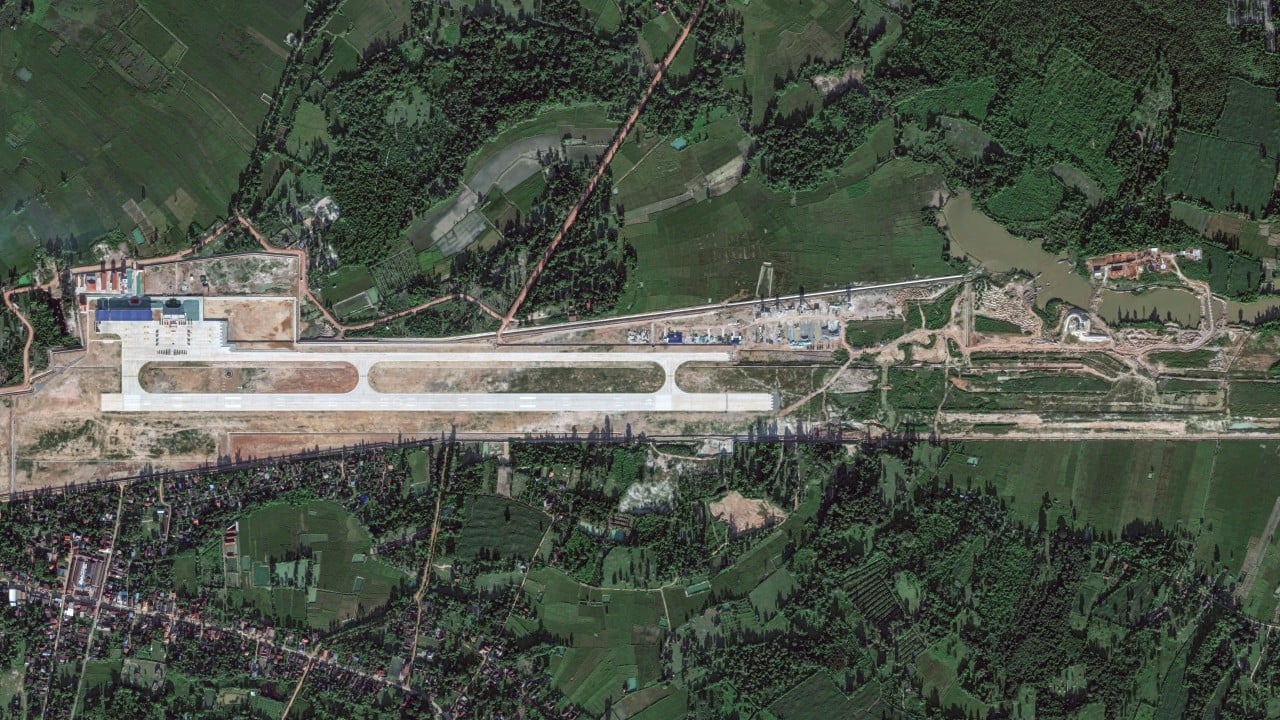
Commercial satellite imagery rarely lies, but it often arrives with a lag that defense analysts spend years trying to outrun. When fresh overhead captures began revealing a sudden surge of heavy construction equipment and rapid tarmac extension in Vientiane Province, Laos, intelligence circles did not have to guess at the architect. By late September, Beijing and Vientiane officially inaugurated the Ban Keun Joint Support and Training Center, breathing new life into a dilapidated strip originally cleared during the Vietnam War era. For Beijing, the installation marks a quiet yet critical milestone: the establishment of its third acknowledged overseas military facility, and only its second direct foothold in mainland Southeast Asia following the contentious developments at Cambodia's Ream Naval Base.
The primary question rippling through defense ministries from Hanoi to Washington is no longer whether Chinese military aircraft are utilizing Ban Keun, but rather what permanent operational capability this airfield represents. Publicly framed by both governments as a bilateral training hub intended to sharpen the mechanical and tactical competencies of Lao military pilots, the structural footprints on the ground tell a more complex story. High-resolution pans reveal an extended runway stretching approximately 2,000 meters, newly erected aircraft hangars, and dedicated aprons capable of accommodating light attack and jet trainer platforms like the K-8 (JL-8).
The Geography of Strategic Creep
To understand why a modest airfield thirty miles north of the Lao capital has drawn outsized anxiety, one must look at the physical map of the Mekong subregion. Laos is landlocked, heavily indebted to its northern neighbor, and governed by a one-party state that shares a deep ideological and economic embrace with Beijing. For years, China’s projection of military power into maritime Southeast Asia was constrained by geography and diplomatic pushback from littoral states embroiled in South China Sea territorial disputes.
Ban Keun changes the vector of approach. While Beijing already maintains sophisticated air bases in its own southern provinces that outrange any tactical asset stationed in Laos, an inland facility creates an entirely different tier of strategic depth. It provides the People's Liberation Army Air Force with a dry-land staging post that sits outside the immediate maritime flashpoints, yet close enough to project influence across the Indochinese peninsula. Analysts monitoring the site note that while permanent combat aircraft deployments have not been officially codified, the infrastructural capacity for rapid forward staging, logistics relay, and electronic surveillance is already baked into the concrete.
This is textbook infrastructure-led diplomacy. Much like the developments in Cambodia, the operational roadmap relies on dual-use justifications that make regional pushback diplomatically awkward for ASEAN members. Vientiane gets a modernized aviation academy and upgraded security ties, while Beijing acquires an institutionalized presence that normalizes the footprint of foreign military personnel on sovereign soil outside its borders.
The Regional Silent Alarm
Neighboring Vietnam is watching these developments with profound unease. Hanoi shares a long, porous border with Laos and fought a historic war of influence alongside Vientiane, making the quiet intrusion of Chinese military architecture into its immediate western strategic buffer an acute security concern. Yet, because the facility is framed as a bilateral arrangement between two sovereign nations, Vietnam’s diplomatic options are severely narrowed. Public protests risk alienating Vientiane further into Beijing's economic orbit, while silent acquiescence normalizes a southern flank that is increasingly vulnerable to Chinese intelligence collection.
To the east, the Philippines and other South China Sea claimants see Ban Keun as another brick in a regional wall. Even if the airfield does not immediately house heavy strategic bombers or advanced stealth fighters, it expands the grid of potential communication nodes, radar installations, and logistical corridors available to the PLA. In modern aerial warfare, a secondary runway with secure hangars does not need to host an entire fighter brigade to be useful; it only needs to serve as an alternate dispersal field, a maintenance stop, or a staging point for drone operations during a crisis.
The Limits of Projection
Despite the strategic optics, seasoned regional observers urge caution against overstating the immediate tactical threat. The base at Ban Keun is modest in scale compared to the fortified island installations in the South China Sea or major domestic bases on the Chinese mainland. The local infrastructure in Laos remains fragile, and the logistical supply lines running south from Yunnan face severe geographic and transit bottlenecks during seasonal monsoons.
Furthermore, Vientiane remains fiercely protective of its formal independence, even as its economic gravity shifts northward. Lao leadership has historically mastered the art of balancing larger patrons, and inviting a permanent, unmitigated Chinese military garrison risks drawing the country too deeply into great power competition against its long-term interests. The joint training designation is deliberately chosen to preserve political deniability for Vientiane, ensuring that the facility remains an ambiguous asset rather than an outright foreign sovereign base.
The evolution of Ban Keun will ultimately be measured not by the initial batch of training aircraft spotted parked on its tarmac, but by the frequency of rotations, the complexity of supporting infrastructure added over the next fiscal cycle, and the degree of integrated command-and-control sharing between the two militaries. Beijing has secured its foothold in the Laotian interior, altering the strategic calculus of mainland Asia without firing a single shot.


