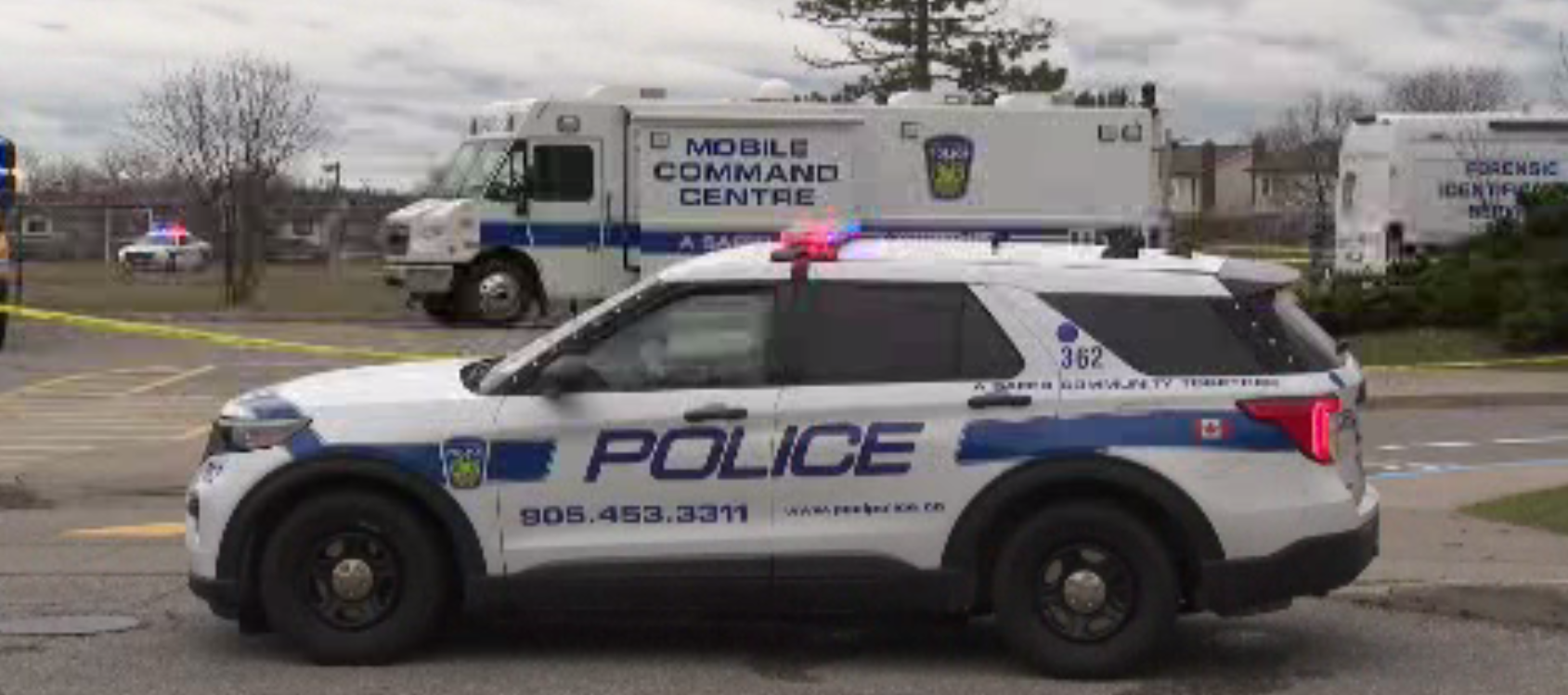
Two people are dead after gunfire erupted during an altercation on the grounds of St. Joachim Elementary School in Brampton late Friday night. Peel Regional Police officers responded to reports of shots fired at around 10:23 p.m. in the area of Rutherford Road and Weybridge Trail. They arrived to find a man in his 20s and a male youth with fatal gunshot wounds. Both were pronounced dead at the scene. This was not a random act of violence. Investigators stated that the incident appears to be a targeted shooting involving several individuals who engaged in a physical dispute before firearms were discharged.
The standard media playbook for suburban violence follows a predictable, tired loop. A yellow tape goes up, a police spokesperson offers a measured soundbite about a "targeted incident," and the cameras pack up. This surface-level reporting fails to address the rot underneath.
What happened at St. Joachim is not an isolated flashpoint. It is the natural consequence of a much larger, quieter crisis unfolding in the Greater Toronto Area. We are witnessing the aggressive migration of urban turf disputes into sleepy, ill-equipped suburban corridors.
The Illusion of Suburban Safety
For decades, families moved to places like Brampton to escape the perceived volatility of the urban core. They bought into a promise of quiet streets and safe schoolyards. That promise has been broken.
When a schoolyard becomes a double-homicide scene, the geographical boundaries of safety have effectively collapsed. Street gangs and organized criminal factions no longer respect the traditional boundaries of the city. Suburban municipalities offer something the dense urban core does not: vast, sprawling networks of residential streets, dark parking lots, and schools that sit empty and unmonitored for long stretches of the night.
These public spaces have become neutral ground for disputes that originate elsewhere. The school yard was not the target because of the school itself. It was chosen because it was dark, accessible, and lacked the dense camera networks or active foot traffic of a downtown intersection.
The Escalation of the Altercation
Police reported that an altercation took place among a group of individuals before the weapons were drawn. This detail exposes a terrifying shift in the mechanics of street violence.
Historically, physical altercations resulted in bruises or, at worst, isolated assaults. Now, the baseline response to a verbal or physical dispute among certain criminal elements is immediate, lethal escalation. The presence of firearms in the hands of young men has turned routine friction into a body count.
The flow of illegal firearms across the border and into suburban communities has reached a critical volume. Handguns are light, easily concealable, and treated as necessary accessories by individuals operating on the fringes of the law. When a group of people meet late at night to settle a score or hash out a dispute, the probability that someone is armed is no longer an outlier. It is the expectation.
We are not dealing with a sudden spike in human rage. We are dealing with an unprecedented saturation of illegal hardware that ensures any flash of rage is permanent and fatal.
The Silence of the Witnesses
In the hours after the shooting, Peel police canvassed the neighborhood, knocking on doors and asking for dashcam or security footage. The suspects had already fled, and investigators admitted they did not know whether the perpetrators left on foot or in a vehicle.
This information gap points to the second pillar of the suburban crime crisis: the wall of silence.
Suburban neighborhoods are not tight-knit communities in the traditional sense. People pull into their garages, close the doors, and live isolated lives behind brick facades. When violence erupts on their doorstep, the instinct is to hunker down rather than get involved. This lack of active community eyes and ears makes these areas highly attractive for illicit activity.
Furthermore, a deep-seated fear of retaliation keeps those who do know something from speaking up. The "targeted" nature of these crimes suggests that the players involved know exactly who they are dealing with. If you are a neighbor who saw a license plate, the risk of reporting it often feels heavier than the civic duty to do so. Law enforcement is left attempting to piece together chaotic crime scenes with minimal cooperative testimony.
A Failed Strategy of Reaction
The current municipal and regional approach to suburban gun violence is fundamentally reactive. Police arrive after the bodies are on the ground. They secure the perimeter, collect the shell casings, and make appeals to the public.
This model is failing.
True intervention requires shifting the focus from the crime scene to the pipeline. We must address how illegal firearms are flowing into these specific postal codes with such ease. We must look at the lack of youth engagement and economic resources in rapidly growing suburban hubs that leave young men vulnerable to the pull of organized crime.
Brampton is one of the fastest-growing cities in Canada, yet its social infrastructure has not kept pace with its population boom. When you build massive swaths of residential housing without equivalent investments in community spaces, employment networks, and specialized youth outreach, you create a vacuum.
The blood on the pavement at St. Joachim Elementary is a grim reminder that we are running out of time to fill that vacuum. The city cannot simply police its way out of this.
If we continue to treat these events as isolated tragedies or mere "altercations" that got out of hand, we are willfully ignoring the systemic shift happening right in front of us. The suburbs are no longer a refuge from violent crime. They are the new front lines.
Peel police have urged anyone with information, surveillance video, or dashcam footage from the area of Rutherford Road and Weybridge Trail on Friday night to contact the Homicide Bureau immediately.


