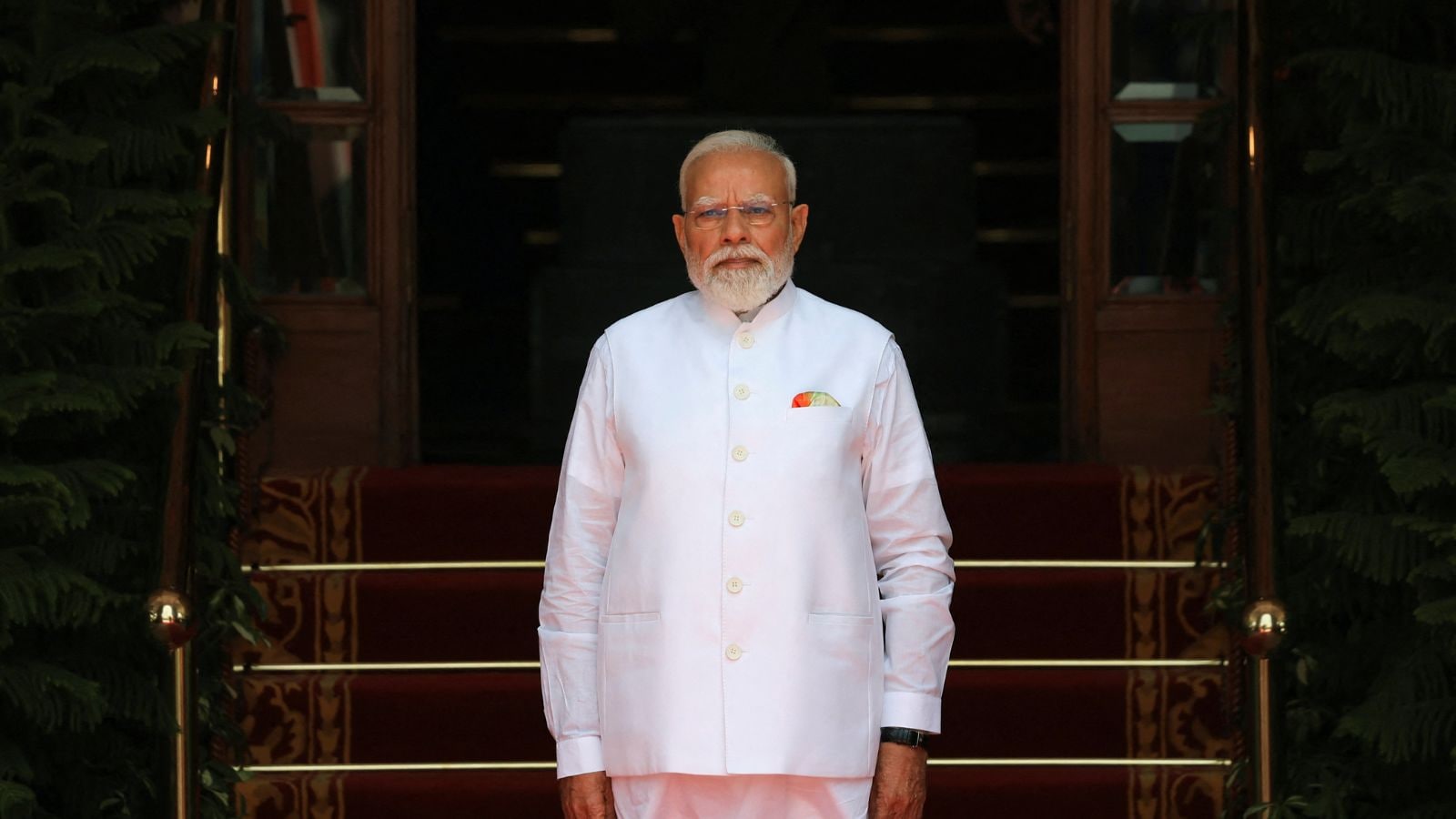
The architecture of international finance resembles a rusting imperial fortress, and New Delhi is currently attempting to redraw its blueprints from the inside. At the eighteenth annual summit hosted at Bharat Mandapam, Indian Prime Minister Narendra Modi targeted the existing global order with a stark spatial metaphor. He likened contemporary multilateral governance to a rigid pyramid. Power, voting rights, and structural privilege remain trapped at the narrow peak, while the nations sustaining global economic output are relegated to the bottom tiers, forced to absorb shocks they never authorized.
This critique arrives as the expanded BRICS bloc—now incorporating heavyweights such as Saudi Arabia, the United Arab Emirates, Iran, and Indonesia alongside founding members—celebrates its twentieth anniversary. Yet this institutional coming-of-age is shadowed by deep operational friction. The grouping is no longer a loose assembly of emerging markets trading polite communiques. It represents a massive economic bloc attempting to transition from rhetoric to financial muscle. Modi's push for institutional reform is not merely an ideological exercise in post-colonial grievance. It is a calculated strategy to translate actual GDP output and trade volume into concrete voting shares within the International Monetary Fund, the World Bank, and the United Nations Security Council.
The mechanics of international rule-making have long favored Western capitals that wrote the post-World War II rulebook. Voting weights inside Bretton Woods institutions continue to undervalue the economic weight of the Global South. For instance, despite collective output shifts over the past two decades, European nations retain disproportionate board representation compared to rapidly expanding Asian and African economies. Modi introduced a three-pillar framework of representation, responsiveness, and rule-making to challenge this imbalance. He insisted that the reform of the United Nations Security Council can no longer be deferred behind endless procedural delays, demanding strict timelines and measurable outcomes.
Beneath the diplomatic handshakes and official declarations, however, lies an inherent tension that official communiques consistently gloss over. BRICS is not a monolithic ideological block. It houses fierce geopolitical rivals and divergent economic models. Beijing pursues an aggressive, state-backed export-led strategy designed to absorb industrial overcapacity, frequently clashing with New Delhi’s imperative to protect domestic manufacturing through targeted tariffs and local supply chain incentives. Meanwhile, energy giants like Russia and Saudi Arabia operate within entirely different pricing and sanctions realities than net importers such as India.
To bypass these internal friction points, India utilized its 2026 chairship to introduce structural continuity mechanisms, including a Troika system and a secure digital repository designed to track the implementation of bloc decisions. For years, BRICS suffered from an annual rotation curse where momentum evaporated the moment a host nation handed over the gavel. Every twelve months, priorities shifted, previous resolutions faded into archives, and concrete follow-ups stalled. By proposing a permanent repository and institutional memory framework, New Delhi is attempting to transform a cyclical talk-shop into a permanent administrative apparatus.
The economic imperative driving this administrative tightening is rooted in vulnerability. Western sanctions regimes, weaponized SWIFT banking exclusions, and sudden tariff adjustments by traditional Western trading partners have forced developing economies to seek alternative settlement architectures. Discussions at the New Delhi summit intensively covered cross-border payment linkages and the expanded utilization of national currencies. While a unified BRICS currency remains a distant and technically improbable aspiration given the disparate monetary policies of member states, bilateral trade settlements conducted in local currencies have grown significantly.
Consider a hypothetical transaction between an Indian manufacturer and a Brazilian raw material supplier settling accounts directly in rupees and reals. This mechanism bypasses traditional correspondent banking corridors rooted in New York or London, reducing transaction costs and insulating trade flows from foreign exchange volatility tied strictly to Western monetary tightening cycles. Yet, scaling this from bilateral deals to a multilateral clearing house exposes deep technical hurdles. Central banks in authoritarian states lack the capital account convertibility and market transparency required to make their currencies universally trusted units of account.
Beyond high finance, India used the 2026 summit to push practical cooperation into domains that directly impact ordinary citizens across the Global South. Modi proposed a Seafarers Emergency Support Network to coordinate maritime security, medical aid, and rapid evacuation protocols across critical shipping lanes. With major trade routes frequently disrupted by geopolitical conflicts in the Middle East and the Red Sea, institutionalizing maritime safety mechanisms provides an immediate, tangible benefit for member states dependent on uninterrupted supply chains.
Similarly, the rollout of the BRICS Startup Innovation Fund and incubator networks targets the technology divide. Critical technologies—spanning artificial intelligence, biotechnology, cyber governance, and outer space—are currently governed by rules drafted by Western technology monopolies. By fostering cross-border digital corridors and startup incubators among member countries, the bloc is attempting to establish alternative standards for data governance and digital trade before Western regulatory frameworks lock in global compliance.
The success of these initiatives depends entirely on whether member states can subordinate short-term bilateral disputes to long-term structural leverage. Bilateral friction along contested borders, such as the Line of Actual Control between India and China, casts a long shadow over multilateral ambitions. Normalizing diplomatic and economic ties remains a prerequisite for any unified stance against Western-dominated financial institutions. When leaders like Xi Jinping and Vladimir Putin sit across the table in New Delhi, the discussions extend far beyond shared anti-Western sentiments; they involve hard bargaining over market access, energy supply security, and technological sovereignty.
The traditional global order is unlikely to yield its privileges voluntarily. Incremental adjustments to voting quotas at the International Monetary Fund have historically moved at glacial speeds, tokenistic concessions designed to stave off systemic defection rather than distribute real power. By establishing rigid timelines, demanding quantifiable representation metrics, and building independent institutional machinery, the 2026 summit has shifted the terms of engagement. The Global South is no longer asking for a seat at a pre-set table. It is drafting specifications for an entirely separate foundation.