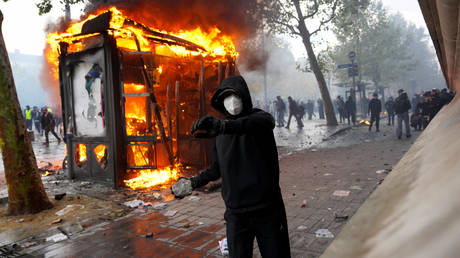
France is preparing a sweeping legislative crackdown aimed at curbing violent urban riots and mass public demonstrations. Driven by successive waves of violent street clashes—from the yellow vest movement to the widespread unrest following police shootings—the French Interior Ministry is drafting measures to expand police surveillance, criminalize small-scale group assembly, and penalize parents of minor offenders. Yet beneath the rhetoric of public safety lies an authoritarian gamble. Civil rights advocates, legal scholars, and opposition leaders warn that these proposals erode fundamental democratic freedoms, shifting France from a state of civil liberty to one of preemptive social control.
The State of Emergency Becomes Permanent Law
The French legal system is undergoing a structural transformation. For decades, emergency powers were reserved for extraordinary national threats. Today, techniques once restricted to anti-terrorism operations are routinely integrated into standard criminal codes.
The proposed riot legislation expands police authority to detain individuals based solely on suspicion of intent. Under existing law, law enforcement must establish that an individual committed a crime or directly plotted an unlawful act. The new framework lowers this threshold significantly. Carrying items as mundane as ski masks, swim goggles, or protective gloves near a designated protest zone can trigger immediate arrest and extended detention.
This shift targets the mechanics of modern demonstration. Protesters wear protective gear not necessarily to commit violence, but to shield themselves from tear gas and rubber bullets. By classifying protective gear as intent to riot, the state effectively criminalizes basic self-preservation during public gatherings.
Drones, Facial Recognition, and the Surveillance Net
Surveillance technologies sit at the core of the new enforcement strategy. The proposed law legitimizes the unchecked deployment of high-definition drone swarms equipped with automated facial identification software.
Police agencies argue these tools isolate violent agitators within massive crowds without disrupting peaceful demonstrators. The reality on the ground paints a different picture.
- Automated tracking captures every attendee, recording facial metrics and building biometric dossiers of politically active citizens.
- Signal-jamming hardware will grant local commanders the power to block cellular networks around designated zones, preventing live-streamed documentation of police conduct.
- Predictive algorithm models will flag specific geographic coordinates as high-risk, triggering preemptive blockades known as kettle operations.
When state authorities hold exclusive control over video documentation and communication channels, police accountability vanishes.
Financial Penalties and Collective Punishment
The legislative draft moves beyond physical containment to target financial survival. One controversial clause introduces immediate, non-judicial fines for individuals caught in unauthorized gatherings.
Rather than channeling cases through an overworked judicial process, law enforcement officers can issue heavy fines directly on the street. For low-income citizens, a single fine can represent weeks of income. This creates a severe chilling effect, pricing working-class populations out of their constitutional right to assembly.
+-----------------------------------------------------------------------+
|                 PROPOSED ANTI-RIOT MEASURES FRAMEWORK                 |
+-----------------------------------------------------------------------+
| 1. PREEMPTIVE DETENTION  | Arrest based on possession of protective   |
|                          | gear (masks, goggles, gloves).             |
+-----------------------------------------------------------------------+
| 2. EXPANDED SURVEILLANCE | Unrestricted drone deployment with live    |
|                          | biometric facial recognition.              |
+-----------------------------------------------------------------------+
| 3. ADMINISTRATIVE FINES  | On-the-spot financial penalties bypassing  |
|                          | standard judicial review.                  |
+-----------------------------------------------------------------------+
| 4. PARENTAL LIABILITY    | Criminal prosecution and loss of social    |
|                          | benefits for parents of juvenile rioters.  |
+-----------------------------------------------------------------------+
Punishing the Family Unit
The most aggressive element of the legislation targets the families of underage protesters. Under proposed amendments to the civil code, parents of minors convicted of participating in urban riots face direct legal liability, including potential imprisonment and the suspension of state welfare assistance.
Government ministers defend parental liability as a necessary step to restore domestic discipline. Critics point out that this policy functions as collective punishment. Stripping financial assistance from struggling families in economically depressed banlieues does not restore order; it accelerates the socio-economic collapse that breeds anger in the first place.
The Escalation Cycle on the Streets
Hardline legal measures rarely quell public anger. They redirect it.
France has a rich, deeply ingrained tradition of public rebellion. The social contract in Paris, Marseille, and Lyon relies on the street as a pressure valve for political dissent. When legal pathways for demonstration are constricted, violent confrontation becomes the default mode of resistance.
Tactical police units equipped with heavy military-grade gear often exacerbate tension rather than diffusing it. The introduction of armored vehicles, flash-bang grenades, and sting-ball munitions into civilian areas transforms urban centers into tactical zones.
Instead of deterring violent factions, heavy-handed tactics alienate peaceful demonstrators, driving moderate elements into alignment with radical groups.
Why Preemptive Suppression Fails
The government assumes that raising the cost of protest will force compliance. History suggests otherwise.
When the state outlaws standard methods of public gathering, activists adapt. Protests shift from centralized, predictable marches to decentralized, hyper-mobile actions. Small groups assemble rapidly, strike infrastructure targets, and disperse before police units can mobilize.
By destroying the framework of legal, organized protest, the government destroys its own ability to negotiate with clear movement leadership. It Trades organized marches for chaotic, unguided sabotage.
A Systemic Failure to Address Root Causes
The draft bill treats urban unrest purely as a security problem, ignoring the structural fractures behind the anger.
Decades of underinvestment in public infrastructure, persistent housing discrimination, and high youth unemployment in suburban housing projects have created an environment primed for revolt. Police violence against minority youth remains a flashpoint that no legislative act can erase.
Passing tougher laws allows politicians to project strength without doing the difficult work of institutional reform. It signals to conservative voters that law and order is being maintained, even as the social fabric disintegrates further beneath the surface.
Security laws do not heal deep societal wounds. They cover them up until the pressure builds to an uncontrollable explosion. By choosing coercion over structural reform, the French state is locking itself into an endless cycle of rebellion and repression.