US President Donald Trump confirmed that he was secretly moved to an alternative military aircraft following the NATO summit in Ankara, Turkey, utilizing an airport catering truck as part of an elaborate security ruse. The operation was initiated by the Secret Service and the military due to a credible threat targeting his travel.
Security logistics at the highest levels of government rarely mirror public perception. When a head of state travels, public arrivals and departures are often choreographed spectacles designed to project routine and stability. Beneath that surface lies a web of constant threat assessments, contingency plans, and deception operations that most citizens never witness. The recent confirmation by Trump regarding his clandestine departure from Turkey exposes the operational realities of protecting a commander-in-chief in a volatile geopolitical climate. Also making headlines in this space: Why North Korea Keeps Firing Missiles Right Before US South Korea Drills.
Anatomy of an Airfield Deception
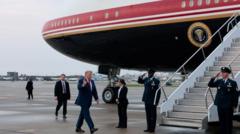
The sequence of events during the departure from Ankara involved layers of misdirection. Trump initially boarded the legacy blue-and-white Boeing serving as Air Force One in plain view of television cameras and the traveling press pool. Journalists and several White House staff members settled in, operating under the assumption that the president was aboard the aircraft.
Moments after clearing the entryway, the reality of the movement shifted. According to accounts detailed by The Washington Post and corroborated by administration officials, an airport catering truck equipped with hydraulic lifts was positioned on the opposite side of the aircraft. Trump and select aides exited the primary jet through a side door directly into the enclosed container of the service vehicle. Additional insights into this topic are detailed by The Guardian.
From there, he was transported across the tarmac away from public view and transferred to a smaller Air Force C-32A military jet, a modified Boeing 757 typically reserved for government officials. Meanwhile, the original aircraft functioned as a high-profile decoy, carrying the press corps and staff toward a stop in Britain while the actual target of the security operation traveled on a separate flight path.
Evaluating the Threat Environment
The catalyst behind the extraordinary protocol was intelligence pointing toward a potential threat originating from Iran. Intelligence agencies from allied nations had flagged risks surrounding the president's aerial transit through regional airspace, prompting the Secret Service to alter transit arrangements at the eleventh hour.
President Trump addressed the operational shift after returning to the United States, indicating that he deferred entirely to the judgment of his security detail.
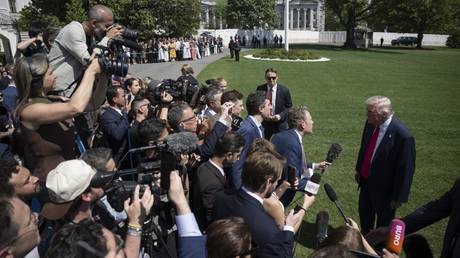
"I go by Secret Service and the military," Trump told reporters. "They wanted me to go on a different flight, a different plane... I do what they say. I guess there was a threat out there. I didn't really ask too much about it. I get a lot of threats."
When questioned about the relative danger of the decoy plane versus his actual transport, Trump offered a counterintuitive assessment of the risk distribution. He suggested that the aircraft left carrying the decoy profile might have faced heightened exposure because it matched the expected signature of a presidential flight.
Historical Precedent for Airfield Shell Games
Deception operations involving presidential aircraft are uncommon, but they are not entirely unprecedented in modern political history. Security architects lean heavily on operational security when traveling through regions with active hostilities or known threats.
A comparable logistical maneuver occurred during a presidential visit to Pakistan, when an administration landed in an unmarked executive jet while the traditional official transport remained parked or served alternate routing to obscure the principal's physical whereabouts. The primary objective in these scenarios remains simple: deny adversaries a predictable target profile by fragmenting intelligence continuity during the most vulnerable phase of travel—takeoff and landing.
The use of multi-plane configurations during this specific international trip also drew scrutiny regarding the newly introduced Boeing 747-8 aircraft gifted by Qatar, which Trump had used to fly into the summit before switching to older variants for the return leg. While administration representatives maintained that the Qatari-gifted aircraft underwent strict security upgrades, the convergence of multiple aircraft types during a high-tension diplomatic mission added layers of complexity that security planners had to manage in real time.
Operating under constant threat matrices requires a tolerance for friction, misdirection, and sudden logistical pivots that challenge standard protocols. As global friction points persist, the invisible machinery protecting executive travel will continue to rely on elaborate deceptions far removed from the public eye.
For more global developments and regional updates, check out this World DNA report on YouTube which covers the aircraft switch.
http://googleusercontent.com/youtube_content/1