When federal ministers, senior executives from Ford and Stellantis, and the leadership of Unifor sit down at the same negotiating table, the agenda stretches far beyond routine labor relations or standard corporate tax breaks. This convergence represents an urgent intervention to stabilize North America's electric vehicle supply chain, protect billions in public subsidies, and prevent thousands of Canadian manufacturing jobs from vanishing during an industry-wide transition.
The automotive sector is currently caught in a brutal squeeze. Legacy automakers committed tens of billions of dollars to electrification based on aggressive regulatory timelines and optimistic consumer adoption curves. Now, faced with cooling EV demand, high interest rates, and fierce price competition from overseas, those same companies are quietly hitting the brakes, delaying plant retooling, and rethinking their capital allocation. For Canada, where federal and provincial governments have staked their industrial future on massive battery and assembly subsidies, any retreat by Stellantis or Ford threatens to unravel an entire economic strategy.
The Anatomy of a Four-Way Collision
To understand why these four specific entities are locked in emergency discussions, you have to follow the money and the manufacturing footprint in Southern Ontario. Unlike traditional collective bargaining, where a union faces off against a single employer, this situation involves interlocking dependencies that bind competitors and regulators together.
Stellantis and Ford operate in the same regional labor pool, rely on overlapping Tier 1 and Tier 2 parts suppliers, and draw from the same finite bucket of federal and provincial taxpayer funds. When Stellantis pauses construction on a battery facility or delays the launch of a new electric platform in Brampton or Windsor, the shockwaves immediately hit Ford's operations in Oakville. Suppliers that retooled their factories to serve both automakers suddenly face idle capacity and looming insolvency.
Ottawa sits at the center of this storm because it wrote the checks. Through the Strategic Innovation Fund and special production subsidies designed to match the U.S. Inflation Reduction Act, the federal government promised unprecedented financial backing to secure EV mandates in Canada. Those agreements, however, contain strict performance clawbacks, job-creation minimums, and timeline requirements. If an automaker alters its production schedule or shifts a vehicle model to a plant in the United States or Mexico, it risks breaching those contracts.
Unifor, representing tens of thousands of autoworkers across these facilities, acts as both the enforcer and the alarm bell. Having negotiated pattern agreements in 2023 that secured historic wage increases and pension protections, the union now faces a different threat. High wages mean nothing if the assembly lines sit dark for two years while plants undergo extended retooling.
Why the EV Transition Hit a Wall
Publicly, automakers maintain their long-term commitment to zero-emission vehicles. Privately, boardrooms in Dearborn and Amsterdam are wrestling with a harsh financial reality. Every electric vehicle sold by a legacy manufacturer right now generally loses money, subsidized by the shrinking profits of internal combustion trucks and SUVs.
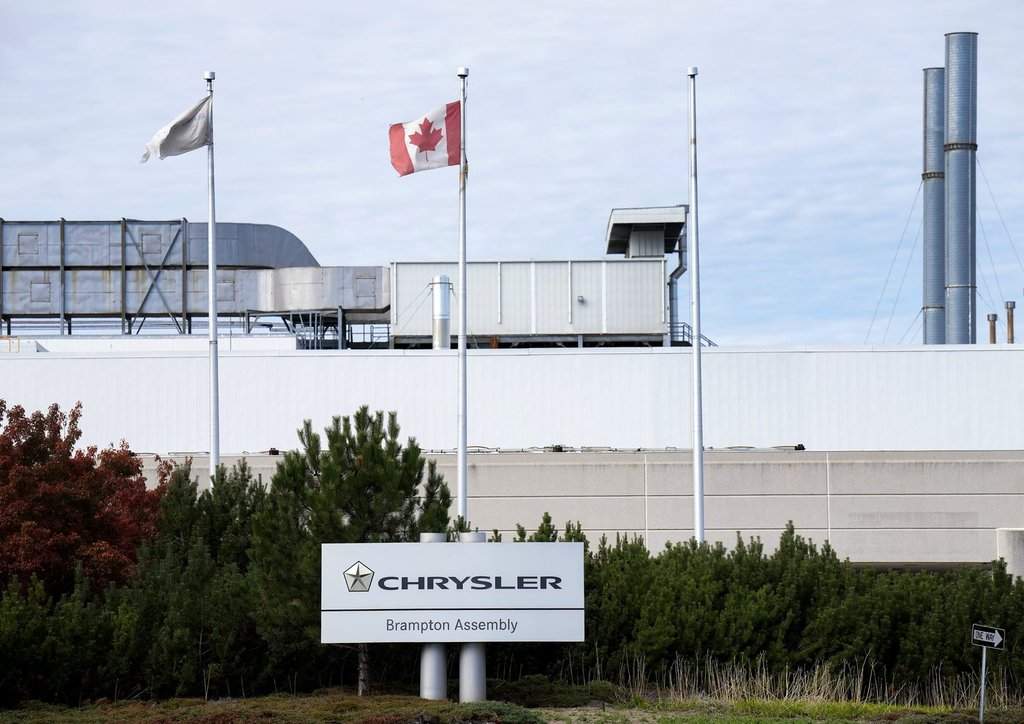
Consider the mechanics of an assembly plant conversion. Retooling a facility like Ford’s Oakville Assembly Complex or Stellantis’s Brampton Assembly Plant is not a weekend software update. It requires gutting the facility, installing heavy-duty stamping and battery-handling robotics, and retraining the workforce. During this downtime, the plant produces zero revenue.
When EV demand was surging, Wall Street rewarded automakers for absorbing these losses. Today, institutional investors are punishing capital expenditure that does not yield immediate free cash flow. As a result, executives are stretching out retooling timelines, pivoting back toward hybrid powertrains, and delaying next-generation electric pickups and crossovers.
For Canadian workers, these strategic pivots translate directly into prolonged layoffs. Supplemental unemployment benefits negotiated by Unifor cushion the blow for a while, but those funds are finite. Once an extended retooling stretches past eighteen months, experienced tradespeople and line workers begin leaving the industry permanently, eroding the skilled labor base that justified building the plants in Ontario in the first place.
The Hidden Friction Between Competitors
Bringing Ford and Stellantis into the same room with federal officials highlights a rarely discussed dynamic in automotive policy. While they are fierce rivals on the dealership lot, their survival in Canada depends on mutual stability.
The Supply Chain Domino Effect
An automotive assembly plant is merely the final stage of a vast logistical web. A single seat manufacturer, stamping plant, or wiring harness supplier in Ontario often relies on contracts from both Ford and Stellantis to achieve economies of scale. If Stellantis delays a vehicle launch by twelve months, that supplier loses half its projected volume. To stay afloat, the supplier must raise prices on Ford or risk bankruptcy, which would shut down Ford's lines anyway. Ottawa and Unifor recognize that you cannot save one automaker's footprint while letting the other's supplier base collapse.
Subsidy Parity and the US Threat
Every negotiation in Ottawa happens under the shadow of Washington. The U.S. Inflation Reduction Act created a gravitational pull that continues to draw manufacturing capital south of the border. Whenever Canadian federal ministers push back against corporate delays, automakers subtly remind them that states like Michigan, Ohio, and Tennessee are ready to offer fresh incentives with fewer regulatory strings attached.
Furthermore, strict parity clauses mean that whatever concessions Ottawa grants to Stellantis to keep Windsor and Brampton on track will immediately be demanded by Ford for Oakville, and eventually by General Motors for Ingersoll and Oshawa. Federal negotiators are walking a tightrope, trying to enforce contract compliance without triggering a capital flight that would hollow out Ontario's industrial heartland.
What Unifor Actually Wants at the Table
It is easy to caricature labor unions as purely focused on hourly wages, yet Unifor’s leadership is playing a much more sophisticated game. The union’s primary objective in these meetings is income security and timeline certainty.
When an automaker announces a delay in EV production, workers are left in limbo. Unifor is pressing both companies and the federal government to bridge the gap through several concrete mechanisms:
- Extended Income Support: Expanding the duration and payout levels of supplemental unemployment benefits during prolonged plant retooling, ensuring workers do not fall off a financial cliff before the new lines start running.
- Bridge Production Mandates: Demanding that automakers allocate interim hybrid or internal combustion models to idle facilities rather than leaving them empty while waiting for next-generation EV platforms to become profitable.
- Supply Chain Protections: Requiring federal subsidy agreements to include strict domestic sourcing rules, preventing automakers from importing cheap battery components or sub-assemblies from non-unionized regions to cut costs.
- Retraining Guarantees: Securing dedicated funding for skilled trades upskilling so current employees are prioritized for high-tech battery and automated maintenance roles, rather than being replaced by outside contractors.
Unifor knows that its leverage peaks before the concrete is poured and the subsidies are fully disbursed. Once a plant is operational, the union relies on the threat of a strike. During a construction or retooling pause, a strike is useless; you cannot walk off a job that isn't currently running. Therefore, political pressure and tripartite intervention with Ottawa are the union's sharpest weapons.
The Taxpayer Dilemma in Ottawa
For the federal government, this meeting is an exercise in political survival and fiscal damage control. Over the past few years, Ottawa committed tens of billions of dollars in combined capital support and production tax credits to attract EV and battery manufacturing. Critics across the political spectrum have questioned whether taxpayers are getting a fair return on that investment, particularly when foreign corporations hold the keys to the factories.
If Stellantis or Ford misses its job targets or scales back its Canadian footprint, federal ministers face an agonizing choice. They can enforce the penalty clauses, demand the return of public funds, and look tough to voters—an action that would almost certainly cause the automakers to cancel their remaining Canadian projects entirely. Alternatively, they can quietly renegotiate the milestones, extend the deadlines, and absorb the political backlash of appearing captive to corporate demands.
History offers a grim precedent. In 2009, during the auto bailouts, governments poured billions into restructuring General Motors and Chrysler to preserve North American manufacturing. While the industry survived, subsequent decades saw steady plant closures and job losses as corporations consolidated operations in lower-cost jurisdictions. Ottawa is desperate to avoid repeating that cycle, which is why ministers are demanding binding, legally enforceable commitments tied to every dollar of public money released.
Overlooked Factors Complicating the Deal
Beyond the headline issues of EV demand and union wages, three structural realities are making a clean resolution nearly impossible.
First is the energy infrastructure bottleneck. Running high-volume battery plants and modernized assembly lines requires massive, uninterrupted flows of clean electricity. Ontario’s power grid is already facing projected capacity deficits over the next decade. Even if Ford, Stellantis, Unifor, and Ottawa agree on every labor and financial term, delays in building high-voltage transmission lines can stall a factory opening just as easily as a strike.
Second is the tariff wall against Chinese EVs. Both the United States and Canada have moved to impose steep tariffs on Chinese-made electric vehicles to protect domestic manufacturing. While this shields Ford and Stellantis from immediate price undercutting in North America, it also removes competitive urgency. Protected behind a tariff wall, legacy automakers have more room to slow down their EV investments and milk profits from traditional gas-powered trucks, which directly contradicts Ottawa's aggressive zero-emission sales mandates.
Third is global corporate restructuring. Stellantis, in particular, is navigating intense pressure from shareholders to slash costs globally, manage bloated inventory in North America, and defend its profit margins. Decisions affecting a plant in Brampton are rarely made in isolation; they are weighed against factory utilization rates in Italy, France, and the American Midwest. Canadian ministers are negotiating with local executives who ultimately answer to global boards with zero sentimental attachment to Ontario.
What a Realistic Resolution Looks Like
Anyone expecting a triumphant press conference announcing accelerated EV timelines and thousands of brand-new jobs will be disappointed. The era of boundless optimism in the electric vehicle sector is over, replaced by hard-nosed triage.
A successful outcome from this high-stakes meeting will look far more pragmatic. It will likely involve a synchronized recalibration of expectations across all four parties. Ottawa will probably agree to grant flexibility on strict timeline milestones, allowing Ford and Stellantis to adjust their production schedules to match actual consumer demand without immediately triggering subsidy clawbacks.
In exchange, the automakers will have to lock in hard guarantees on headcount, commit to bridging the retooling gap with hybrid or high-demand combustion models where feasible, and open their books to prove that Canadian facilities are not bearing a disproportionate share of global cost-cutting. Unifor, meanwhile, will trade temporary patience on production start dates for ironclad financial protections that keep its members whole while the factories sit idle.
The assembly lines of Southern Ontario have survived oil shocks, recessions, trade wars, and bankruptcies, yet this moment tests the fundamental bargain of modern industrial policy. Public money can buy the bricks, the mortar, and the robotics, but it cannot force consumers to buy cars they cannot afford, nor can it compel global corporations to run factories at a loss forever.