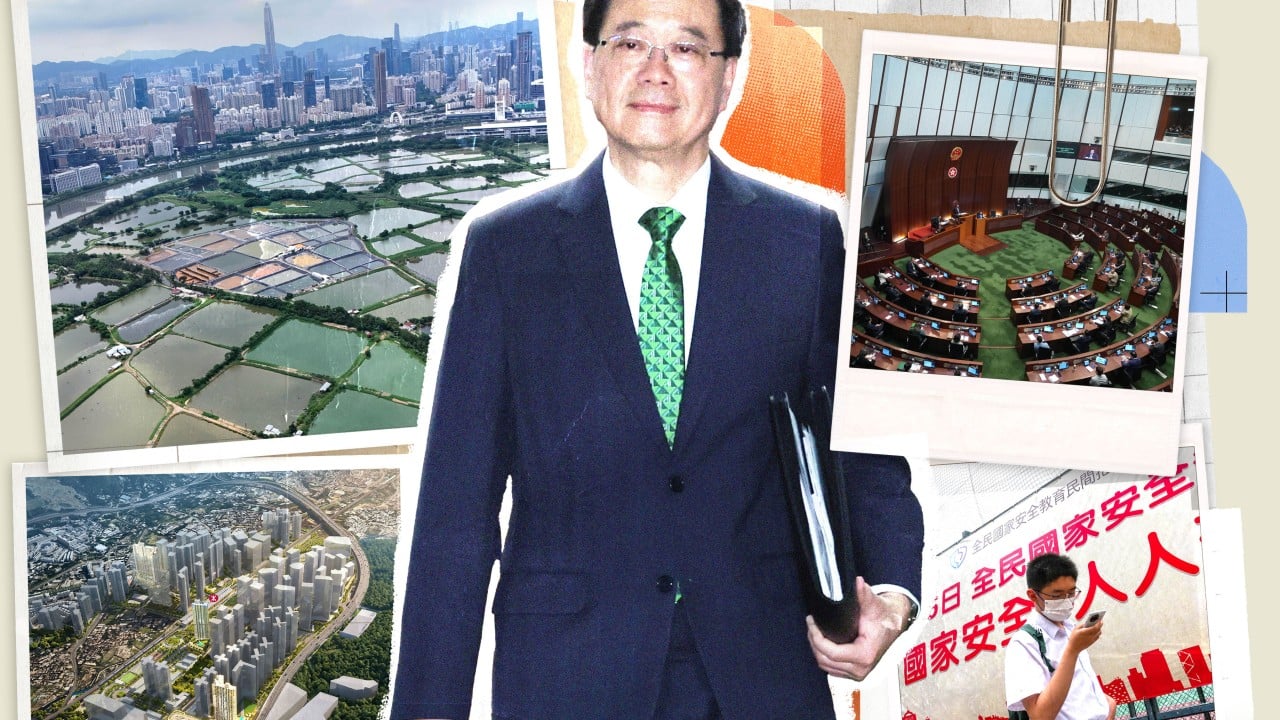
For decades, the financial hub at the mouth of the Pearl River operated on a distinctly laissez-faire heartbeat. Markets dictated terms, colonial-legacy bureaucracy kept its hands off commercial enterprise, and long-term economic forecasting was left to private conglomerates and multinational banking houses. That old reality died quietly. When the administration under Chief Executive John Lee initiated the drafting of the territory's first-ever Five-Year Plan, aligning directly with Beijing's national 15th Five-Year blueprint, commentators rushed to debate whether national security priorities would overshadow commercial vitality. They missed the actual crisis entirely.
The real friction point is not whether security will crowd out commerce. The underlying structural emergency is that a historically reactive, free-market government is completely unequipped to execute top-down industrial planning without breaking the very financial mechanisms that keep the city alive. Observers analyzing the policy trajectory assume that a softer or harder focus on security defines the debate. This binary framing ignores the administrative mechanics of what happens when a common-law, open-capital jurisdiction attempts to mimic mainland-style state guidance while maintaining a currency pegged to the US dollar and operating under a wholly different legal foundation.
The consultation documents and subsequent rollouts reveal an administration scrambling to institutionalize long-term targeting for sectors like artificial intelligence, biomedicine, and the Northern Metropolis development zone. Yet, the institutional DNA required to make a five-year plan function effectively simply does not exist within the local civil service.
The Mechanics of State Guidance in a Common Law Enclave
On paper, synchronizing local development goals with the national economic apparatus sounds straightforward. In practice, central planning requires state control over key production factors, resource allocation, and capital flows. Hong Kong possesses none of these traditional levers. Land is heavily monetized through government auctions—a system designed to maximize public revenue through high prices, which directly contradicts any mandate to build affordable, high-tech industrial clusters quickly.
Consider a hypothetical technology park initiative intended to rival Shenzhen's hardware ecosystems. Under a standard mainland governance model, municipal authorities can directly assign land use rights, command state-owned banks to issue zero-interest credit lines to designated enterprises, and mandate talent relocation from provincial universities. Hong Kong bureaucrats attempting the same playbook face an immovable wall of judicial oversight, private property protections, and a skeptical private sector.
Local developers and international financial institutions do not operate on five-year political cycles. They operate on quarterly returns, yield spreads, and liquidity risk. When the government tries to steer capital toward strategic emerging industries using moral suasion or minor tax incentives, global capital simply looks at the regulatory friction and reallocates elsewhere. The state wants patient capital; international markets demand immediate liquidity. This mismatch creates a policy vacuum where grand ambitions meet commercial indifference.
The Security Paradox and Foreign Capital Flight
National security legislation, spanning the 2020 enactment and subsequent local ordinances, fundamentally altered the territory's risk profile. While official commentary insists that security safeguards create a stable environment for long-term investment, institutional investors view compliance through an entirely different lens.
Compliance costs for multinational firms operating in the territory have skyrocketed. Legal departments now maintain redundant verification structures to ensure that everyday market research, cross-border data transfers, and economic forecasting do not inadvertently brush against broad national security thresholds. This administrative drag is rarely captured in official economic indicators, but it bleeds quietly into corporate balance sheets.
When a five-year economic blueprint relies heavily on positioning the city as an international financial and innovation bridge, it assumes the bridge is trusted by travelers from both sides. Western institutional funds have steadily reduced their direct exposure, replacing on-the-ground presence with remote management or exiting positions entirely. Domestic capital from the mainland has stepped into the breach, but mainland capital behaves differently. It is sensitive to Beijing's macro-prudential directives, meaning the local bourse increasingly mirrors mainland policy sentiment rather than global liquidity trends.
This structural shift transforms the financial exchange from a truly international price-discovery mechanism into a specialized regional platform. That evolution may serve national strategic imperatives, but it sacrifices the high-margin, cross-border advisory fees that previously sustained the local professional services sector.
Navigating the Structural Impasse
The administration faces a narrowing window to prove that its planning experiment can generate tangible economic momentum without strangling market confidence. Merely setting targets for artificial intelligence adoption or low-altitude economies does not create the underlying talent pipelines or risk-tolerant venture ecosystems required to sustain them.
Local universities produce world-class academic research, but commercialization rates remain chronically low due to a conservative venture capital culture that prefers physical real estate over unproven software or biotech prototypes. Without direct state equity injection—which local fiscal conservatism resists—or aggressive immigration reforms tailored to global tech talent, the targets outlined in the development blueprint risk becoming rhetorical exercises.
The transition from a passive administrative harbor to an active developmental state requires more than good intentions and patriotic alignment. It demands an overhaul of how government interacts with commercial enterprise, how land is valued, and how risk is distributed between the public purse and private investors. Until these foundational contradictions are resolved, debates over the tone of national security policies miss the core vulnerability. The primary threat to the territory's economic future is not ideological overreach, but structural paralysis in the face of an economic model it was never designed to run.