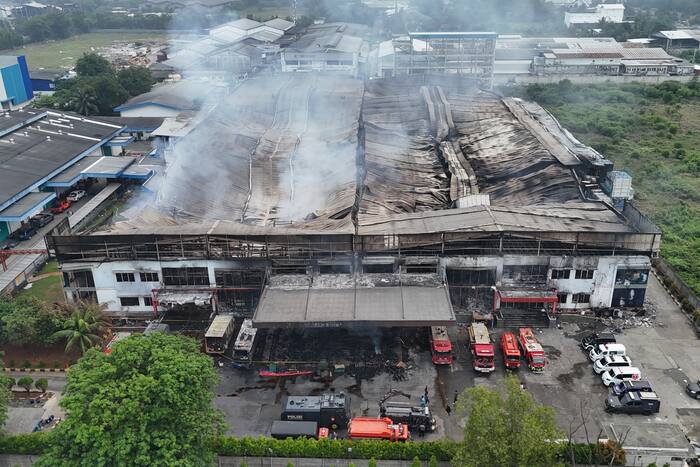
When a fire tore through a confectionery plant in Indonesia, trapping dozens of workers inside, the immediate headlines focused on the desperate search for 34 missing employees. That surface-level reporting misses the real story. Industrial fires of this scale in Southeast Asia's manufacturing hubs are rarely freak accidents; they are the predictable result of combustible dust hazards, lax municipal enforcement, and informal subcontracting networks that obscure basic accountability. Rescuers digging through twisted sheet metal and melted sugar vats are confronting the physical aftermath of a systemic regulatory breakdown that prioritizes rapid export growth over human survival.
To understand how a facility making everyday sweets turns into a death trap in seconds, you have to look at the chemistry of the factory floor. Most people think of sugar and cornstarch as harmless kitchen staples. Inside an enclosed industrial environment, however, fine particulate matter suspended in the air behaves like vaporized gasoline. Meanwhile, you can read related stories here: Seventy-Four Lashes for a Song (And the Sound That Outlives the Whip).
The Physics of a Confectionery Trap
A confectionery plant is a textbook dust explosion environment. Sugar, flour, cocoa powder, and starch are all organic materials that burn violently when dispersed as a fine cloud in an enclosed space and exposed to an ignition source.
The mechanism is brutal in its simplicity. A primary ignition—often a spark from an unshielded electric motor, an overheated bearing on a conveyor belt, or static discharge from pneumatic transfer pipes—triggers a localized flash fire. That initial pressure wave shakes loose decades of accumulated dust resting on rafters, ductwork, and machinery housings. Within milliseconds, that newly suspended cloud ignites, creating a secondary explosion exponentially more powerful than the first. To explore the full picture, we recommend the recent analysis by Al Jazeera.
Unlike a standard structural fire that spreads room by room, a dust-fueled blast moves at supersonic speeds through ventilation shafts and production lines. Workers on the floor do not get a five-minute warning to walk calmly toward an exit. They get a wall of flame and immediate structural collapse.
Compound that explosive potential with the physical realities of candy manufacturing. High-heat boiling kettles, pressurized steam lines, and vast quantities of flammable packaging films—polypropylene wrappers, cardboard cartons, and plastic shrink-wrap—create an immense fuel load. Once the initial blast breaches containment, burning sugar melts into a viscous, napalm-like liquid that sticks to skin and blocks escape routes. Water hoses used by municipal fire brigades often make things worse initially, scattering burning particulates or causing violent steam flashes when hitting superheated syrups and cooking oils.
Why Rescue Operations Stall in Industrial Zones
When 34 workers go missing in a single shift, the public naturally asks why evacuation protocols failed. The answer lies in how mid-tier manufacturing facilities across Indonesia's industrial corridors are built and modified over time.
Rapid industrial expansion in regions surrounding Jakarta, Surabaya, and Medan has outpaced municipal zoning and fire safety inspections. Many factories begin as modest warehouses and expand organically as orders grow. Owners add mezzanine levels for storage, partition large open floors with cheap drywall or sheet metal, and brick over original loading bays to install new machinery.
In the process, egress routes vanish.
Fire exits are routinely locked from the outside to prevent inventory theft—a widespread practice across low-margin consumer goods manufacturing. Windows are barred with heavy iron grilles for security. When a blast knocks out the main electrical grid, emergency lighting either fails due to dead batteries or was never installed at all. Disoriented workers, blinded by thick, acrid smoke from burning plastics, run into dead-end corridors or padlocked steel doors.
Local search and rescue teams—typically coordinated through Indonesia's National Search and Rescue Agency (Basarnas) alongside regional fire departments—face an immediate structural nightmare. Lightweight steel-truss roofs, standard in modern industrial parks because they are cheap and fast to erect, lose their load-bearing capacity rapidly under intense heat. They buckle inward, trapping victims beneath tangled steel decking and heavy industrial mixers. Rescuers cannot bring in heavy excavation machinery until the smoldering debris cools and structural engineers assess collapse risks, turning a rescue operation into a grim recovery effort within hours.
The Shadow Workforce Behind the Missing Count
Notice the phrasing that always emerges in the first 48 hours of an Indonesian industrial disaster: authorities are "racing to find" a specific number of missing workers, yet that number frequently shifts as days pass.
That confusion is not merely the chaos of an active disaster zone. It is a symptom of informal labor subcontracting.
Across Indonesia's food and beverage sector, permanent, directly hired staff often make up only a fraction of the people inside the plant on any given day. To keep labor costs flexible and bypass severance obligations under national labor laws, factory operators rely heavily on third-party labor agencies (yayasan) and daily casual workers (buruh harian lepas).
Consider a hypothetical scenario common across industrial estates in West Java. A packaging line needs 40 extra hands to fulfill a seasonal order before a major holiday. A local labor broker recruits workers from surrounding villages, brings them through the factory gate at 6:00 AM, and logs them on a handwritten clipboard at the security post. Their names never enter the central HR database. They receive zero safety onboarding, no personal protective equipment beyond a basic hairnet, and no orientation on where the fire extinguishers or secondary exits are located.
When the building collapses and that security clipboard burns up in the gatehouse, nobody knows with absolute certainty who was inside. Families show up at the perimeter fence holding photocopies of national ID cards, pleading with officials to add their relatives to the missing list. Meanwhile, factory management scrambles to reconstruct attendance logs from fragmented WhatsApp messages sent by floor supervisors.
Regulatory Theater Versus Reality on the Ground
On paper, Indonesia possesses comprehensive occupational health and safety laws. Law No. 1 of 1970 on Work Safety, supplemented by decades of Ministry of Manpower regulations, mandates strict fire suppression systems, regular safety audits, and worker safety committees (P2K3) for facilities employing more than 100 people or handling hazardous processes.
The gap between statute and enforcement, however, is vast.
Indonesia suffers from a chronic shortage of certified labor inspectors relative to its millions of registered businesses. A single inspector in a dense industrial regency may be responsible for overseeing hundreds of facilities, ranging from massive petrochemical complexes to unregulated home-industry workshops. Inspections are frequently announced in advance, allowing factory managers to unlock fire doors, clear blocked aisles, and temporarily display expired fire extinguishers for the walkthrough.
Even when violations are documented, the penalties rarely deter corner-cutting. Administrative fines are often negligible compared to the capital expenditure required to retrofit a plant with explosion-proof electrical wiring, automated sprinkler networks, and industrial dust-collection systems. Criminal prosecutions of factory owners following fatal fires are rare, and when they do occur, cases frequently stall in local courts or result in suspended sentences that fail to alter industry behavior.
Insurance practices reinforce this complacency. Many mid-sized domestic manufacturers carry minimal property coverage and rely on state social security programs (BPJS Ketenagakerjaan) to handle worker injury or death payouts—assuming the workers were formally registered in the first place. Without private insurers demanding rigorous fire-risk engineering audits as a condition of coverage, the financial incentive to invest in preventative safety evaporates.
The Supply Chain Blind Spot
To view a candy factory fire purely as a domestic Indonesian regulatory failure ignores the broader commercial ecosystem that keeps these plants running.
Global and regional food conglomerates, retail chains, and private-label distributors aggressively squeeze margins down the supply chain. Confectionery is a volume-driven business where fractions of a cent per unit determine who wins a contract. When buyers demand lower unit prices and faster turnaround times without auditing the physical safety infrastructure of their tier-two and tier-three suppliers, they inadvertently subsidize dangerous working conditions.
Western and multinational brands have spent the last fifteen years building elaborate social compliance auditing regimes in the garment and footwear sectors following disasters like the 2013 Rana Plaza collapse in Bangladesh. Food processing and packaging plants, particularly those serving domestic or regional Asian markets, have largely escaped that level of external scrutiny. Audits, when conducted, tend to focus on food hygiene—ensuring no hair, glass, or bacteria enters the product—rather than structural fire safety or dust explosion mitigation.
A factory can pass a food-grade hygiene inspection with flying colors while operating ungrounded machinery in a room thick with explosive cornstarch dust. Clean floors do not stop a spark from igniting airborne particulates.
What Meaningful Accountability Actually Requires
Following every major factory fire in Indonesia, a predictable script unfolds. Local officials express condolences, police summon plant managers for questioning, and national ministries promise a sweeping audit of industrial zones. Within three months, media attention moves on, and locked exit doors quietly swing shut again across hundreds of similar facilities.
Breaking that cycle requires concrete structural changes rather than rhetorical pledges:
- Mandatory digital biometric tracking at plant perimeters linked directly to municipal emergency response systems, ensuring real-time headcounts exist off-site before a disaster strikes.
- Unannounced third-party fire engineering audits tied directly to business operating licenses (NIB), specifically targeting combustible dust hazards, electrical grounding, and unobstructed egress.
- Piercing the corporate veil on subcontracted labor, making facility owners strictly liable—both criminally and financially—for every individual physically present on their premises, regardless of which labor broker issued their paycheck.
- Supply chain transparency mandates requiring major food distributors and retailers to disclose their manufacturing suppliers and verify independent structural safety certifications.
Until Indonesian regulators treat locked fire exits and unmitigated dust hazards as criminal negligence rather than minor administrative infractions, rescue crews will keep pulling bodies out of the ashes of preventable disasters.