When Serbia votes for a new parliament, the outcome rarely hinges on the ideological debates plastered across Belgrade billboards. Instead, the race is decided months earlier through a deeply entrenched system of state patronage, fractured opposition alliances, and geopolitical tightrope-walking between Brussels, Moscow, and Beijing. To understand how Serbia's 250-seat National Assembly is actually won, you have to look past the surface-level campaign rhetoric and examine the structural machinery that governs Balkan politics.
Most coverage of Serbian parliamentary elections treats them like standard European contests where swing voters weigh tax policy against social spending. That framing misses the point entirely. Serbia operates as a hybrid regime—a system where formal democratic institutions exist alongside an uneven playing field that heavily favors the ruling party.
The Anatomy of the 250-Seat Contest
Serbia elects its unicameral National Assembly through a single nationwide constituency using proportional representation. Voters do not cast ballots for individual district representatives. They vote for closed party lists or coalitions, and seats are distributed using the D'Hondt method, a mathematical formula that slightly favors larger parties over smaller ones.
To enter parliament, a party list must clear a 3 percent electoral threshold. That threshold was lowered from 5 percent ahead of the 2020 elections—a strategic move by the ruling majority that made it easier for smaller, often compliant parties to enter the legislature and fragment the opposition vote. Ethnic minority lists are exempt from this 3 percent rule, operating under a "natural threshold" that allows parties representing Hungarians, Bosniaks, Albanians, and Croats to win seats with significantly fewer votes.
On paper, this creates a diverse legislature. In practice, the closed-list system concentrates enormous power in the hands of party leaders. Because voters cannot select individual candidates on a list, a member of parliament owes their political survival entirely to the party boss who placed them high enough on the ballot to win a seat. Loyalty upward matters infinitely more than accountability downward.
Why Snap Elections Are a Political Weapon
In mature democracies, snap elections usually signal a government in crisis—a collapsing coalition, a lost vote of confidence, or a paralyzing scandal. In Serbia, early elections have become a routine governance tool used by the ruling Serbian Progressive Party (SNS) to maintain permanent campaign momentum and keep rivals off balance.
Calling an early vote accomplishes three things simultaneously. First, it interrupts opposition organizing before disparate groups can build unified regional networks or raise serious money. Second, it allows the ruling party to tie parliamentary races to the personal popularity of President Aleksandar Vučić, even when his own office is not on the ballot. For years, ruling coalition lists have featured Vučić’s name directly in their official ballot titles, turning local and legislative races into de facto referendums on a single leader.
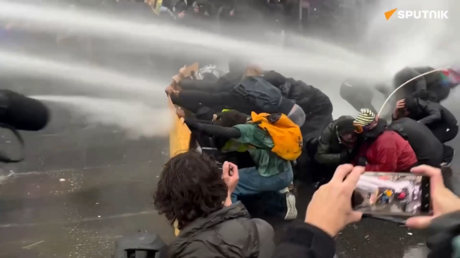
Third, snap elections reset the political clock whenever domestic pressure mounts. Whether the trigger is mass street protests over urban development, public outrage following tragic mass shootings, or international pressure over regional disputes, dissolving parliament channels street energy back into an institutional arena where the ruling apparatus holds every structural advantage.
The Patronage Engine and the Media Monopoly
You cannot analyze Serbian elections without examining the public sector employment network. Hundreds of thousands of Serbian citizens work in state-owned enterprises, municipal administrations, healthcare, and education. In a country where private-sector wages outside major tech hubs remain modest, a state job is economic security.
Election observers from the OSCE Office for Democratic Institutions and Human Rights (ODIHR) have repeatedly documented how this dependency translates into votes. Public employees face intense informal pressure to attend campaign rallies, secure lists of guaranteed voters among family and friends—known locally as "safe votes"—and prove their participation on election day. When your livelihood is tied to a temporary contract signed by a politically appointed director, abstaining from politics carries real financial risk.
Media dominance reinforces this ground game. While independent cable channels and investigative portals exist, their reach is largely confined to urban centers like Belgrade and Novi Sad. Across rural Serbia and smaller industrial towns, information flows primarily through national broadcast frequencies and high-circulation tabloids that align closely with government narratives. During campaign cycles, airtime on national broadcasters skews overwhelmingly toward state officials, blurring the line between routine governance and partisan campaigning—a practice monitors call functionary campaigning.
The Opposition Dilemma
Facing a consolidated political machine, Serbia’s opposition parties have struggled for years with a fundamental strategic question. Should they unite into a single "big tent" coalition to maximize their vote share, or run in distinct ideological columns to avoid alienating picky voters?
Neither option is clean. A unified pro-European, centrist, and left-leaning bloc prevents votes from being wasted below the 3 percent threshold and projects strength to discouraged citizens. Yet those coalitions frequently fracture over personality clashes, disagreement on how to handle Kosovo, and competing ambitions among party leaders who spent the 2000s governing together before losing power in 2012.
Meanwhile, right-wing and nationalist opposition parties occupy a tricky space. They attack the government from the flank, accusing Belgrade of making quiet concessions to Western mediators regarding Kosovo or failing to defend Serbian interests in neighboring Bosnia and Herzegovina. Because their ideological positions on Russia and European integration often overlap with the rhetoric of the ruling party's own base, these nationalist groups struggle to differentiate themselves when state media amplifies the government's own patriotic credentials.
Voter Migration and Electoral Engineering
Recent Serbian election cycles have brought a specific controversy to the forefront of international scrutiny: voter migration and residency manipulation.
Investigations by domestic watchdog groups like CRTA and international observers have highlighted instances where voters registered in neighboring Bosnia and Herzegovina—specifically from the Republika Srpska entity, where many hold dual Serbian citizenship—were bused into Belgrade to cast ballots in simultaneous local and parliamentary elections. Under Serbian law, dual citizens have the legal right to vote in national parliamentary elections. However, registering non-residents at temporary addresses—including abandoned buildings or electrical substations—to tip tight municipal races crosses into direct electoral engineering.
This practice exposes a core vulnerability in Serbia’s electoral framework. The unified voter registry lacks transparent, real-time auditing mechanisms that opposition parties trust. Without an independent body empowered to verify residency claims before ballots are printed, every tight election result immediately triggers disputes over legitimacy, street blockades, and calls for international mediation.
The Four-Chair Geopolitical Balancing Act
Foreign capitals watch Serbia’s parliamentary elections closely because Belgrade sits at the crossroads of competing global interests. For over a decade, Serbian foreign policy has rested on a four-pillar doctrine balancing ties with the European Union, the United States, Russia, and China.
Brussels remains Serbia's largest trading partner and primary source of foreign direct investment, and Serbia holds official EU candidate status. Yet accession talks have largely stalled over rule-of-law benchmarks, judicial independence, and Serbia’s refusal to align with EU foreign policy sanctions against Moscow following the invasion of Ukraine.
Despite public friction, Western diplomats have often prioritized regional stability over democratic reform in Belgrade. European leaders want cooperation on migration routes, critical raw materials like Serbia's massive lithium reserves in the Jadar Valley, and gradual normalization between Belgrade and Pristina. As long as a Serbian government delivers predictability on those files, Brussels and Washington have historically stopped short of imposing serious consequences for domestic democratic backsliding.
At the same time, Beijing has poured billions into Serbian infrastructure, mining, and surveillance technology without attaching governance conditions, while Moscow retains deep cultural influence and energy leverage through Serbia’s reliance on Russian natural gas. A new Serbian parliament rarely alters this four-chair balancing act; instead, the election serves to renew the mandate of whichever leadership can convince all four powers that it remains the only reliable interlocutor in the Western Balkans.
What Actually Changes After the Ballots Are Counted
For international investors and regional observers, the immediate aftermath of a Serbian parliamentary vote follows a predictable script. Even when the ruling party wins an outright majority of seats, it typically invites long-standing coalition partners—most notably the Socialist Party of Serbia (SPS), the successor to Slobodan Milošević's party—and ethnic minority parties into the governing cabinet.
Sharing power when you do not mathematically need to is a deliberate tactic. It spreads political responsibility for unpopular decisions, keeps potential rivals inside the tent where they can be monitored, and projects broad national consensus to foreign partners.
The real shifts happen quietly in the weeks following the formation of a new government. Watch the allocation of key ministries—specifically finance, energy, mining, and internal affairs—alongside appointments to the boards of major state-owned enterprises like Elektroprivreda Srbije (EPS) and Telekom Srbija. Those appointments reveal which internal factions within the ruling coalition gained leverage during the campaign and which foreign economic partnerships will take priority over the next term.
Until Serbia overhauls its campaign finance oversight, breaks the link between public-sector employment and party loyalty, and opens national broadcast frequencies to genuine political debate, parliamentary elections will remain less a contest over who governs and more a periodic stress test of how much pressure the existing system can absorb before something gives.