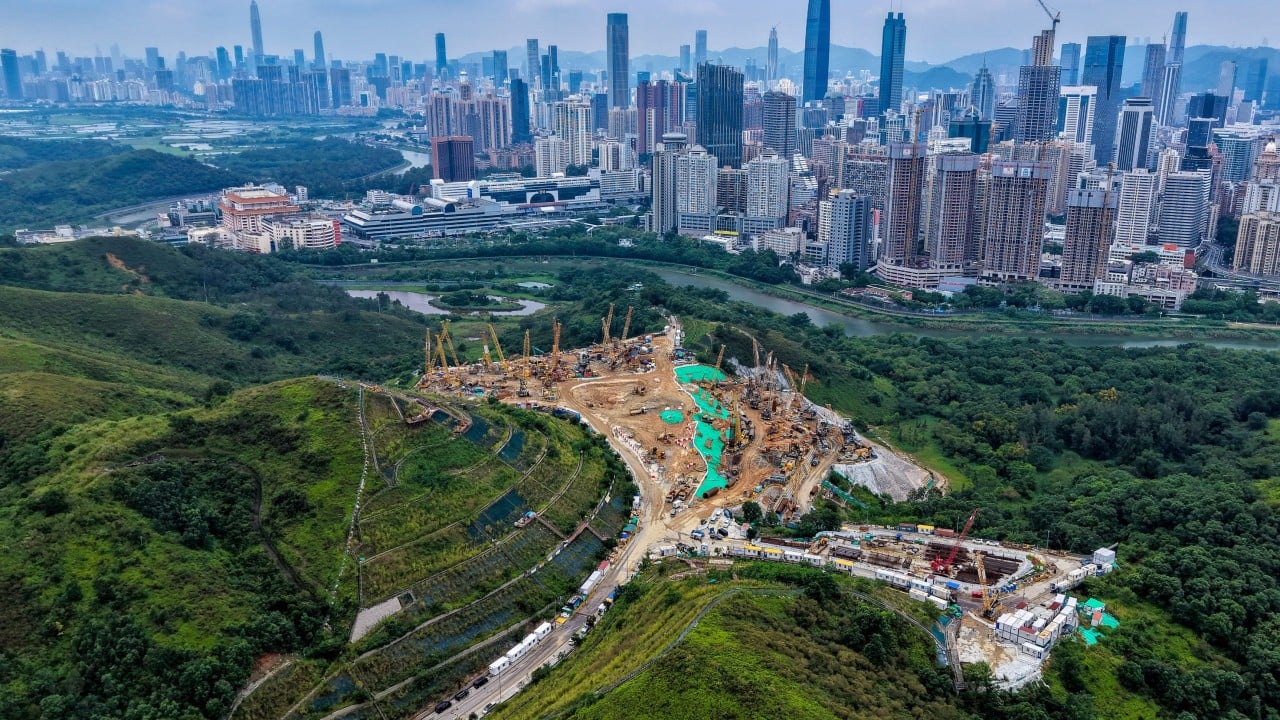
Hong Kong is stripping away decades of statutory red tape to force through its most ambitious urban project in modern history. A sweeping legislative bill designed to fast-track the Northern Metropolis—a sprawling 30,000-hectare economic and residential zone along the Shenzhen border—is nearing final passage, granting the administration unprecedented authority to bypass traditional town planning, land resumption, and environmental review bottlenecks.
For anyone watching Hong Kong’s real estate and infrastructure sectors over the past thirty years, this moment feels familiar yet fundamentally different. The city has always built big. From the Rose Garden airport project in the 1990s to the cross-border high-speed rail link, Hong Kong’s playbook relied on massive capital outlays paired with slow, litigious, and hyper-procedural regulatory reviews. That era is ending. Facing severe fiscal deficits, sluggish private land sales, and intense economic competition from neighboring mainland cities, the government is no longer willing to wait fifteen years for a single zoning change to clear the courts. Discover more on a similar issue: this related article.
The upcoming legislation does not merely tweak existing ordinances. It creates a parallel legal track specifically engineered to compress development timelines from decades into years.
Why Traditional Town Planning Failed the Border Zone
To understand why the government is reaching for statutory blunt force, you have to look at how land development normally works in Hong Kong. Under the traditional regime, turning raw agricultural plots or fragmented brownfield sites in the New Territories into a functioning innovation hub requires navigating a labyrinth of overlapping laws. The Town Planning Ordinance, the Lands Resumption Ordinance, the Roads (Works, Use and Compensation) Ordinance, and the Environmental Impact Assessment Ordinance all operate on separate clocks. More journalism by Forbes highlights related perspectives on this issue.
A single objection from a rural landowner or an environmental group could trigger years of statutory hearings, judicial reviews, and revised gazettes. In the past, when Hong Kong’s treasury was overflowing with land premium revenues and the central business district on Hong Kong Island was the undisputed financial engine of Asia, the city could afford that friction.
Not anymore. The Northern Metropolis is supposed to cover roughly one-third of Hong Kong’s total land area and eventually house around 2.5 million people. More importantly, it is meant to solve the city's existential economic problem: an over-reliance on traditional finance and property speculation. By turning the northern border into an innovation and technology (I&T) hub integrated with Shenzhen, officials hope to build a second economic engine.
You cannot build a tech ecosystem on a twenty-year construction schedule. Tech companies, semiconductor manufacturers, and biotech labs operate on three-to-five-year capital cycles. If Hong Kong tells a major mainland or international enterprise that their research campus will be ready in 2042 after the third round of ecological mitigation reviews, that company will sign a lease in Shenzhen or Singapore the very next morning.
How the Fast-Track Mechanism Actually Works
The new bill introduces a set of statutory shortcuts that fundamentally alter the balance of power between the executive branch, private landowners, and civil society. Rather than treating each parcel of land as a standalone regulatory battle, the legislation consolidates approval powers under high-level government authorities.
First, it streamlines land resumption and clearance. Historically, the government had to wait until detailed zoning and engineering plans were finalized before resuming private land. Under the fast-track framework, authorities can initiate land acquisition much earlier in the planning cycle, decoupling the physical clearing of sites from the bureaucratic finalization of downstream infrastructure designs. Compensation disputes still go through statutory channels, but they can no longer freeze the bulldozers at the gate.
Second, the bill compresses statutory consultation windows. Public objections to zoning changes and roadworks are narrowed in scope and duration. Instead of multiple rounds of open-ended hearings where different branches of the government examine overlapping complaints, objections are consolidated into single-window reviews with strict statutory deadlines.
Third, it introduces flexible land grant mechanisms. In a conventional Hong Kong land sale, the government auctions a plot to the highest bidder with rigid floor-area ratios and strict use-case covenants. For the Northern Metropolis, the government is moving toward direct land grants, non-in-situ land exchanges, and multi-tiered development contracts. Consider a hypothetical example: if a major logistics conglomerate holds scattered agricultural leases across the New Territories, the new framework allows officials to swap those fragmented holdings for a single consolidated commercial plot inside the core zone, bypassing the open auction floor entirely to lock in an anchor tenant.
The Fiscal Reality Behind the Legislative Rush
Lawmakers and policy analysts often frame the Northern Metropolis as a visionary master plan. On the ground, inside the boardrooms of Hong Kong’s major property developers, it looks much more like a high-stakes financial rescue operation.
Hong Kong’s public finances have taken a beating. For decades, the government kept income and corporate taxes low by acting as a monopoly land supplier, deriving a massive chunk of its annual revenue from selling land leases at astronomical prices. When the property market cooled and borrowing costs surged, developers stopped bidding. Several high-profile government land tenders failed outright because bids fell below the administration's reserve prices.
Without land sale revenues, funding a mega-project like the Northern Metropolis solely through the public purse becomes mathematically perilous. The government simply does not have the liquid fiscal cushion it enjoyed ten years ago.
This is where the fast-track bill intersects with capital markets. By stripping away regulatory uncertainty, the government is trying to de-risk the border zone enough to attract private institutional capital and state-backed mainland enterprises. Developers will not commit billions of dollars to site formation, drainage, and primary road networks if they face seven years of statutory litigation before they can pour concrete. The legislation is essentially a regulatory subsidy—trading public procedural oversight for private sector balance-sheet participation.
The Shifting Role of Hong Kong’s Property Tycoons
For generations, Hong Kong’s "Big Four" property developers operated on a predictable model: buy agricultural land cheap, hold it in a land bank for decades, negotiate a land premium conversion with the government when market prices peaked, and build high-density residential towers.
The fast-track bill disrupts that slow-burn playbook. By accelerating compulsory land resumption and establishing fixed timelines for land exchanges, the government is forcing developers out of passive land banking. If a developer sits on rural plots inside the Northern Metropolis boundary hoping to wait out the market for a better valuation, the administration now holds the statutory hammer to resume the land at statutory agricultural rates before the developer can capture the commercial upside.
At the same time, the government desperately needs those exact developers to co-invest in the area's large-scale site formation. It is a tense standoff. Officials are using legislative speed as leverage to push private tycoons into public-private partnerships, asking them to build public infrastructure alongside commercial towers in exchange for expedited development rights.
What Gets Trampled When Red Tape Disappears
Speed in urban planning is never free. Every statutory check that the bill removes was originally written into Hong Kong law for a specific reason, usually following a historical failure, an environmental disaster, or a corruption scandal.
The most immediate casualty is ecological protection. The northern New Territories contain some of the most sensitive wetland ecosystems in southern China, including the Mai Po Inner Deep Bay Ramsar Site, a critical stopover for tens of thousands of migratory birds along the East Asian-Australasian Flyway. Under standard procedures, any adjacent development requires rigorous, multi-season ecological baseline surveys and strict buffer zones.
When environmental impact assessments are compressed to meet industrial construction targets, baseline data gets thinner. Environmentalists and urban planners have repeatedly warned that building high-density tech parks right up against fragile fishponds and wetlands risks permanent habitat fragmentation. Once wetlands are drained and paved over for semiconductor fabrication plants or cross-border rail depots, no amount of downstream mitigation brings them back.
Beyond ecology, there is the question of brownfield displacement and rural livelihoods. The New Territories are dotted with thousands of hectares of brownfield sites—informal open-air storage yards, recycling depots, container parks, and vehicle repair workshops. While these sites look chaotic from a helicopter, they form the invisible backbone of Hong Kong’s logistics, construction, and waste-management supply chains.
Fast-tracking land clearance means evicting hundreds of these small-scale operators on accelerated schedules. Without adequate multi-story industrial buildings already constructed to house them, clearing brownfield sites in the north simply pushes those messy, essential industries into other districts or drives up operating costs across the entire construction and logistics sector.
The Geopolitical Subtext of Border Integration
You cannot separate this bill from the broader political geography of the Greater Bay Area. For more than a century, the Shenzhen River was treated as a hard administrative buffer. Development in Hong Kong faced south toward Victoria Harbour, leaving the northern border intentionally underdeveloped as a rural frontier zone.
That spatial logic is being reversed. Shenzhen is no longer a low-cost manufacturing backyard; it is a global powerhouse in hardware, telecommunications, artificial intelligence, and electric vehicles, boasting a GDP that has already surpassed Hong Kong’s.
Beijing has made it clear that Hong Kong’s long-term stability depends on deep economic integration with the mainland’s southern tech corridor. The Lok Ma Chau Loop, the San Tin Technopole, and the Hung Shui Kiu commercial hub—all core components of the Northern Metropolis—are designed to act as physical docking stations for mainland capital, talent, and research institutions.
In this context, legislative gridlock in Hong Kong is viewed not merely as a local administrative headache, but as a strategic bottleneck. Passing a landmark bill to force the Northern Metropolis forward sends an unmistakable signal to central authorities and mainland corporate leaders: Hong Kong is aligning its regulatory clock with Shenzhen’s legendary construction speed.
The Execution Trap Ahead
Passing a bill in the legislature is the easy part. Turning thirty thousand hectares of fishponds, villages, and border crossings into a self-sustaining economic engine is an entirely different beast.
History offers plenty of cautionary tales across Asia of state-backed mega-zones that solved their legal and construction bottlenecks only to struggle with economic occupancy. Building glass-and-steel research towers does not automatically create an innovation ecosystem. Hong Kong still faces acute shortages of specialized engineering talent, high commercial electricity and operational costs compared to Guangdong, and complex cross-border data and capital flow restrictions that separate its legal system from the mainland's.
Even with every statutory barrier cleared, the Northern Metropolis will require hundreds of billions of dollars in sustained capital expenditure over the next decade. If global interest rates remain elevated, or if mainland tech giants decide they already have enough office space across the river in Qianhai and Nanshan, Hong Kong could find itself with newly cleared land, streamlined zoning laws, and a massive financing gap.
The legislation gives the government the power to build without waiting for permission. Now it has to prove that once the bulldozers finish clearing the border, the private sector will actually show up to pay the bill.