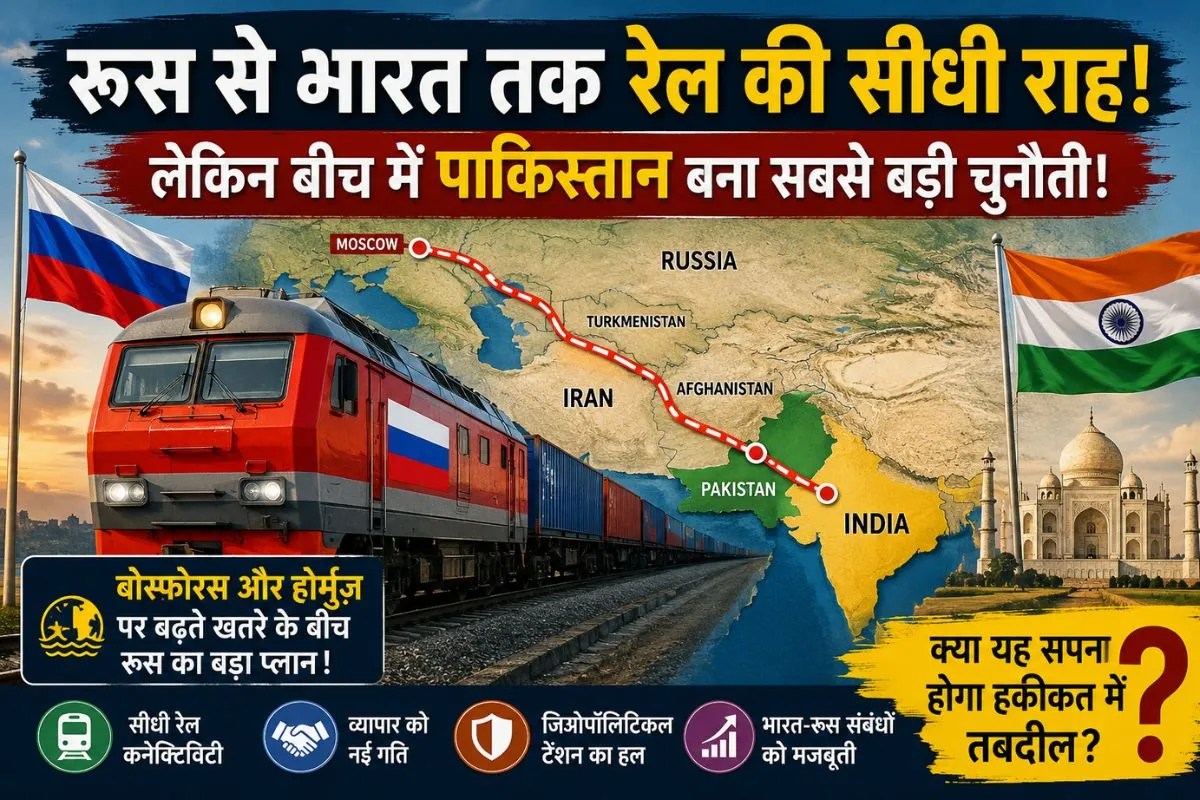
Moscow wants to build a direct railway line running straight to the Indian Ocean, bypassing volatile maritime chokepoints through a path that cuts across Turkmenistan, Iran, Afghanistan, and Pakistan. Russian Deputy Prime Minister Marat Khusnullin floated the concept to state media, presenting an overland rail freight network as an insurance policy against rising military friction in the Strait of Hormuz and the Bosphorus. On paper, the proposal promises an unbroken steel highway connecting Russia to South Asian markets. On the ground, it collides with centuries of topography, unyielding political enmity, and the graveyard of previous pipeline dreams.
To understand why this announcement generated simultaneous headlines and quiet sighs from regional experts, one must examine the map of contemporary Eurasia. Maritime arteries are fracturing. The Strait of Hormuz, through which a massive share of global energy moves, faces acute security disruptions. Simultaneously, the Turkish-controlled Bosphorus remains a geopolitical bottleneck for Russian exports seeking open water. Moscow needs reliable, sanctions-resistant corridors to anchor its long-term trade with New Delhi, especially as bilateral commerce aims toward ambitious financial targets.
Yet looking past the surface appeal reveals structural contradictions that no amount of engineering optimism can easily resolve.
The Mirage of the Trans-Asian Track
A continuous rail link from the Russian Federation down to the warm waters of the Indian Ocean sounds modern, but it resurrects logistical ghosts. Consider the fate of the Turkmenistan-Afghanistan-Pakistan-India (TAPI) natural gas pipeline. Conceived decades ago to carry energy from Central Asian fields through the Hindu Kush and down into South Asia, TAPI remains largely unrealized because sovereign territory cannot be easily divorced from regional hostility.
Laying dual-gauge or standard-gauge rail lines across thousands of kilometers of desert and high mountain ranges requires more than capital. It requires absolute, predictable security cooperation between governments that rarely agree on border management, let alone grand economic visions.
Furthermore, freight economics dictate that bulk commodities prefer maritime transit unless land routes offer massive time advantages or face catastrophic maritime blockades. A multi-country train route passing through four distinct jurisdictions introduces a compounding series of customs delays, bureaucratic friction, and security liabilities. Every border crossing breaks the momentum of commercial freight.
The Pakistan Factor and the Reality of Frontier Politics
The elephant in the room is not just a single border; it is an entire arc of instability. Routing a commercial spine through Afghanistan and Pakistan assumes a level of administrative continuity and interstate trust that has zero historical precedent in the modern era.
Relations between Islamabad and Kabul fluctuate between tense standoffs and open border closures. Meanwhile, Islamabad's security dynamic with New Delhi remains frozen in a state of permanent strategic competition. Expecting cargo trains carrying Russian goods to transit smoothly through Pakistan into India ignores every major diplomatic reality of the South Asian subcontinent.
Even if the physical tracks were laid across the rugged terrain of Balochistan or the Khyber pass, the vulnerability of linear infrastructure to sabotage, local insurgencies, and geopolitical leverage points makes it a fragile trade artery. Nations do not risk billions in infrastructure investment on routes where a single hostile decree can halt regional commerce overnight.
Working Around the Map Through the INSTC
Moscow and New Delhi are not actually waiting for a hypothetical trans-Pakistan railway to move goods. For years, the operational focus has centered on the International North-South Transport Corridor (INSTC).
The INSTC relies on a much more rational combination of maritime shipping across the Caspian Sea, rail networks through Iran and Azerbaijan, and direct connections toward Russian hubs like Astrakhan and St. Petersburg. While the western branch of the INSTC still features missing rail links—such as the chronically delayed Rasht-Astara stretch in Iran—its geographic logic avoids the high-risk terrain of the Afghan-Pakistani frontier entirely.
When Russian officials casually suggest exploring routes through Pakistan, they are signaling a desperate appetite for diversification rather than presenting a vetted engineering blueprint. It is an exercise in geopolitical loud-thinking. It reminds maritime regulators and Western sanctions enforcers that Moscow retains alternative options on the continental chessboard, no matter how steep the physical barriers.
The steel tracks connecting Russia to the Indian Ocean will continue to exist primarily in ministerial statements and preliminary feasibility notes, constrained permanently by the immutable borders they seek to cross.
:max_bytes(150000):strip_icc()/ar-American-Cheese-taste-test-horizon-4x3-54cc339550cd44b9a818c17bdfd5428d.jpg)