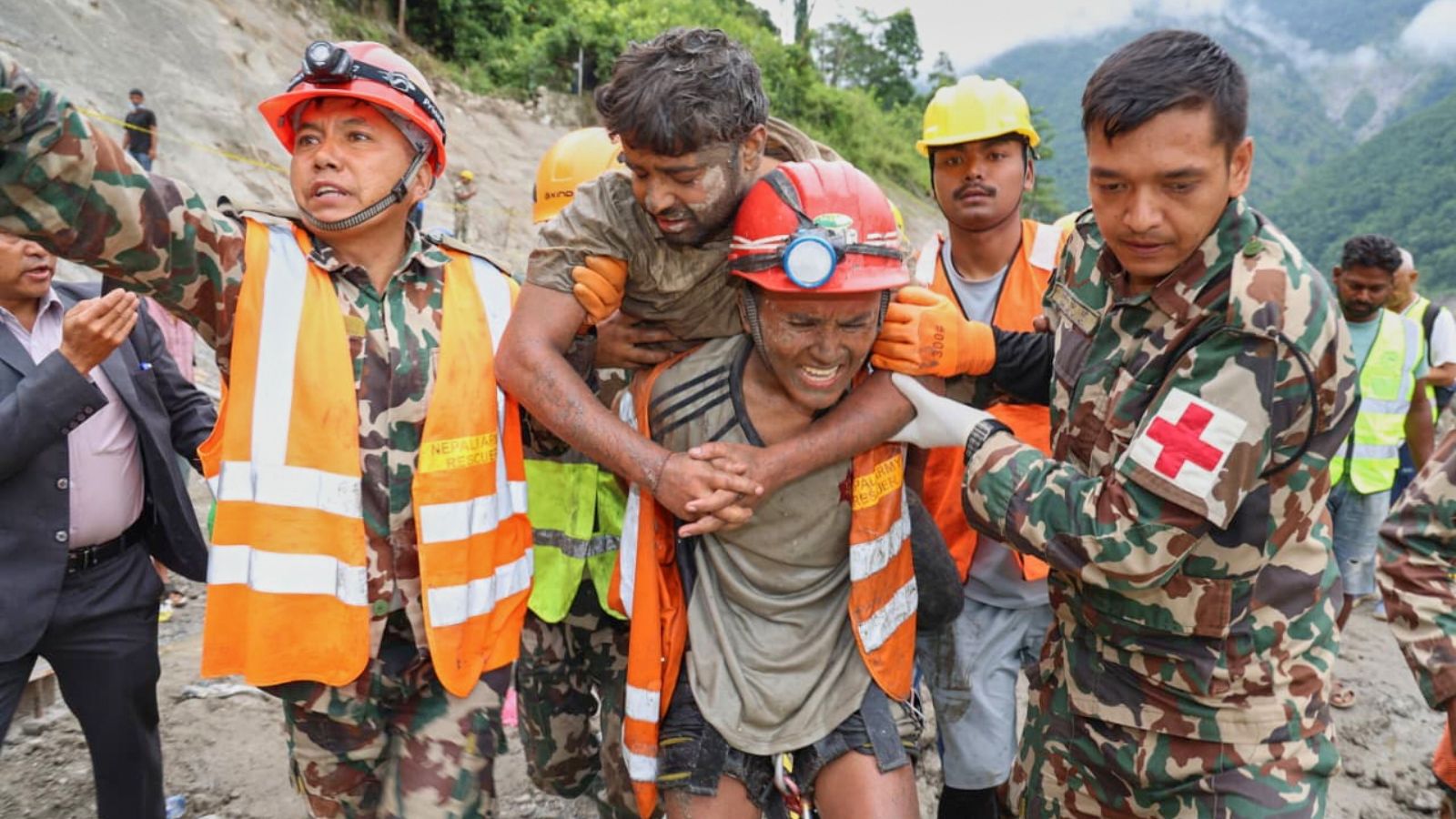
Nine days after a catastrophic flood erased the landscape and choked the Upper Trishuli 3A Hydropower Station with 170 meters of mud, two workers walked out of the dark. Sanjay Sah and Kabir Maharjan survived a subterranean entombment that defied statistical probability, emerging into the daylight on a Friday that rewrote the margins of disaster engineering. Their extraction is not merely a heartwarming tale of human endurance. It is a grueling case study in high-stakes underground excavation, pinpoint geospatial triage, and the narrow physics of air pockets beneath hundreds of tons of slurry.
When the flood struck the Trishuli valley, it did more than wash away infrastructure. It obliterated geographical markers, turning the valley floor into an unrecognizable desert of silt, rock, and displaced timber. For the rescue teams mobilized by the Nepali Army and international advisors, the mission began with a maddening logistical void. The tunnel entrance had vanished entirely.
The Geometry of a Disappearing Portal
In typical subterranean search operations, responders begin at a known portal. Here, the portal was buried beneath layers of compacted mud and car-sized boulders dropped by a wall of water. Rescuers had to reconstruct the geography of the plant from memory, surviving helicopter footage, post-disaster satellite imagery, and fragmented pre-disaster topographic maps. They triangulated the position of the missing infrastructure by cross-referencing surviving surface anomalies, such as bent power poles and tree lines.
Once heavy excavators finally exposed the suspected zone, the brute-force reality of tunneling through disaster debris set in. The interior of the conduit was choked with thousands of cubic meters of sediment. Clearing it required a delicate balance between mechanical excavation and controlled explosive charges. Engineers on site faced a terrifying paradox. Using explosives inside a blocked tunnel where survivors might be breathing trapped air runs the distinct risk of triggering secondary collapses or directing lethal shockwaves through confined spaces.
The Nepal Army executed these blasts with surgical precision, breaking down multi-ton boulders that blocked passage while keeping the surrounding structural integrity intact. Concurrently, pumps were hauled to the site to fight rising internal water levels, while drainage trenches were slashed toward the nearby riverbed to bleed off residual flooding.
Inside the Air Pocket
Sanjay Sah, a 30-year-old mechanical foreman with the Nepal Electricity Authority, had stayed behind to push his colleagues toward safety as the wall of water descended on the control room. Instead of escaping, he was caught in the rush, eventually finding refuge roughly 170 meters deep inside the mountain.
Survival for over 200 hours in a subterranean tomb relies entirely on micro-environments. Deep-tunnel engineering reveals that large-diameter conduits often trap pockets of compressed air near their ceilings when water surges through horizontally. Sah and Maharjan endured by clinging to these upper strata of the tunnel profile, where oxygen remained at just sufficient levels to sustain consciousness, albeit in a severely dazed state.
For nine days, Sah combated sensory deprivation and the psychological weight of total darkness by reciting mantras. Communication with the outside world was nonexistent until heavy drill bits and rescue workers pierced the final plug of debris. Rescuers advancing through a tiny, person-sized crawl space near the top of the tunnel arch finally heard faint acoustic returns from the interior.
The Engineering Reality Beyond the Miracle
While global headlines celebrate the extraction of Sah and Maharjan, the broader structural crisis across Nepal's hydropower sector remains stark. Authorities note that hundreds of workers remain missing across multiple valley projects following the disaster. The success at Trishuli 3A has transformed rescue doctrine, shifting operations from recovery missions to aggressive, targeted air-pocket probings in upper-level tunnel sections—what disaster specialists term the "Goldilocks zones" of compromised underground stations.
Yet, the operation underscores glaring vulnerabilities in how underground industrial complexes are designed to handle extreme climate-induced hydrological events. Standard safety protocols assume rapid evacuation routes that rely on surface access points remaining clear. When entire mountainsides liquefy and pour directly into intake tunnels, those evacuation routes become death traps.
The physical toll on the survivors tells its own story. Transported immediately to military medical facilities in Kathmandu, both men exhibited the classic physiological markers of prolonged confinement, dehydration, and crush syndrome indicators. Their psychological recovery will mirror the physical rehabilitation—long, arduous, and lived in the shadow of an event that should have ended differently.
As heavy machinery continues to churn through the remaining blockages in the Trishuli valley, the focus shifts back to the silent kilometers of concrete stretching deep into the rock face. The extraction of two men proves that human endurance can outlast the clock under specific, improbable conditions. Whether the remaining search zones hold similar answers depends entirely on the precision of the drills and the resilience of the air pockets left behind in the dark.