The friction surrounding Nvidia, CEO Jensen Huang, and alleged China espionage stems from a fundamental clash between globalized silicon supply chains and aggressive national security policy. Over the past several years, the world's most valuable chipmaker has found itself trapped between Washington's tightening export controls and Beijing's relentless drive for artificial intelligence self-sufficiency. While headlines often frame this as a traditional spy thriller involving stolen blueprints, the reality on the ground is far more systemic, encompassing insider intellectual property theft, shell-company smuggling networks, and fierce political scrutiny over Huang's personal diplomacy in mainland China.
Anyone who has covered the semiconductor sector for more than a decade knows that hardware doesn't respect borders. For thirty years, the industry operated on a simple premise: design in California, fabricate in Taiwan, assemble in mainland China, and sell everywhere. That era is dead. Today, the graphics processing units (GPUs) that power large language models are treated less like commercial electronics and more like enriched uranium.
The Anatomy of Modern Silicon Espionage
When people hear the word espionage, they picture trench coats and microdots. In the semiconductor industry, it looks like a departing engineer downloading terabytes of proprietary source code onto a personal hard drive before boarding a flight to Shenzhen.
Nvidia has been a prime target for this exact form of insider threat, though it is rarely alone. Across Silicon Valley, tech giants have spent the last decade fortifying their internal networks against employees recruited by state-backed Chinese talent programs. The mechanics are straightforward. A rival entity—often funded by municipal or state investment vehicles in China—offers an engineer a massive compensation package, equity, and a leadership title to build a domestic alternative from scratch. To jumpstart the timeline, the recruit brings along trade secrets.
Consider the documented mechanics of trade secret litigation across the chip sector. Companies routinely discover anomalies in their data-loss prevention logs only after an employee submits their resignation. By the time forensic teams trace the unauthorized access to Register Transfer Level (RTL) code or proprietary CUDA compiler architectures, the files have already crossed jurisdictions where Western court injunctions carry zero weight.
It isn't just about stealing files. It is about compressing time. Designing a competitive AI accelerator from a blank sheet of paper takes five to seven years and billions of dollars. Acquiring the verification scripts, thermal management data, and interconnect protocols of an existing market leader shaves years off that development cycle. For Nvidia, whose moat relies heavily on its software ecosystem rather than just raw transistor counts, protecting its internal codebase is a matter of existential survival.
Washington's Export Controls and the Smuggling Underground
To understand why the espionage and compliance controversies around Nvidia have escalated so dramatically, you have to look at October 2022. That was the month the U.S. Department of Commerce's Bureau of Industry and Security (BIS) dropped a regulatory bomb, restricting the export of high-end AI chips—specifically the A100 and H100—to China.
Nvidia responded like any profit-driven public company would. It engineered around the rules. Within weeks, the company introduced the A800 and H800, processors deliberately throttled to reduce chip-to-chip interconnect speeds just enough to fall beneath the Commerce Department's thresholds. Washington wasn't amused. In October 2023, regulators closed that loophole, banning the modified chips and forcing Nvidia to create an even more restricted line, including the H20, tailored specifically for the Chinese market.
Whenever a government bans a high-demand commodity without eliminating the underlying demand, a black market emerges instantly.
Across electronics hubs like Huaqiangbei in Shenzhen, underground brokers began openly advertising restricted Nvidia hardware. How did chips subject to strict U.S. export licensing end up in Chinese server racks? Not through state-sponsored hacking, but through mundane, decentralized smuggling networks.
How the Gray Market Operates
- Shell Entities: Intermediaries register innocuous-sounding technology firms in third-party jurisdictions across Southeast Asia, the Middle East, or Europe.
- Server Bundling: Rather than buying bare GPUs, which attract immediate regulatory scrutiny, brokers purchase complete, pre-assembled server racks from authorized original equipment manufacturers (OEMs).
- Physical Diversion: Once the servers clear customs in a permitted country, the hardware is stripped down, repacked into unmarked shipping containers, and routed through Hong Kong into mainland China.
- Cloud Arbitrage: When physical chips prove too difficult to move, Chinese AI labs simply rent compute clusters hosted in data centers outside China, bypassing physical border controls entirely.
Nvidia has repeatedly stated that it complies strictly with all U.S. export regulations and requires its distributors to do the same. Yet, in a global supply chain moving millions of components a month, tracking every individual processor after it leaves a contract manufacturer's loading dock is nearly impossible. Critics in Washington argue that Nvidia hasn't policed its downstream partners aggressively enough, turning a blind eye to suspicious volume spikes in regions with minimal domestic AI infrastructure.
Jensen Huang on the Geopolitical Tightrope
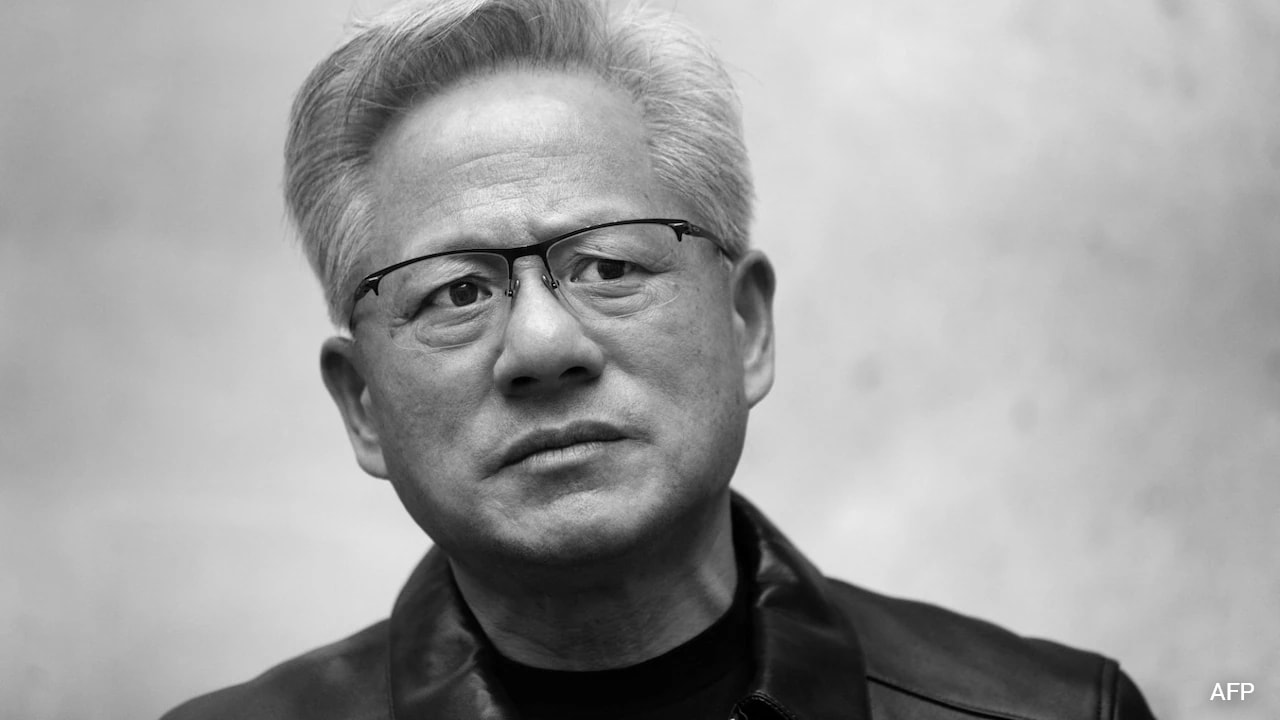
At the center of this storm stands Jensen Huang, a founder who has navigated every major technological shift in computing since 1993. Born in Taiwan and raised in the United States, Huang possesses a rare cultural fluency that served Nvidia brilliantly during the decades of seamless globalization. Now, that exact positioning makes him a lightning rod.
In early 2024, Huang made a low-profile trip to mainland China, visiting Nvidia's offices in Beijing, Shanghai, and Shenzhen. Videos surfaced on Chinese social media showing the billionaire CEO wearing a traditional floral vest, dancing at a company Lunar New Year celebration. In Silicon Valley, it looked like standard corporate morale-building. In Washington, national security hawks viewed it through a much darker lens.
Lawmakers on the House Select Committee on the Chinese Communist Party have repeatedly questioned whether American chip executives are prioritizing quarterly revenue over national security. For years, mainland China and Hong Kong accounted for roughly 20 to 25 percent of Nvidia's data center revenue. Walking away from a market of that scale isn't something any CEO does voluntarily, especially when Wall Street demands relentless quarter-over-quarter growth.
Huang has been unusually candid about the dilemma. He has warned publicly that overly aggressive export controls will ultimately backfire on the United States. His argument rests on basic industrial economics: if American companies are legally barred from selling to Chinese developers, those developers will have no choice but to pour capital and talent into domestic competitors like Huawei. Once a rival ecosystem matures inside a protected market of 1.4 billion people, it won't stay confined to China. It will eventually challenge American dominance globally.
The Taiwan Factor and Supply Chain Vulnerability
You cannot separate the Nvidia controversy from the geography of Taiwan. Nvidia is a fabless semiconductor company. It designs the chips, writes the software, and manages the architecture, but it does not own a single fabrication plant. Every cutting-edge GPU Nvidia sells is etched onto silicon wafers by Taiwan Semiconductor Manufacturing Company (TSMC) and packaged using advanced techniques like CoWoS (Chip-on-Wafer-on-Substrate) on the island.
This concentration creates an acute intelligence vulnerability. Taiwan sits roughly 100 miles off the coast of mainland China and has been the target of relentless cyber intrusion and human intelligence operations for decades. Prosecutors in Taipei routinely bring charges against individuals accused of poaching local engineering talent or funneling proprietary process technology to mainland firms.
While TSMC's manufacturing secrets are distinct from Nvidia's architectural designs, the two are deeply intertwined during the production process. Nvidia engineers work closely with TSMC teams to optimize yields and debug silicon defects. Any breach at the foundry level—or among the dozens of Taiwanese printed circuit board and cooling suppliers that form Nvidia's ecosystem—exposes sensitive technical specifications.
Furthermore, the sheer economic leverage Beijing holds over the broader Taiwanese business community complicates corporate security. Many suppliers that build components for Nvidia's data center servers operate massive factories in mainland China. Executives at these firms must constantly balance compliance with American intellectual property rules against maintaining smooth regulatory relationships with local Chinese authorities.
Software Is the Real Battleground
Much of the public debate focuses on hardware specifications—teraflops, memory bandwidth, and interconnect speeds. That misses the actual point. Hardware can be reverse-engineered, smuggled, or eventually matched through brute-force engineering. Nvidia's true dominance rests on CUDA, its proprietary parallel computing platform and programming model.
For nearly two decades, Nvidia gave CUDA away to universities, researchers, and startups. Millions of developers learned how to write AI models specifically optimized for Nvidia's architecture. Switching away from CUDA to a competing chip isn't as simple as unplugging one server and plugging in another; it requires rewriting massive codebases and retraining engineering teams.
Because CUDA is so entrenched, espionage and reverse-engineering efforts increasingly target software compatibility layers. Rival chipmakers in China aren't just trying to build faster silicon; they are trying to build translation layers that allow existing CUDA code to run seamlessly on non-Nvidia hardware.
This creates a gray zone in intellectual property law. Writing an independent software compiler that mimics the behavior of an established standard isn't necessarily illegal—clean-room reverse engineering has a long history in computing. However, when engineers who previously had access to Nvidia's internal source code suddenly appear at startups developing CUDA-compatible software stacks, alarm bells ring across Silicon Valley's legal departments.
The Structural Paradox of National Security Capitalism
The ongoing controversy surrounding Nvidia, Jensen Huang, and China isn't a temporary scandal that will resolve once a few court cases conclude or a new set of export rules takes effect. It is the permanent operating condition of the modern technology sector.
Washington wants American firms to maintain absolute technological supremacy over Beijing, yet that supremacy was historically funded by selling products into global markets—including China. Meanwhile, Beijing is determined to eliminate its reliance on Western silicon, using every state-backed industrial policy, talent recruitment drive, and gray-market procurement channel at its disposal to close the gap.
Caught in the middle, Nvidia has implemented stricter internal access controls, expanded its compliance teams, and redesigned its product roadmap multiple times to satisfy regulators. Yet as long as a single high-end GPU can generate massive economic and military advantages, the incentives to steal the designs, poach the engineers, or smuggle the hardware will always outpace the ability of compliance officers to stop them.