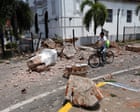
The ground beneath the central provinces of Panama did not just shake; it groaned, fractured, and then kept moving. When a magnitude 7.7 earthquake struck off the southern coast, followed swiftly by a 6.6 tremor and a relentless barrage of over one hundred aftershocks, the immediate panic rippled far beyond the epicenters in Herrera, Veraguas, Coclé, and Los Santos. In Panama City, skyscrapers swayed violently, office workers emptied onto asphalt, and the illusion of an impenetrable modern commercial fortress evaporated in seconds.
Yet, as the dust settled over cracked colonial masonry and ruined rural roofs, a peculiar narrative took hold across international wire services. Observers pointed to the remarkably low direct casualty count—just dozens of injuries and zero immediate fatalities—and credited Panama's stringent building codes for averting a mass catastrophe.
That assessment is dangerously incomplete. Focusing solely on the survival rates in the high-rises of the capital masks the grinding, structural vulnerability exposed in the nation's interior.
The Anatomy of the Fault Line
Geologically, Panama occupies a complex tectonic jigsaw puzzle. The nation sits where the Cocos, Nazca, and Caribbean plates grind against one another, all interacting within the volatile architecture of the Pacific Ring of Fire. When the initial rupture occurred at a shallow depth of ten kilometers, the energy release was direct and brutally efficient. Shallow-focus earthquakes characteristically trap high-frequency seismic waves near the surface, turning ordinary soil into a dynamic liquid and wreaking disproportionate havoc on rigid structures that lack ductile engineering.
Government officials moved quickly to declare a state of emergency, deploying civil protection units and mobilizing relief supplies. But emergency decrees do not instantly rebuild washed-out roads or clear landslides that cut off remote agricultural communities. While Tocumen International Airport resumed operations swiftly after structural checks and the Panama Canal Authority reported normal navigation following rapid safety protocols, rural towns in the central provinces found themselves isolated with compromised water treatment facilities and shattered infrastructure.
Houses built of traditional materials crumbled into heaps of adobe and tile. Historic landmarks like the San Atanasio church in La Villa de Los Santos—a structure that weathered centuries—suffered severe structural damage.
The Tale of Two Panamas
The stark divide revealed by the tremors lies in structural disparity. Modern commercial towers in Panama City are engineered with rigorous seismic parameters, utilizing advanced dampening and deep-pile foundations designed to flex under stress. These skyscrapers performed precisely as intended, preventing a corporate-center apocalypse.
Contrast that engineering reality with the interior provinces, where hundreds of residential homes and public schools lacked the capital's structural safeguards. Weeks after the initial shockwaves, thousands of residents remained displaced, housed under temporary canvas tents or crowded into makeshift shelters. The emergency response prevented a humanitarian slaughter, but it exposed a widening equity gap in disaster resilience. Urban centers feature engineered protection, while rural populations depend on aging, unreinforced masonry that cannot survive a major tectonic event.
The Cost of Prolonged Shaking
Earthquakes are not isolated chronological moments; they are ongoing psychological and mechanical processes. The true wear and tear on a community often comes from the tail. More than one hundred aftershocks, some scaling past magnitude 5.8, kept a traumatized populace sleeping on park lawns and public squares.
This continuous seismic background noise degrades weakened structures incrementally. A wall that survived the initial 7.7 jolt might lean precariously after the third or fourth significant aftershock, transforming a minor tremor into an unexpected collapse hazard. Local emergency services found themselves locked in a permanent triage loop, responding to fresh fissures and structural failures days after the primary event had faded from foreign news cycles.
As international aid trickles in and temporary shelters become semi-permanent fixtures for thousands, the deeper test for Panamanian authorities begins. The country dodged a historic mortality disaster, but the crisis laid bare the urgent need to extend seismic retrofitting far beyond the profitable skyline of the capital and into the rural heartland.