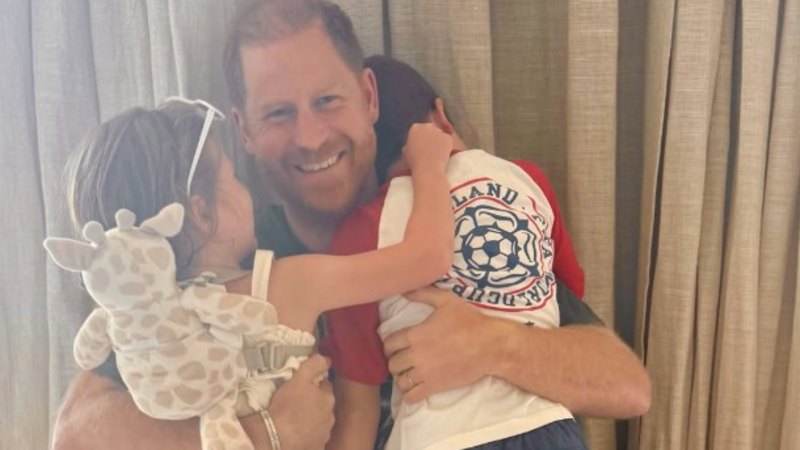
Prince Harry and Meghan Markle pulled their children, Prince Archie and Princess Lilibet, from a British school just two days after the term began, following immediate vulnerability assessments raised by their private security team regarding transit logistics and localized threat exposure. The abrupt pivot underscores a much wider institutional fracture: the ongoing, bitter standoff between the Duke of Sussex and the British government over state-funded police protection.
When the family relocated back to the United Kingdom after six years in California, they expected a managed transition. Instead, reality hit the pavement within forty-eight hours. The initial school run exposed severe vulnerabilities in route predictability, traffic bottlenecks, and the structural limitations imposed on private bodyguards operating under British law. Private security details in the UK do not carry firearms, nor do they possess real-time access to national intelligence databases or police convoy protocols. For a high-profile target class featuring young royals, relying entirely on commercial-grade private protection while navigating predictable daily transit corridors is an operational hazard.
The Mechanics of the Threat Assessment
To understand why a school transfer happens after only two days, one must look at how threat mitigation functions for high-value targets. Protective intelligence units prioritize predictability reduction. A static daily schedule—dropping children off at the exact same hour via identical arterial roads—creates a predictable pattern.
In this specific case, the private detail flagged the physical layout of the route. Heavy congestion forced vehicles into slow-moving queues, compounding vulnerability windows. In executive protection terms, a stationary vehicle trapped in traffic is a soft target. When the risk analysis revealed that local paparazzi and unvetted bystanders could easily map the exact timing and positioning of the children's commute, the security detail advised an immediate extraction and relocation to a more sequestered environment.
This friction highlights the deep chasm between public perception and physical reality. Critics frequently argue that private wealth should completely offset security overhead. Yet money cannot buy legislative exemptions. British firearms regulations strictly restrict weapon permits, meaning private contractors hired by the Sussexes cannot provide the armed deterrence that tier-one diplomatic protection officers routinely supply.
The Executive Committee for the Protection Equation
The timing of the school shuffle coincides with ongoing deliberations by the Executive Committee for the Protection of Royalty and Public Figures, known as RAVEC. Harry has spent years locked in legal battles to overturn decisions downgrading his security status after he stepped back from official royal duties.
Government counsel has consistently maintained that because the Duke no longer performs official working royal duties, and because he resides abroad for extended periods, his family does not automatically qualify for taxpayer-funded Met Police protection. Yet, each time the family touches down on British soil, the threat matrix shifts dynamically. The Department for Executive Protection faces an unenviable precedent: granting bespoke security to non-working royals opens administrative and financial floodgates, while denying it leaves a high-profile target vulnerable to fixated individuals and aggressive media elements.
The friction also exposes the limitations of celebrity privacy management in Europe compared to North America. While paparazzi laws and estate buffers in regions like Montecito offer a degree of spatial isolation, the densely populated infrastructure of the UK makes complete anonymity nearly impossible for descendants of the monarch. Every public movement is scrutinized, every vehicle is logged, and every change in routine becomes headline fodder.
The Broader Strategic Miscalculation
The episode points to a fundamental failure in advance planning between the family's private advisors and local logistical coordinators. Moving children into an educational institution without thoroughly stress-testing the transit route weeks in advance suggests a rushed reentry.
In security logistics, the first rule of asset relocation is reconnaissance. If the primary and secondary routes fail baseline security thresholds—such as maintaining continuous movement, avoiding choke points, and ensuring immediate egress options—the asset should never be introduced to the location. Pulling Archie and Lilibet after two days is an admission of tactical failure during the initial deployment phase.
As RAVEC evaluates the updated risk assessments for both Harry and Meghan, incidents like this serve as weaponized data points for both sides. To the Duke's legal team, the forced school move is empirical proof that private measures are insufficient against the unique threat profile facing the monarch's grandchildren. To detractors, the episode is framed as self-inflicted drama designed to force the government’s hand on state-funded protection.
The reality lies in the cold mathematics of risk management. Until a definitive agreement is reached regarding who secures the perimeter, the family's movements across the UK will remain a reactionary exercise in crisis management rather than a sustainable routine.