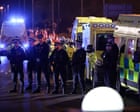
Viral footage showing Immigration and Customs Enforcement agents detaining a father and his young daughter on a Seattle jet bridge has ignited fierce protests across the Pacific Northwest and exposed the hidden mechanics of domestic transit enforcement. While initial local news coverage focused strictly on the emotional shock of the confrontation at Seattle-Tacoma International Airport, the deeper story lies in how federal authorities use commercial aviation manifests, local sanctuary loopholes, and statutory transit zones to execute arrests far from any international border.
The incident itself unfolded in minutes. Passengers boarding an outbound flight watched as plainclothes officers intercepted the pair right before they stepped onto the aircraft. Cellphone cameras rolled. The resulting clip spread rapidly across regional social media networks, drawing hundreds of demonstrators to the airport terminal and federal detention facilities in Tacoma within hours.
To understand why this specific arrest triggered such an immediate, visceral reaction in Seattle, you have to look beyond the video frame and examine the friction between federal immigration mandates and local sanctuary policies.
The Anatomy of a Jet Bridge Enforcement Action
Most travelers assume that clearing Transportation Security Administration checkpoints means they are free to board their plane. That assumption is wrong. Commercial airports are uniquely porous environments when it comes to federal law enforcement jurisdiction, operating under overlapping layers of local port authority rules and sweeping federal statutes.
When ICE conducts an operation inside a terminal or on a jet bridge, it is rarely a random sweep. These are targeted actions built on data shared long before a passenger ever arrives at the departure gate.
How Passenger Data Moves From Airlines to Federal Agents
Every time a traveler books a domestic flight, the airline collects Passenger Name Record data alongside standard Secure Flight information—full legal name, date of birth, and gender. While TSA uses this data primarily to screen against terrorist watchlists, federal law enforcement agencies maintain well-established pipelines to cross-reference flight manifests against administrative immigration databases.
If an individual has an active deportation order, an unresolved immigration court appearance, or a prior removal record, their booking can trigger an automated alert. Agents do not need to guess which gate a target will use. They know the flight number, the seat assignment, and the exact boarding window.
Why Agents Wait Until Boarding
Arresting someone at the curb or in a crowded ticketing lobby carries operational risks. Public concourses offer multiple exit routes, unpredictable crowd dynamics, and high visibility.
A jet bridge, by contrast, is a sterile, enclosed bottleneck. Once a passenger scans their boarding pass and walks down that narrow corridor toward the aircraft door, there is nowhere left to run. From a tactical standpoint, federal agents favor the jet bridge because it isolates the subject from the general public. The irony in Seattle was that the doors to the gate area were still open, allowing fellow passengers to film the entire encounter and broadcast it to the world before the plane even pushed back from the gate.
The Sanctuary City Collision Course
Seattle and King County enforce some of the strictest local sanctuary ordinances in the United States. Under municipal and county laws, local police officers and jail administrators are strictly prohibited from honoring federal immigration detainers unless those requests are accompanied by a judicial warrant signed by a federal judge.
For years, those local policies successfully choked off the traditional pipeline between county jails and ICE detention centers. Federal agents could no longer rely on local sheriffs to hold undocumented residents past their release dates.
So ICE adapted.
When local governments close the jailhouse doors, federal enforcement shifts to public spaces, courthouses, and transportation hubs. Sea-Tac Airport sits within the jurisdiction of the Port of Seattle, which maintains its own police department and adheres to regional welcoming-city principles. Yet the Port of Seattle cannot legally bar federal agents from operating inside federalized aviation spaces or executing administrative warrants in public terminals.
This jurisdictional tug-of-war creates a recurring flashpoint. Local officials publicly condemn the optics of family arrests at the airport, pointing out that such tactics erode public trust and discourage immigrant communities from reporting crimes or traveling safely. Federal officials counter that local sanctuary laws leave them no choice. Denied the ability to conduct transfers inside secure county jails, ICE argues that officers are forced to make arrests in open environments like airport terminals, increasing the likelihood of public confrontation and collateral distress.
The Legal Gray Zone of Domestic Travel
A common misconception among the public—and even among some travelers—is that constitutional protections against warrantless searches and seizures apply identically everywhere inside the United States. In reality, federal immigration enforcement operates under a distinct set of legal rules that expand dramatically near borders and ports of entry.
Under federal regulations, Customs and Border Protection agents hold broad authority to question individuals about their citizenship within a 100-mile external boundary zone. Because Seattle sits directly on Puget Sound, the entire metropolitan area, including Sea-Tac Airport, falls squarely inside that 100-mile radius.
While ICE is a separate agency from CBP and primarily enforces interior immigration law rather than border inspections, the proximity to an international port of entry blurs the operational boundaries. Even on purely domestic flights, travelers inside major coastal hubs routinely encounter multiple uniformed and plainclothes federal agencies operating side by side.
Consider a hypothetical scenario to see how this plays out in practice. Suppose a father with a pending asylum appeal books a domestic flight from Seattle to Chicago to attend a family wedding. He uses a valid, state-issued driver's license at the TSA checkpoint. TSA verifies his identity and waves him through because his identification is legitimate and he poses no aviation security threat. Twenty minutes later, at the gate, ICE agents step forward with an administrative warrant—a document signed by an ICE supervisor rather than a federal judge. Because the arrest occurs in a public area of the terminal rather than inside a private residence, the agents do not need a judicial warrant to take him into custody.
For families traveling with children, the consequences of that distinction are immediate and devastating.
What Happens to Children During Enforcement Actions
The viral video from Seattle struck a nerve largely because a child was directly involved in the detention. Federal agencies operate under formal directives governing parental interests, designed in theory to prevent the unnecessary separation of families and ensure minor children are placed with verified relatives or child welfare services when a parent is detained.
In practice, the speed of an airport arrest leaves little room for deliberate care planning.
When a parent is intercepted on a jet bridge, agents face an immediate logistical problem regarding what to do with the accompanying minor. If another adult relative is not present at the airport, the child is often transported alongside the parent to a regional processing facility—in the Pacific Northwest, typically the Northwest ICE Processing Center in Tacoma—while agents attempt to contact family members or coordinate with state child protective services.
Advocates and immigration attorneys in Washington state have repeatedly documented the trauma caused by these rapid detentions. Even when parent and child remain together during initial processing, the sudden transition from a commercial flight gate to a secure federal holding room happens without warning, legal counsel, or preparation.
The Role of the Northwest ICE Processing Center
Every high-profile immigration arrest in western Washington inevitably leads back to the Tacoma facility. Operated by a private prison contractor on behalf of ICE, the 1,575-bed detention center has served as the epicenter of Pacific Northwest immigration protests for more than a decade.
When footage of the Seattle airport arrest hit the internet, protesters did not just gather at Sea-Tac. They mobilized outside the Tacoma gates because local activists know the exact logistical pipeline. Individuals detained at Seattle transportation hubs are routinely booked into Tacoma within hours, processed for expedited removal, or placed on charter deportation flights departing from nearby Boeing Field.
That institutional memory explains why the Seattle protests escalated so quickly. For local advocacy networks, the video was not an isolated shock; it was visible proof of a system they have spent years trying to dismantle.
The Industry Blind Spot in Commercial Aviation
While politicians and activists trade blame over immigration policy, the commercial aviation industry largely escapes scrutiny for its passive role in facilitating these arrests.
Airlines are legally required to transmit passenger manifest data to the federal government under post-9/11 aviation security mandates. Carriers have zero discretion over whether to share that information with the Department of Homeland Security. Once the data enters federal servers, airlines lose visibility into how different agencies use it.
Yet the operational reality on the ground puts airline gate agents and flight crews in an impossible position.
Gate agents are trained in customer service, baggage compliance, and boarding efficiency. They are not constitutional lawyers or law enforcement liaisons. When plainclothes federal officers approach a podium, flash credentials, and demand access to the jet bridge, airline employees have little practical choice other than to step aside. Interfering with federal agents executing a warrant can expose airline staff to obstruction charges and federal penalties.
Still, the reputational fallout lands squarely on the carriers and the airport authority. Passengers who witness an emotional arrest during boarding rarely distinguish between TSA screeners, airline staff, Port of Seattle police, and ICE deportation officers. To the average traveler watching a father and daughter get pulled off a flight, the entire airport ecosystem feels complicit.
Why Viral Videos Rarely Change Enforcement Policy
Public outrage over recorded immigration arrests follows a predictable cycle. A disturbing clip emerges. Elected officials issue statements expressing concern and demanding answers from federal leadership. Protesters rally outside federal buildings. Within two weeks, the news cycle moves on, while the underlying enforcement mechanisms remain completely untouched.
There is a structural reason for this inertia. ICE enforcement priorities are set at the executive level in Washington, D.C., insulated from local political pressure in cities like Seattle. Municipal mayors, county executives, and port commissioners hold zero statutory authority over federal immigration agents. They can pass resolutions, restrict local police cooperation, and fund legal defense networks for detainees, but they cannot rewrite the Immigration and Nationality Act.
Furthermore, federal agencies view public jet bridge arrests as legally sound under existing Supreme Court precedent. Courts have consistently held that individuals have a diminished expectation of privacy in public spaces and commercial transportation terminals. As long as agents possess valid administrative authority and do not use excessive force, judicial challenges to the location of the arrest almost always fail.
What Travelers and Advocates Actually Need to Know
Understanding the gap between public perception and legal reality is essential for anyone navigating immigration risks in the United States. The rules governing domestic air travel are widely misunderstood, often with life-altering consequences for mixed-status families.
First, domestic flights do not offer a safe harbor from federal immigration databases. Presenting a valid state driver's license or foreign passport at security satisfies TSA identity verification, but the underlying reservation data remains accessible to Department of Homeland Security components.
Second, knowing the difference between an administrative warrant (Form I-200 or I-205) and a judicial warrant matters, though its practical utility shrinks inside an airport. While an administrative warrant does not authorize ICE agents to enter a private home without consent, it gives them full authority to arrest a named individual in any public space, including an airport concourse or boarding bridge.
Third, families with unresolved immigration cases should never travel without a documented emergency care plan. Carrying notarized caregiver authorization forms and keeping emergency contact numbers memorized—not just stored on a locked smartphone that agents can confiscate—can prevent a detained parent's child from entering state foster care while relatives scramble to locate them.
The protests in Seattle forced a uncomfortable reality back into public view. Commercial airports are no longer just transit hubs connecting cities; they are active enforcement corridors where federal data systems, local sanctuary limits, and human lives collide in full view of the boarding line.