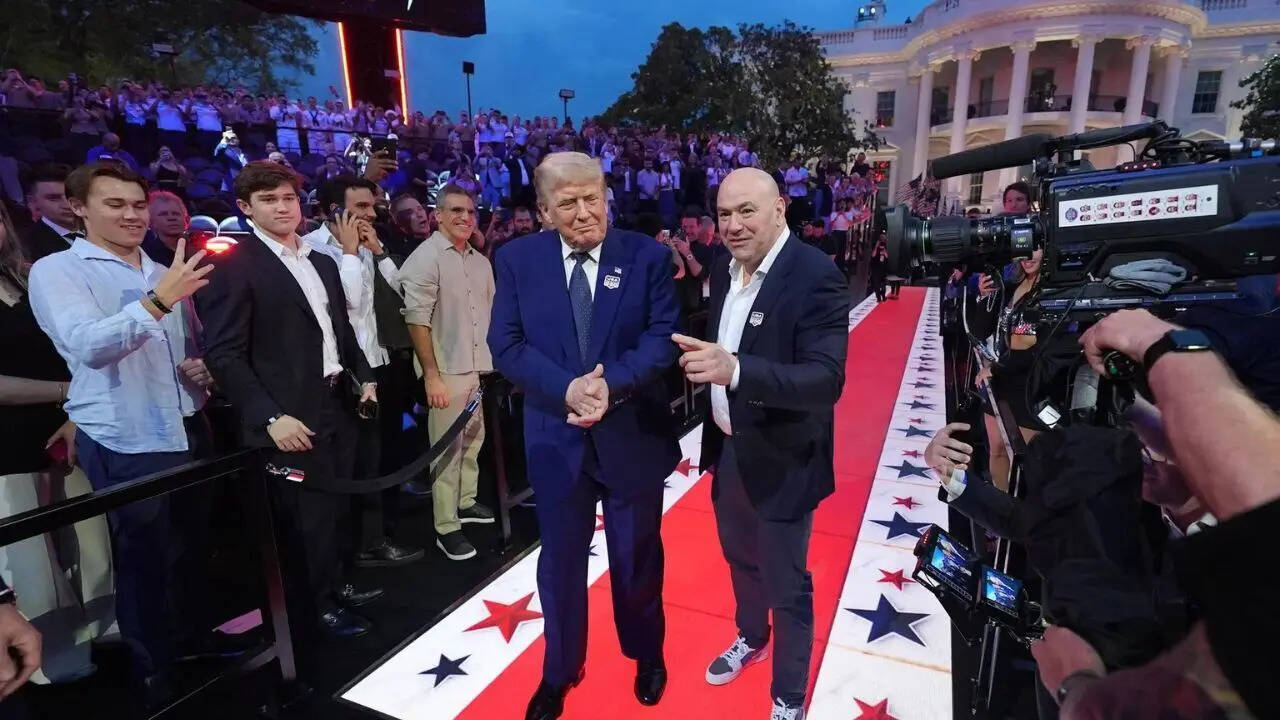
The modern presidential security apparatus is facing its most severe operational strain since the Cold War. Federal law enforcement agencies recently neutralized a sophisticated, multi-layered conspiracy targeting President-elect Donald Trump, Vice President-elect JD Vance, and high-profile guests including tech executive Elon Musk and Israeli Prime Minister Benjamin Netanyahu. The planned assault was timed to coincide with a major public appearance at a Ultimate Fighting Championship (UFC) event at Madison Square Garden.
FBI counterterrorism teams moved swiftly to arrest five individuals connected to the plot, preventing what intelligence officials describe as a highly coordinated attempt to breach executive protection perimeters. This operation highlights critical vulnerabilities in securing high-density commercial venues when multiple high-profile international targets gather simultaneously.
The Evolution of the Venue Threat
Securing an arena holding twenty thousand spectators presents unique geometric and tactical challenges. Traditional security design relies on a series of concentric rings meant to push potential threats far away from the protectee. In a dense urban environment like Manhattan, those rings compress significantly.
Federal indictments indicate the suspects sought to exploit the chaotic transit corridors surrounding the venue. Rather than attempting to smuggle conventional weapons past the primary magnetometers, the group focused on the logistical choke points where VIP motorcades enter and exit the facility. This shift in tactics reflects a broader trend among modern threat actors who recognize that the interior of a federal security perimeter is highly secure, but the transition zones remain vulnerable.
Tactical teams analyzing the plot noted that the presence of foreign heads of state alongside domestic political leaders complicates command structures. When local police, federal agencies, and foreign intelligence details share a single physical space, communication lag becomes a distinct hazard. The suspects intended to use this exact friction point to execute their plan.
The Logistics of Coordinated Interception
An operation of this scale requires precise tracking of moving targets. Investigators revealed that the cell utilized commercial tracking data, public flight manifests, and localized surveillance to map out the exact arrival windows of the various targets.
[Concentric Security Rings]
Ring 1: Outer Perimeter (Traffic control, intelligence monitoring)
Ring 2: Middle Perimeter (Avenue checkpoints, credential verification)
Ring 3: Inner Perimeter (Magnetometers, tactical response teams)
Ring 4: Core Protection (Secret Service physical shield)
The coordination required to track multiple distinct motorcades moving through New York City traffic is immense. The cell did not rely on complex cyber espionage; instead, they used readily available consumer technologies. Cheap digital scanners, open-source flight trackers, and physical spotters positioned at key infrastructure nodes allowed them to build a real-time operational picture.
This reliance on commercial tools allowed the conspiracy to remain undetected by traditional signals intelligence monitoring for months. It was only when a member of the cell attempted to procure specialized hardware through a flagged intermediary that the FBI joint terrorism task force initiated the investigation that ultimately led to the arrests.
Decentralized Cells and Low-Signature Procurement
The five individuals taken into custody operated under a decentralized model that has become standard among non-state actors. They did not communicate through centralized command structures, which made early detection via standard metadata analysis exceptionally difficult.
Each operative held a specific functional role within the conspiracy. One handled local logistics and safe houses, two were tasked with physical reconnaissance of the Madison Square Garden exterior, and the remaining two acted as the primary tactical elements. By keeping the operational units small and isolated from one another, the group minimized the risk of a single mistake compromising the entire network.
The procurement strategy further demonstrates the maturity of the plot. The group avoided bulk purchases of restricted items, choosing instead to acquire standard materials across multiple jurisdictions over an eighteen-month period. This slow accumulation of resources is designed specifically to bypass the automated alerts used by financial institutions and law enforcement agencies to spot emerging threats.
The Friction of Joint Force Protection
When a tech executive, a president-elect, and a foreign prime minister occupy the same VIP seating section, the administrative overhead of keeping them safe spikes exponentially. The Secret Service holds statutory authority over domestic political figures, but foreign leaders bring their own heavily armed, highly insular security details.
These foreign teams operate under different rules of engagement and maintain independent communication networks. During a crisis, the lack of an integrated radio frequency can lead to catastrophic misunderstandings. If one detail moves to evacuate their protectee without notifying the central command post, it can trigger a cascading panic that compromises the security of every other VIP in the room.
Communication Challenges in High-Density Operations
- Frequency Allocation: Multiple agencies competing for clean radio bands within a reinforced concrete structure that naturally degrades signal strength.
- Chain of Command: Determining which agency has the ultimate authority to order a venue lockdown or a total evacuation during a fluid situation.
- Intelligence Sharing: The reluctance of foreign intelligence agencies to share real-time threat assessments with domestic local law enforcement due to classification barriers.
The FBI investigation revealed that the conspirators spent considerable time studying past joint-protection details to identify moments of hesitation or poor coordination between agencies. They identified the precise moment of arrival, when authority shifts from the highway patrol escort to the venue's stationary security detail, as the optimal window for disruption.
The Reality of Urban Counterterrorism
Defeating this specific plot required a shift from reactive protection to aggressive, intelligence-driven interdiction. The Secret Service can no longer rely solely on physical barriers and heavy weaponry to guarantee safety in an era where threats are planned in encrypted digital spaces and executed using decentralized tactics.
The arrest of these five individuals prevents a immediate crisis, but the systemic vulnerabilities exposed by the conspiracy remain. As long as high-profile figures continue to gather in commercial venues that are fundamentally designed for public access rather than military-grade defense, the security apparatus will remain under historic strain. The margin for error in these environments is nonexistent, and the tactics employed by adversaries are evolving faster than the bureaucratic structures designed to stop them.