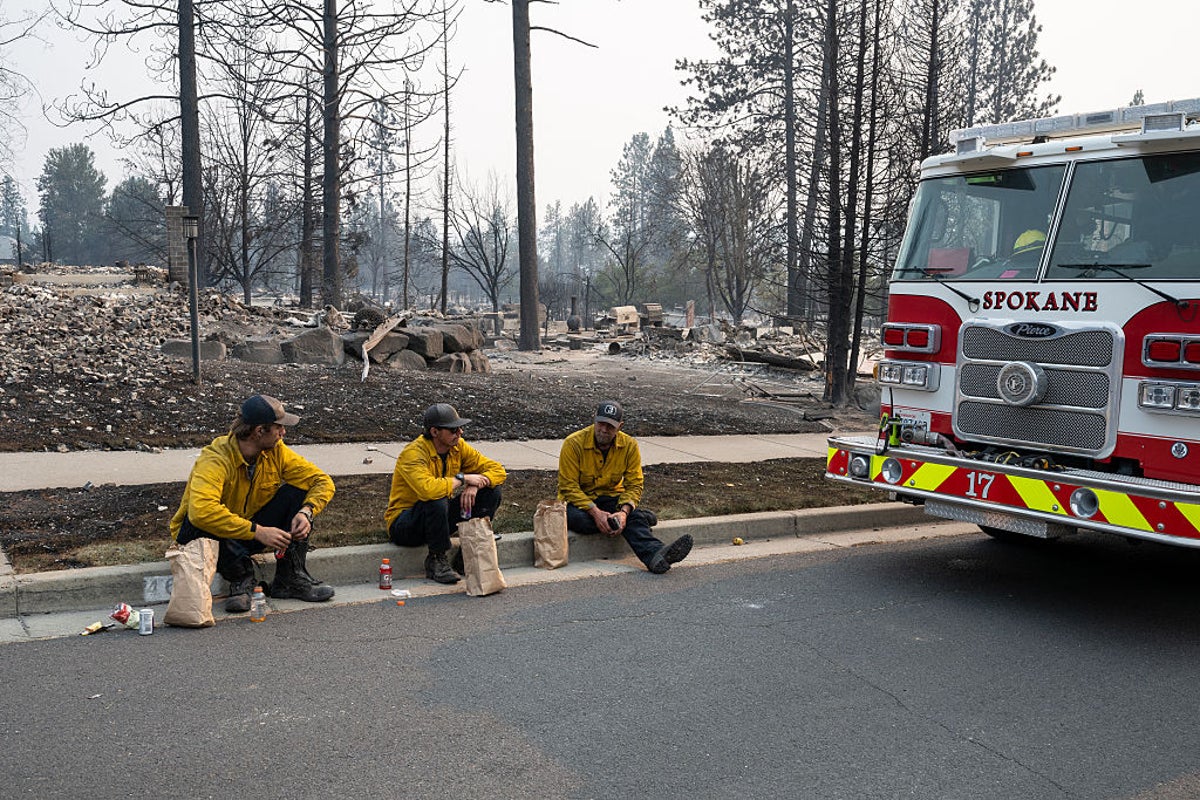
The fires surrounding Spokane did not turn destructive because of bad luck or an unpredictable turn of fate. They turned destructive because decades of ecological neglect collided with a rapidly shifting climate, creating an environment where a single spark behaves like an industrial blowtorch. When the blazes tore through eastern Washington, forcing tens of thousands to flee and reducing hundreds of structures to ash, mainstream reports blamed the usual culprits: dry grass, high temperatures, and sudden winds.
Those factors matter, but they are symptoms of a deeper structural failure. For a closer look into this area, we suggest: this related article.
To understand why modern wildfires in the Inland Northwest defy traditional containment strategies, we have to look past the smoke and examine the mechanics of the Wildland-Urban Interface, or WUI. This zone, where human development bleeds directly into dense timber and native grasslands, has expanded exponentially over the last twenty years. People want the pine trees, the acreage, and the isolation. What they fail to account for is that living inside a tinderbox requires an entirely different standard of infrastructure, one that most municipalities have stubbornly refused to mandate.
The Anatomy of a Fast-Moving Spread
Look at how these fires behave during a red flag warning event. The National Weather Service issues the warnings, pointing to low humidity and sustained winds. Yet, development continues unchecked in high-hazard corridors. For additional background on this issue, in-depth coverage is available on USA Today.
When a fire starts in cured grass, the rate of spread is not linear. It is exponential. Grass fires can travel up to six miles per hour under moderate winds. When gusts exceed forty miles per hour, as they frequently do during late-summer eastern Washington blowups, that speed triples. Flames leap over natural firebreaks, hop four-lane highways, and shower ember storms a mile ahead of the primary front.
Firefighters on the ground face an impossible choice. Do they protect a cluster of homes or try to flank a wall of fire moving faster than a sprinting human?
Consider a hypothetical subdivision built in a wooded canyon outside Spokane. The road network consists of a single narrow, winding access lane designed for rural traffic fifty years ago. When mandatory evacuation orders drop, residents trying to escape head outward while emergency apparatus tries to push inward. The resulting gridlock stalls evacuation trucks, traps civilians, and forces first responders to abandon offensive firefighting to rescue stranded motorists.
This bottleneck effect repeats itself across the county. Infrastructure built for quiet rural living cannot handle high-density mass evacuation during an environmental catastrophe.
The Fuel Load Problem
Decades of fire suppression policies have left local forests choked with fuel. For most of the twentieth century, federal and state agencies operated under a strict mandate: put out every fire by ten o'clock the morning after it started.
While well-intentioned, this policy short-circuited a natural ecological cycle. Low-intensity fires historically swept through the understory every few years, clearing out dead brush, saplings, and accumulated pine needles while leaving mature, fire-resistant Ponderosa pines standing. By suppressing those frequent, low-intensity burns, forest managers inadvertently engineered massive biological storage bins.
When a fire finally breaches a suppressed forest today, it does not stay on the ground. It climbs ladder fuels—small trees and dense brush connecting the forest floor to the upper canopy—and transforms into a crown fire. Crown fires generate their own weather systems, throwing burning debris thousands of feet into the air and creating temperatures hot enough to melt aluminum vehicle wheels.
Thinning projects and controlled burns offer a remedy, but they remain critically underfunded. Environmental litigation, administrative gridlock, and short political attention spans mean that only a fraction of the necessary acreage gets treated each year. The rest sits waiting for an ignition source.
The Hard Truth About Mitigation
Homeowners bear a heavy share of responsibility, though few want to hear it. Modern construction materials often feature architectural designs that practically invite destruction. Wooden decks overhang steep slopes filled with dry brush. Untreated wood shake roofs act as giant matchbooks when airborne embers land on them.
Defensible space guidelines exist on paper, but enforcement is practically nonexistent. A homeowner who clears thirty feet of defensible space around their house dramatically increases their property's survival rate. Yet, many prefer to keep dense ornamental landscaping, pine trees touching gutters, and firewood stacked directly against exterior walls for aesthetic reasons.
When an ember storm hits, those aesthetic choices decide which homes survive and which turn into smoking foundations.
Insurance markets are finally starting to react, though brutally. Major carriers are pulling out of high-risk fire zones across the West or raising premiums to astronomical levels. This financial shockwave forces a reckoning that local governments avoided for decades. If insurance becomes unavailable or unaffordable, property values drop, and development patterns are forced to shift.
The devastation around Spokane is a preview of a permanent new baseline. Until regional planners stop treating wildfires as freak anomalies and start designing communities around the reality of frequent, high-intensity burns, the outcome of the next red flag warning will look identical to the last one.