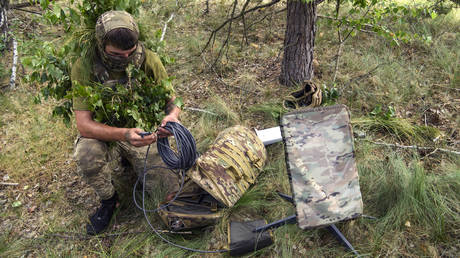
Ukraine confirmed that SpaceX lifted velocity and altitude restrictions on Starlink terminals operating along the front lines, ending a technical bottleneck that had temporarily crippled Kyiv’s unmanned aerial and maritime fleet. For weeks, automated geofencing and speed caps caused Starlink connections to sever whenever unmanned vehicles crossed specific velocity thresholds or ventured beyond predefined operational zones. While the immediate signal blackouts are over, the incident exposed a glaring vulnerability in modern warfare. A single private aerospace corporation holds the literal off-switch for a sovereign nation's military command and control.
The friction began when SpaceX engineers implemented strict software limits designed to prevent Russian forces from using captured or black-market Starlink dishes on long-range strike drones. Those automated tripwires failed to distinguish between friend and foe. Ukrainian drone operators suddenly found their high-speed first-person-view (FPV) interceptors and unmanned surface vessels losing telemetry mid-mission.
The Mechanics of Algorithmic Geofencing
To understand why Ukrainian drones went blind, you have to look at how low-Earth orbit (LEO) satellite constellations manage terminal handoffs. Unlike traditional geostationary satellites that hover over a single patch of the Earth, Starlink satellites scream across the sky at roughly 17,000 miles per hour. A ground terminal must constantly negotiate split-second handoffs from one passing satellite to the next using phased-array antennas.
When you mount that terminal onto a moving platform—like a fixed-wing reconnaissance drone or an explosive-laden sea drone—the Doppler shift and rapid changes in spatial geometry complicate those handoffs. SpaceX manages this through firmware-level telemetry checks. Every Starlink dish continuously reports its precise GPS coordinates, altitude, and velocity vector back to the network core.
When Russian forces began strapping grey-market terminals onto Shahed-type drones and reconnaissance wings to bypass Ukrainian electronic warfare, SpaceX responded with blunt-force software constraints. The network was programmed to drop packets or sever authentication entirely if a terminal exceeded specific speed limits or crossed certain geographic polygons near the line of contact.
The math was ruthless. If a drone accelerated past a predetermined knot threshold during a terminal dive, the dish disconnected. If an unmanned boat pushed deeper into contested waters than the static geofence allowed, the video feed turned to static.
Ukrainian engineers and frontline units were caught in the crossfire of SpaceX's automated compliance filters. Because the restrictions were enforced dynamically at the network layer rather than through physical hardware locks, local operators had zero ability to override the blackouts in the field. Fixing the issue required direct, high-level intervention between Kyiv’s defense ministries and SpaceX’s engineering leadership to whitelist specific terminal serial numbers and adjust the velocity tolerances for authorized Ukrainian military hardware.
Why Commercial Infrastructure Fails Under Fire
For decades, military communications relied on bespoke, hardened satellite networks built at astronomical expense by legacy defense contractors. Those systems were slow, agonizingly expensive, and severely bandwidth-constrained, yet they operated under strict sovereign military control. Starlink inverted that model overnight. By offering high-throughput, low-latency connectivity through commercial off-the-shelf hardware, SpaceX democratized battlefield broadband.
That convenience carries a steep operational tax. Commercial networks are optimized for predictable consumer behavior, regulatory compliance, and network stability—not the chaotic, rapidly shifting geometry of an active warzone.
Consider the structural mismatches that emerge when a civilian internet provider becomes a military backbone:
- Static Geofencing vs. Fluid Frontlines: War does not respect clean digital polygons. When an armored column advances or a maritime drone executes an evasive maneuver, static GPS boundaries become a liability. Waiting hours or days for a corporate engineering team in California to redraw a geofence polygon is an eternity when artillery is zeroing in on your position.
- The Grey-Market Dilemma: Starlink hardware is small, portable, and sold globally. Preventing an adversary from acquiring terminals through third-party shell companies in neighboring countries is nearly impossible. Because SpaceX cannot physically repossess stolen or smuggled dishes, it must rely on behavioral algorithms—like speed and altitude caps—to guess who is operating the hardware. Those guesses inevitably generate false positives.
- Terms of Service as Rules of Engagement: SpaceX has repeatedly stated that standard Starlink terminals were never intended to be weaponized. Yet on a modern battlefield, the line between tactical communications and weapons guidance does not exist. Using a satellite link to stream video from a reconnaissance drone that spots a target for artillery is functionally identical to using that same link to guide a loitering munition into a trench. Relying on a private company's evolving interpretation of its own acceptable use policy introduces unacceptable strategic risk.
The Illusion of Redundancy on the Front Lines
Military planners love to preach the gospel of redundancy—the idea that if your primary communications link fails, you simply fall back on your secondary and tertiary systems. In practice, Starlink spoiled everyone.
Once commanders grew accustomed to streaming live, high-definition video feeds from dozens of drones simultaneously into tactical operations centers, older communication methods became obsolete overnight. Traditional high-frequency (HF) and ultra-high-frequency (UHF) tactical radios simply cannot push that volume of data. They are built for voice traffic and low-bitrate text bursts, not real-time video telemetry.
When the Starlink speed limits kicked in, there was no true backup waiting in the wings. Ground-based mesh networks—which pass radio signals from node to node across the terrain—suffer from strict line-of-sight limitations and are heavily vulnerable to Russian electronic warfare jamming. Once a drone flies beyond the radio horizon or dips behind a ridgeline, terrestrial links die.
Satellite communications are the only reliable way to maintain command and control over long distances without deploying vulnerable airborne relay stations. By monopolizing that capability through sheer technical superiority, Starlink inadvertently created a single point of failure across the entire theater of operations. When the firmware throttled the connection, the entire kill chain ground to a halt.
The Pentagon's Wake-Up Call and the Rise of Starshield
The throttling crisis in Ukraine did not happen in a vacuum. Defense officials in Washington, Brussels, and across the Indo-Pacific watched the blackouts unfold with quiet alarm. The Pentagon has spent billions integrating commercial space assets into its broader military architecture, operating under the assumption that private companies will seamlessly scale up during a crisis.
The friction in Ukraine proved that commercial service agreements are no substitute for dedicated military command authority. If a private CEO or a corporate compliance team can alter network parameters mid-conflict due to legal fears, export control regulations, or geopolitical pressure, the military does not actually control its own nervous system.
This realization is precisely why the U.S. Department of Defense accelerated contracts for Starshield—SpaceX’s militarized, government-owned sibling to Starlink. Unlike standard Starlink, where SpaceX retains ownership of the network architecture and enforces its own terms of service, Starshield is designed to give military customers direct, sovereign control over payloads, encryption standards, and operational parameters.
Under a Starshield-style framework, the government owns the operational logic. Military commanders dictate where the beams point, which terminals are authorized to operate at hypersonic or high-subsonic speeds, and when geofences are lifted. The contractor provides the launch vehicles and bus hardware, while the military retains the keys to the network.
However, Starshield is not a magic bullet, particularly for nations that lack the Pentagon's massive procurement budgets. Building out dedicated sovereign constellations requires years of launch cadence and tens of billions of dollars. Until allied nations deploy independent LEO networks—such as the European Union's delayed IRIS² constellation or expanded OneWeb military tiers—smaller militaries remain tethered to commercial infrastructure.
The Counter-Argument From SpaceX's Perspective
It is easy to paint SpaceX as an erratic gatekeeper arbitrarily turning off the tap during a desperate fight. A more honest assessment requires looking at the legal and technical tightrope the company walks every single day.
SpaceX is a U.S. defense contractor bound by strict International Traffic in Arms Regulations (ITAR) and export control laws. If standard commercial Starlink terminals—which are classified as dual-use or civilian goods—are routinely used as direct guidance systems for autonomous weapons, SpaceX risks triggering massive federal compliance violations. Turning a blind eye to how its hardware is modified in the field could expose the company to severe legal penalties and jeopardize its core launch contracts with NASA and the U.S. Space Force.
Furthermore, the electronic warfare environment in Ukraine is the most intense in human history. Russian forces constantly probe the Starlink network for vulnerabilities, spoofing GPS signals and attempting to hijack terminal authentication protocols. If SpaceX does not aggressively police anomalous terminal behavior—such as dishes suddenly moving at high speeds inside contested territories—adversaries will exploit those gaps to turn SpaceX's own constellation against Ukrainian troops.
From an engineering standpoint, the speed limits were not an act of sabotage; they were a clumsy, automated defense mechanism triggered by an unprecedented proliferation of unauthorized hardware on the enemy side of the trench.
What Sovereign Militaries Must Do Now
Lifting the speed caps restored Ukraine’s immediate drone capabilities, yet the underlying vulnerability remains entirely intact. Any military relying on commercial LEO constellations for frontline operations is operating on borrowed time. As electronic warfare grows more sophisticated and autonomous systems proliferate, the friction between corporate risk management and battlefield necessity will only intensify.
Military procurement officers and field commanders must adapt to this reality immediately:
- Decouple Terminal Guidance from Satellite Links: Drones cannot rely on continuous satellite connectivity during the final phase of an attack. Engineers must prioritize onboard edge-computing and terminal visual guidance systems—allowing a drone to lock onto a target optically and complete its run autonomously even if the Starlink link drops ten miles out.
- Enforce Hardware-Level Whitelisting Protocols: Relying on behavioral algorithms like speed limits to weed out enemy terminals is fundamentally flawed. Providers and defense ministries must establish cryptographically secure, hardware-level authentication registries before terminals ever reach the front, ensuring authorized military units are permanently exempt from civilian velocity caps.
- Invest in Hybrid Multi-Orbit Architectures: Putting all tactical bandwidth into a single LEO constellation invites disaster. Militaries must build software-defined radios capable of dynamically switching traffic across LEO, Medium-Earth Orbit (MEO), and terrestrial mesh networks simultaneously, treating commercial satellite links as a high-speed bonus rather than an indispensable crutch.
The lifting of the Starlink restrictions gave Ukrainian drone operators their eyes back, at least for the moment. Until nations build sovereign communications networks that no corporate boardroom can throttle, every modern army remains one software update away from going blind.