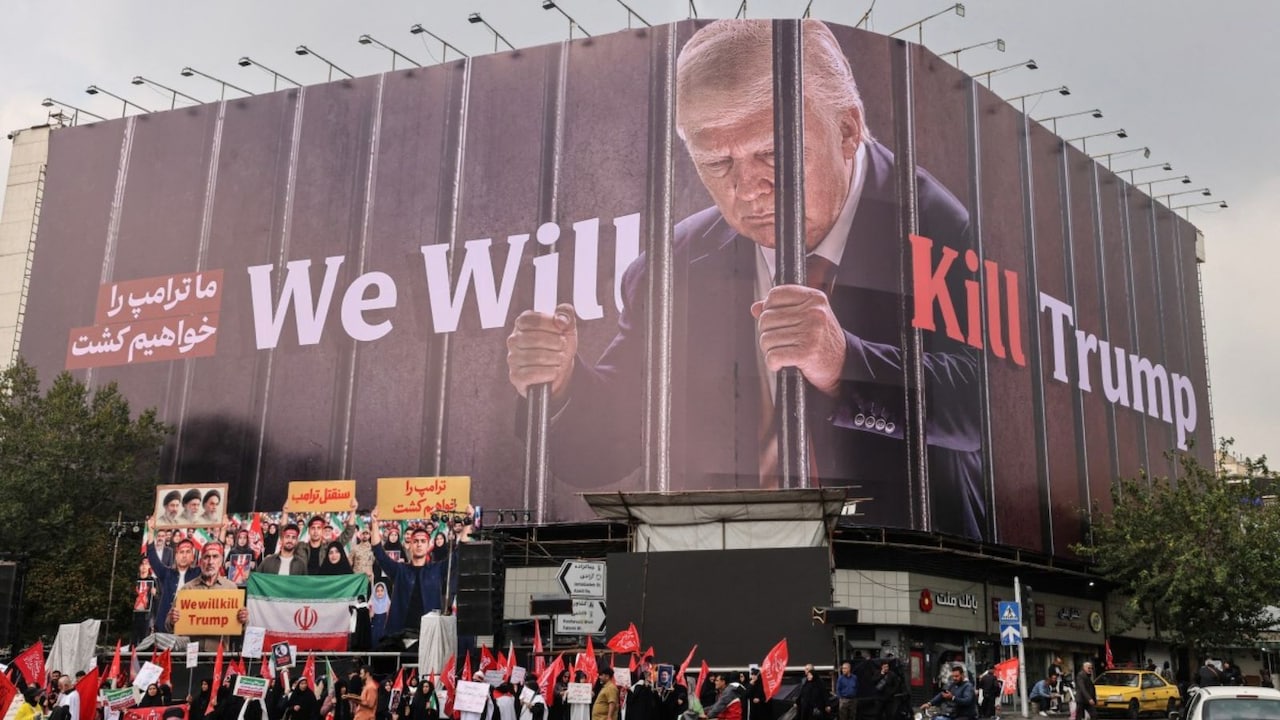
A massive mural depicting Donald Trump behind prison bars alongside an explicit vow of assassination did not appear in Tehran by accident. Erected in Palestine Square—the state-sanctioned nerve center of Iranian visual propaganda—the billboard serves as a calculated piece of psychological warfare aimed simultaneously at domestic hardliners and Western intelligence agencies.
Western tabloids routinely treat these installations as isolated bursts of regime hysteria. They miss the point. Having tracked Tehran’s information warfare apparatus for decades, it is clear that these murals are neither spontaneous street art nor mere saber-rattling. They are precision-engineered geopolitical signals paid for by the Islamic Revolutionary Guard Corps (IRGC) and executed by state-backed design studios to project strength precisely when the regime feels most vulnerable. You might also find this similar story interesting: Iran’s Five Peace Conditions Are a Distraction And Washington Keeps Falling For It.
The Architecture of State-Sponsored Rage
To understand the Iran Trump billboard, you have to understand the geography of Tehran. Palestine Square and Valiasr Square are not commercial advertising hubs. They are state-owned canvases managed primarily by the Owj Arts and Media Organization, a cultural front deeply embedded within the IRGC.
When a mural goes up in Palestine Square, it has passed through multiple layers of ideological vetting. Nothing reaches that scaffolding without explicit approval from the upper echelons of the security establishment. The design studios responsible for these installations employ top-tier graphic designers, illustrators, and digital artists who use Western cinematic tropes to maximize viral spread. As highlighted in latest reports by BBC News, the results are worth noting.
The imagery is deliberately legible to an international audience. While domestic propaganda often relies on dense Shia iconography and Persian calligraphy that requires cultural translation, anti-American murals use universal visual language. Prison bars. Crosshairs. Coffins draped in stars and stripes. English text printed in bold, sans-serif fonts. The creators know the primary audience is not the commuter stuck in Tehran traffic. The primary audience is the foreign correspondent snapping a photo for the Associated Press wire, and the algorithm that will push that image onto millions of Western smartphone screens within two hours.
The Mechanics of the Viral Loop
Tehran’s media strategists operate on a simple, repeatable distribution model.
- Installation at dawn. Crews erect the massive vinyl banner overnight so it greets morning commuters and state photographers simultaneously.
- State media amplification. Outlets like Tasnim News Agency and Fars News—both tied to the IRGC—publish high-resolution photographs alongside aggressive commentary.
- Western media pickup. Sensationalist headlines in the United States and Europe repeat the threat verbatim, effectively giving the Islamic Republic millions of dollars in free earned media.
- Domestic validation. Iranian state television broadcasts screenshots of Western news coverage back to its own citizens, framing the reaction as proof that the United States is terrified of Iranian resolve.
It is an asymmetric communications strategy. Lacking the global broadcasting footprint of American networks, Tehran hijacks Western outrage to distribute its own messaging.
Why the Soleimani Shadow Never Fades
The explicit vow to kill Donald Trump is rooted in a specific, unresolved blood feud. On January 3, 2020, a US drone strike ordered by Trump killed Qasem Soleimani, the commander of the Quds Force and the architect of Iran’s regional proxy network, at Baghdad International Airport.
In the geometry of Iranian power, Soleimani was not merely a general. He was the regime’s most potent symbol of extraterritorial reach, a figure elevated to near-mythic status by state media long before his death. Allowing his assassination to go unanswered would represent a catastrophic failure of deterrence for Supreme Leader Ali Khamenei.
"Revenge is certain," Khamenei declared days after the strike, a phrase that immediately became the foundational text for hundreds of murals, stamps, and television broadcasts across the country.
Since 2020, the hard revenge campaign has evolved into a permanent fixture of Iranian domestic policy. It serves as an ideological glue holding together a fragmented political base. Whenever economic mismanagement, currency collapse, or civil unrest threatens the stability of the Islamic Republic, the security apparatus pivots back to the Soleimani assassination. By placing Trump behind bars or in the crosshairs on a 50-foot billboard, the regime reminds its core loyalists that the battle is existential, righteous, and ongoing.
Kinetic Plots Behind the Graphic Design
Dismissing these billboards as empty rhetoric is a mistake Western intelligence agencies stopped making years ago. The murals run parallel to documented, real-world operational plotting.
Federal indictments unsealed by the US Department of Justice have repeatedly detailed active IRGC attempts to recruit hitmen, criminal syndicates, and operatives on American soil. Targets have included former National Security Advisor John Bolton, former Secretary of State Mike Pompeo, and Donald Trump himself. In 2024, US authorities charged an Afghan national, Farhad Shakeri, in connection with an IRGC plot to surveil and assassinate Trump prior to the presidential election.
The billboards and the covert plots serve different functions within the same operational doctrine:
| Operational Layer | Primary Mechanism | Strategic Objective |
|---|---|---|
| Overt Propaganda | Massive murals in Tehran, English-language social media campaigns, state TV broadcasts | Maintain psychological pressure, rally domestic hardliners, provoke Western media coverage |
| Covert Operations | Hiring third-party criminal networks, cyber espionage, surveillance of former US officials | Achieve plausible deniability while maintaining a credible threat of lethal retaliation |
| Proxy Escalation | Rocket attacks, maritime harassment, regional militia mobilization | Raise the financial and political cost of US presence in the Middle East |
The visual threat in Palestine Square acts as a psychological force multiplier for the covert teams operating abroad. Even if an assassination plot is disrupted by the FBI—which has happened multiple times—the public threat remains suspended over Washington, forcing the US Secret Service and intelligence community to expend massive resources on protective details.
The Domestic Audience Problem
There is a glaring contradiction at the heart of Tehran’s billboard diplomacy, and you only see it when you look at the streets beneath the scaffolding.
While the regime spends substantial sums printing multi-story threats against American leaders, the average resident of Tehran is battling crushing inflation, a devalued rial, and chronic utility shortages. For millions of ordinary Iranians, especially the youth demographic that fueled the "Woman, Life, Freedom" protests, these murals do not inspire revolutionary fervor. They inspire exhaustion.
Interviews and ground reports from Tehran consistently reveal a widening chasm between the state’s visual environment and public sentiment. To a shopkeeper in central Tehran struggling to import basic goods due to international sanctions, a massive banner promising to jail or execute an American president looks less like strength and more like reckless provocation that invites further economic ruin.
The Erosion of Visual Shock Value
Propaganda relies on novelty and emotional resonance to remain effective. When the same square displays a new apocalyptic warning every three weeks, the local population develops banner blindness.
In the early years after the 1979 Islamic Revolution, hand-painted murals of martyrs and anti-imperialist slogans carried genuine grassroots energy. Today, the process is entirely industrialized. Vinyl banners are printed on massive commercial plotters, hoisted by cranes, and swapped out like seasonal retail advertisements. The industrialization of the message has hollowed out its emotional core for everyone except the most committed regime loyalists.
Strategic Ambiguity as a Survival Tool
Why does Tehran continue investing in these high-profile visual provocations if they risk alienating the public and inviting American retaliation? Because strategic ambiguity is the only card the Islamic Republic can afford to play at full volume.
Direct conventional warfare against the United States military is suicidal for Iran. The asymmetry in air power, naval capability, and satellite intelligence is absolute. Therefore, Tehran relies on gray-zone tactics—actions that sit just below the threshold of full-scale war while imposing continuous psychological and political friction on Washington.
Placing Donald Trump behind prison bars on a Tehran billboard achieves three specific tactical goals without firing a single ballistic missile:
- It exploits American political polarization. Tehran’s analysts closely monitor US domestic politics. They understand that any threat involving Trump immediately triggers intense media coverage, partisan debate, and heightened security protocols in Washington.
- It projects parity. By depicting a US president as a captured criminal, the regime creates a visual fiction in which the Islamic Republic holds judicial and military authority over the superpower.
- It establishes a low-cost escalation ladder. A billboard can be erected in six hours and taken down in two. If diplomatic backchannels in Oman or Qatar suddenly yield progress on sanctions relief or nuclear negotiations, the vinyl comes down quietly and is replaced by a mural celebrating Persian poetry or national unity.
How Western Media Feeds the Machine
Every time a major Western outlet runs a breathless headline quoting a Tehran billboard word-for-word without explaining the institutional machinery behind it, the Owj Arts and Media Organization logs a victory.
Standard journalism often strips away context in favor of shock value. A photograph of a menacing mural accompanied by a 300-word summary treats the threat at face value, amplifying the exact sense of menace Tehran wants to project while ignoring the domestic fragility the mural is designed to mask.
True analytical rigor requires looking past the vinyl. When the Islamic Republic shouts loudest from the rooftops of Palestine Square, it is rarely acting from a position of unassailable strength. More often, the volume of the threat is directly proportional to the pressure building inside the regime’s own walls—economic isolation, succession anxiety surrounding an aging Supreme Leader, and a population that no longer believes the slogans printed overhead.