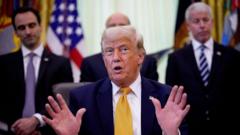
The White House just threw a diplomatic hand grenade across the Atlantic, threatening immediate 100 percent tariffs on any nation daring to impose a digital services tax on American technology giants. President Donald Trump announced the sweeping ultimatum on Truth Social, explicitly targeting European capitals currently drafting fiscal measures aimed at Silicon Valley revenue. The threat directly undermines a fragile, hard-fought trade agreement finalized just weeks ago in May, which was supposed to cap duties on European Union exports at 15 percent ahead of a strict July 4 implementation deadline. By declaring that this new penalty will supersede any existing or pending trade deals, the administration has set the stage for an unprecedented economic showdown that places global commerce in the line of fire.
The core dispute boils down to how governments collect revenue from corporations that generate billions within their borders without owning a single brick-and-mortar storefront there. European regulators argue that tech giants evade local corporate income taxes by routing digital transactions through low-tax hubs like Ireland. Washington, conversely, views these targeted fiscal measures as thinly veiled protectionism engineered specifically to drain the coffers of companies like Meta, Alphabet, and Amazon. It is an irreconcilable clash of legal and philosophical frameworks. The escalation marks a shift from conventional trade disputes over steel or agricultural subsidies into a high-stakes war over fiscal sovereignty and tech hegemony.
The Collision of Tax Code Sovereignty and Trade Brinkmanship
For years, the Organisation for Economic Co-operation and Development tried to broker a global framework to rewrite international tax rules for multinational corporations. Those talks stalled. Exhausted by the diplomatic gridlock and facing widening budget deficits, individual European nations began taking matters into their own hands. More than a dozen countries have already implemented or proposed some form of a digital services tax, usually charging a flat two to five percent on gross revenues generated from local users via search engines, social media platforms, and digital marketplaces.
The European approach seeks to tax where the economic value is actively created by users clicking, scrolling, and purchasing online. Britain led the charge in 2020 with its two percent levy, explicitly arguing that traditional corporate tax laws failed to capture the realities of software-driven marketplaces. France followed a similar playbook, targeting large technology platforms with a three percent tax on domestic revenues. From Paris to London, the political calculation was simple: American tech firms extract immense wealth from domestic populations while contributing negligible amounts to public coffers.
Washington sees a fundamentally different reality. The American government views these specific measures as discriminatory trade barriers designed to penalize domestic commercial success. Because the thresholds of these European taxes are calibrated to exempt smaller domestic tech firms while capturing massive multinational platforms, they disproportionately squeeze the American balance sheet. The White House is treating the digital services tax not as an internal fiscal policy matter, but as an aggressive raid on America's most lucrative corporate sector.
The immediate economic impact of a 100 percent counter-tariff would be catastrophic for European exporters who rely on American consumers. Industries ranging from luxury goods and automotive manufacturing to industrial machinery would see their prices double overnight at U.S. ports of entry. This is not a surgical strike; it is a scorched-earth policy meant to terrify European lawmakers into abandoning their legislative agendas before the July 4 deadline.
The Death of the Scotiabank Agreement and the Transatlantic Fracture
The timing of this tariff threat exposes a deeper systemic breakdown in international diplomacy. In May, European Commission President Ursula von der Leyen and the Trump administration finalized a trade package that was meant to establish a prolonged period of commercial stability. That deal, rooted in preliminary talks held at Trump's golf course in Scotland the previous year, capped most European Union export tariffs at 15 percent. It was hailed by Brussels as a triumph of pragmatic diplomacy.
The celebration was premature. Digital services taxes were conspicuously omitted from that May agreement, left on the backburner as a thorny issue to be solved through separate channels. By weaponizing a 100 percent tariff threat just weeks before the July 4 enforcement deadline, the White House has effectively torn up the spirit of the deal before the ink could dry. European officials now realize that the 15 percent cap is meaningless if a single social media tax proposal in Poland or Belgium can trigger an immediate, total embargo on their physical exports.
+------------------------------------------------------------------------+
|                      THE TRANSATLANTIC TARIFF DEADLOCK                  |
+------------------------------------------------------------------------+
|                                                                        |
|   EUROPEAN UNION / U.K.                               UNITED STATES    |
|   =====================                               =============    |
|                                                                        |
|   * Levies 2-5% tax on domestic                       * Threatens 100% |
|     digital revenues.                                   counter-tariffs|
|   * Claims tech giants evade                          * Views taxes as |
|     local corporate tax.                                targeted bias. |
|                                                                        |
|                  \                                 /                   |
|                   \                               /                    |
|                    v                             v                     |
|             +-------------------------------------------+              |
|             |  COLLAPSE OF MAY 2026 TARIFF AGREEMENT   |              |
|             |  (Threatens 15% cap before July 4)        |
|             +-------------------------------------------+              |
+------------------------------------------------------------------------+
The European Commission responded with uncharacteristic bluntness. Olof Gill, a spokesperson for the Commission, stated that unilateral retaliatory measures targeting legitimate domestic tax policies are entirely unjustified. He insisted that Europe will respond swiftly and decisively to defend its regulatory autonomy, setting up a retaliatory loop that could freeze a significant portion of global trade. The rhetoric indicates that Europe is no longer willing to back down quietly under the threat of economic sanctions.
This hardening of stances leaves little room for a compromise. If Brussels blinks and forces member states to repeal their tech taxes, it surrenders its sovereign right to write its own internal tax codes. If it stands firm, a full-scale trade war will hit European manufacturing at a time when the continent’s industrial base is already struggling with high energy costs and sluggish domestic growth.
The Legal Quagmire and Regulatory Realities
Beneath the political theater lies a complicated web of legal statutory authority. The White House claims it can levy these massive penalties immediately, but trade experts point to a string of domestic judicial and legislative hurdles that complicate that narrative. The administration has historically relied on broad emergency powers to reshape trade policy, but those mechanisms face severe opposition from the judicial branch.
A prior Supreme Court ruling severely limited the executive branch’s ability to use the International Emergency Economic Powers Act to assign custom, country-specific tariff rates across the globe without explicit congressional approval. When the court invalidated that broad approach, the administration adjusted by temporarily utilizing Section 122 of the Trade Act of 1974 to enact a worldwide 10 percent emergency tariff. That specific provision carries a hard legal deadline of 150 days unless Congress votes to extend it, making it an ineffective tool for a permanent, targeted 100 percent economic penalty against Europe.
To bypass these limitations for this new offensive, the administration is leaning on Section 301 of the Trade Act of 1974. This statute allows the United States Trade Representative to investigate and retaliate against foreign government actions that burden or restrict American commerce. While Section 301 provides a firmer legal footing for retaliatory tariffs, the process traditionally requires lengthy investigation periods, public comment phases, and specific determinations of economic harm. The administration's assertion that these tariffs will take effect immediately and automatically overrides the deliberate, bureaucratic framework established by federal trade law.
                  +-----------------------------------+
                  |   U.S. EXECUTIVE TARIFF ROADS     |
                  +-----------------------------------+
                                    |
         +--------------------------+--------------------------+
         |                                                     |
         v                                                     v
+---------------------------------+                 +---------------------------------+
|     IEEPA EMERGENCY POWERS      |                 |     SECTION 301 INVESTIGATION   |
+---------------------------------+                 +---------------------------------+
| * Historically favored by WH    |                 | * Targets discriminatory acts   |
| * Struck down by Supreme Court  |                 | * Requires formal notice/proof  |
| * Prohibits selective rates     |                 | * Subject to long review phases |
+---------------------------------+                 +---------------------------------+
Furthermore, the implementation of a 100 percent tariff creates a logistical nightmare for global supply chains. Modern manufacturing relies on highly integrated, cross-border component sharing. An American automotive plant might depend on specialized German valves, while an aerospace facility in Ohio requires precision electronics manufactured in France. Instantly doubling the cost of these baseline components does not protect domestic industry; it penalizes domestic manufacturers who rely on international networks to assemble their final products.
The corporate entities that this tariff threat aims to protect are caught in an awkward position. While executive leadership at companies like Meta and Google despise the foreign digital services taxes, they are equally terrified of a chaotic, unstructured trade war that destabilizes the global economic environment. A total breakdown in transatlantic commerce would depress consumer spending globally, ultimately hurting the ad revenues and marketplace transactions that drive big tech's core business model.
The Weaponization of the Corporate Safe Haven
Europe’s push for digital taxation is driven by a deep structural flaw in how multinational corporate profits are categorized globally. For decades, companies have used a legitimate accounting practice known as profit shifting. By establishing intellectual property rights in low-tax jurisdictions like Ireland or Luxembourg, a tech giant can charge its subsidiaries in higher-tax countries like France or Germany massive internal licensing fees. This process effectively wipes out taxable corporate income in the countries where the actual consumers reside, shifting the profits to a tax haven where they are assessed at single-digit rates.
Digital services taxes were explicitly invented to short-circuit this accounting loophole. By taxing gross revenue instead of net profit, European governments ensured that companies could not use internal write-offs and licensing fees to lower their tax liability. If a company serves digital ads to millions of citizens in Madrid, the Spanish government collects its percentage from that top-line revenue before it can be moved offshore. It is a crude instrument, but one born out of sheer frustration with an archaic global tax system that has failed to keep pace with the intangible software economy.
The American retaliation flips the leverage. While Europe controls the local regulatory environment, the United States controls access to the world’s most lucrative consumer market. The White House is wagering that the immediate pain felt by European automakers, winemakers, and luxury brands will force those domestic industries to lobby their own governments to kill the tech taxes. The administration previously tested this hypothesis by threatening France's wine and champagne sectors, a tactic that successfully delayed the collection of certain French levies in prior negotiation cycles. Similarly, Ottawa completely abandoned a scheduled digital services tax last year after Washington threatened to derail broader trade negotiations.
The strategy assumes that Europe’s political leaders answer to their industrial lobbies in a predictable, transactional manner. That assumption may no longer hold true in the current geopolitical climate. European leadership is facing intense domestic pressure to project strength and maintain regulatory independence from Washington's volatile shifts in trade policy. If European politicians capitulate now, they signaling to the rest of the world that their domestic tax laws are subject to veto by a social media post from Washington.
The Long-Term Commercial Fallout
The fallout from this dispute will ripple far beyond the tech sector and manufacturing supply chains. If the July 4 trade deal completely falls apart under the weight of these 100 percent tariff threats, the resulting trade war will fundamentally realign corporate investment strategies for the next decade. Companies will be forced to abandon just-in-time inventory models and onshore their operations at massive capital expense simply to avoid being caught in the crossfire of sudden executive edicts.
The consumer will ultimately pay the price for this economic brinkmanship. A 100 percent tariff on European imports means that everything from imported cheeses and olive oils to industrial components and high-end machinery will double in cost for American buyers. Retailers will pass those costs directly down the supply chain, fueling inflationary pressures that central banks have spent years trying to tame. The conflict will transform from an abstract dispute over digital ad revenues into a tangible, expensive burden for ordinary citizens on both sides of the ocean.
International trade agreements were originally designed to provide predictability, allowing businesses to plan capital expenditures years into the future based on stable tax and tariff rates. That predictability is gone. By demonstrating that a multi-billion-dollar trade agreement can be upended instantly over an unrelated legislative dispute, the administration has permanently altered the risk assessment for global commerce. Corporate boards can no longer treat international treaties as secure guarantees; they must treat them as temporary truces vulnerable to collapse at any moment.
The immediate question is which European nation will break rank first, or if the European Union will manage to maintain a unified, retaliatory front as the July 4 deadline approaches. Washington is banking on division, calculating that countries with minimal tech sectors but massive manufacturing exposure will demand a retreat to save their factories. Brussels is preparing for economic combat, constructing a list of American target industries for counter-tariffs that will maximize political discomfort in Washington. The clock is ticking down to the holiday deadline, and the global economy is strapped to the explosives.