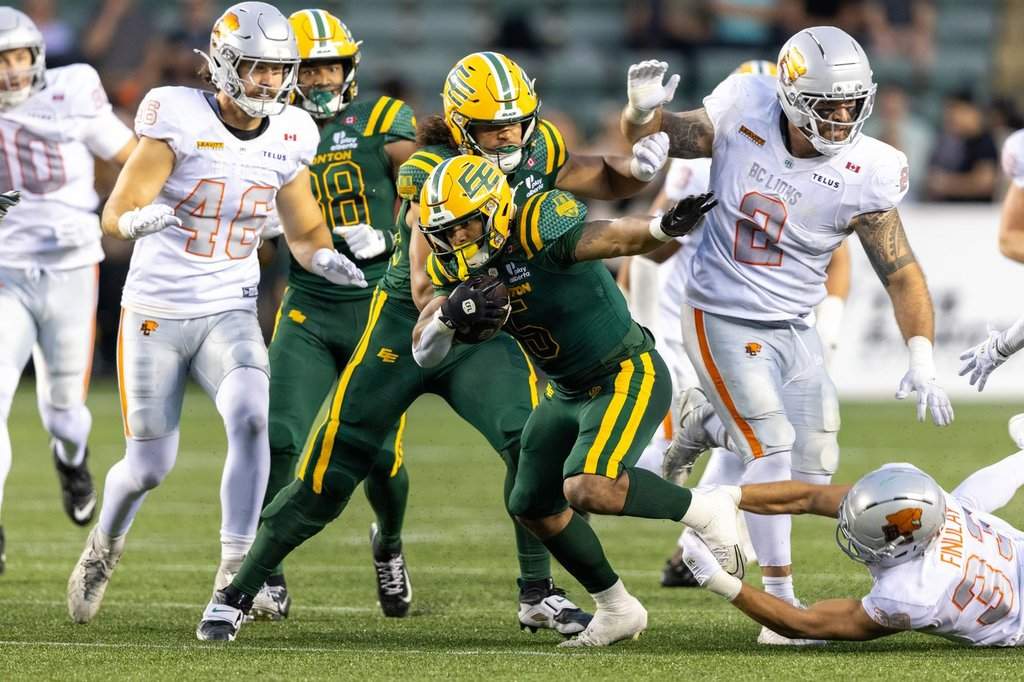
Edmonton Elks running back Justin Rankin intends to dismantle the BC Lions run defence by targeting vertical crease discipline, forcing over-pursuit from aggressive edge defenders, and exploiting the spatial vulnerabilities created by three-down football's wider field. Because Canadian Football League defences routinely deploy lighter, speed-oriented personnel in the box to counter pass-heavy offences, a patient, north-south runner like Rankin can punish over-aggressive linebackers through delayed cutbacks and precise zone-blocking reads.
Watch the tape. Everyone focuses on the highlight-reel stiff-arms and the explosive bursts through the second level, yet the real battle between Edmonton's backfield and Vancouver's front seven happens in the first three yards off the line of scrimmage. For years, conventional wisdom around the CFL suggested that establishing the ground game was a secondary luxury, a clock-killing afterthought used only after a quarterback had already carved up the secondary. That thinking is dead. Against a BC defensive front built to pin its ears back and hunt passers, running the football is not about burning clock. It is about survival. In other updates, read about: The Heavy Burden of Saving Someone Else.
The Structural Reality of the CFL Box
To understand how Rankin attacks the BC Lions, you have to understand the geometry of the Canadian game. With twelve men on the field, a 65-yard width, and a full yard separating the offensive and defensive lines at the snap, defensive coordinators face an impossible math problem. If you load the box to stop the run, you leave your defensive backs on islands against receivers who get a running start toward the line of scrimmage. If you drop extra defenders into coverage, you invite a physical running back to gash your front five for six or seven yards a pop.
BC's defensive philosophy leans heavily on speed, disruption, and gap penetration. Their front four is designed to shoot upfield, wrecking blocking schemes before a play can develop. When it works, running backs get swallowed behind the line of scrimmage for three-yard losses, putting the offence in second-and-long nightmares where the Lions' pass rush becomes lethal. Sky Sports has provided coverage on this important subject in extensive detail.
Rankin’s skill set acts as a direct counterweight to this aggressive styling. Unlike pure scatbacks who bounce every run to the perimeter at the first sign of traffic, Rankin possesses the patience to let his offensive linemen establish leverage before planting his foot and driving vertically. When defensive tackles shoot upfield too quickly, they vacate the very lanes they are supposed to protect. A runner with sharp vision does not try to outrun a penetrating defensive end to the sideline; he steps inside the defender's upfield shoulder and disappears into the vacated space.
Why Edge Discipline Breaks Down Against Patient Runners
Speed kills, until it runs itself out of the play.
Defensive ends and weak-side linebackers in the CFL are trained to flow violently toward the football. The wider field demands it. If an edge defender hesitates for a fraction of a second, a fast ball carrier will turn the corner and gain fifteen yards before the boundary cornerback can even engage. Consequently, defensive coaches drill pursuit angles relentlessly.
This creates a predictable vulnerability. When Edmonton runs outside zone or stretch concepts, the offensive line moves laterally in unison, coaxing the BC front seven to sprint toward the sideline. Linebackers scrape over the top of blocks, eager to beat Rankin to the edge. The moment those linebackers over-commit their hips toward the perimeter, the cutback lane opens up behind them.
Rankin excels at reading the shoulders of the backside defensive end and the middle linebacker. He presses the hole at full speed, selling the outside bounce to freeze the second-level defenders, and then plants abruptly to slice back against the grain. In a hypothetical scenario where BC's weak-side linebacker flows two steps too far toward the boundary on a second-and-four stretch play, Rankin does not need a massive hole. He needs eighteen inches of daylight to slip through the B-gap, turning a potential two-yard gain into a twelve-yard chain-mover that keeps the Lions' defence trapped on the field.
The Myth of the Pass-First League
Ask casual observers about Canadian football and they will talk about quarterbacks throwing for four hundred yards and receivers sprinting in motion. Ask offensive coordinators who actually win Grey Cups and they will talk about second-and-manageable.
The entire architecture of a CFL offensive game plan hinges on the efficiency of first down. Because teams only get two downs to gain ten yards before punting, failing to gain at least four yards on first down drastically narrows the playbook. If Edmonton falls behind the sticks against BC, the Lions' defensive coordinator can unleash exotic blitz packages, drop eight men into coverage, and force the Elks' quarterback into low-percentage throws.
Rankin's primary value to Edmonton is not just breaking off forty-yard touchdowns, though his top-end gear makes him a threat whenever he clears the second level. His real value lies in turning zero-yard gains into four-yard gains. He lowers his pads at the point of contact, absorbs arm tackles from defensive backs, and consistently falls forward.
When an offence averages five yards per carry on first down, the entire defensive structure of the opponent begins to fracture. Safeties have to creep closer to the line of scrimmage to support the run. Linebackers hesitate on play-action fakes, terrified of getting caught out of position on another inside zone handoff. Suddenly, the passing windows that looked impossibly tight in the first quarter start opening up across the middle of the field.
Counter-Adjustments and the Trench War
Of course, BC's coaching staff watches the exact same film. They know Rankin wants to press the line and cut back, and they know Edmonton wants to use his ground production to set up play-action shots downfield. Expecting the Lions to simply sit back and let Rankin dictate the tempo is naive.
To neutralize Edmonton's ground game, BC will likely deploy a mix of gap exchanges and run blitzes designed to muddy Rankin's initial reads. Instead of rushing straight upfield, defensive tackles will slant hard into adjacent gaps while linebackers shoot through the vacated spaces. This forces the offensive line to pass off blocks on the fly—a notoriously difficult task when communication breaks down in a loud stadium.
If the Elks' interior offensive linemen fail to secure their double-teams at the point of attack, Rankin will face penetration before he even completes the mesh point with his quarterback. No amount of vision or agility can save a running back when a three-hundred-pound defensive tackle meets him two yards deep in the backfield.
Furthermore, BC will look to test Rankin in pass protection. Defences love to bring delayed pressures off the edge when they suspect a running back is staying in to block. If Rankin struggles to identify the free rusher or fails to anchor against a blitzing linebacker, Edmonton's coaching staff will be forced to pull him off the field on obvious passing downs, telegraphing their intentions to the Lions' defence every time he steps off the turf.
The Psychological Toll of Physical Football
Football is a game of attrition disguised as a game of strategy. You can draw up brilliant zone-blocking schemes on a whiteboard all week, and you can map out pursuit angles on an iPad until midnight, but by the fourth quarter, everything comes down to who is tired of hitting whom.
Defensive linemen love rushing the passer. They love pinning their ears back, using spin moves, and chasing quarterbacks. They hate playing run defence. Defending the run requires taking on double-teams, fighting off low blocks, shedding three-hundred-pound guards, and tackling a two-hundred-pound running back running at full speed twenty-five times a game. It is exhausting, thankless work that drains the explosive twitch out of a pass rusher's legs.
This is the hidden leverage Rankin brings to the matchup. Every time he hammers into the line of scrimmage for five yards, he is making a withdrawal from the BC defensive line's energy bank. By the time the fourth quarter rolls around, those defensive ends who looked unstoppable in the opening drive are breathing heavily with their hands on their hips. Their first step slows down by a tenth of a second. Their rush lanes get sloppy.
And that is when the whole game tilts. When a defence loses its edge integrity late in the fourth quarter because its front seven is exhausted from tackling a relentless running back, the quarterback finally gets clean pockets, the receivers find wide-open grass, and the scoreboard starts spinning.
Execution Over Scheme
Ultimately, solving the BC Lions run defence will not come down to a trick play or a revolutionary new blocking concept. Football rarely rewards cute adjustments when physical dominance is lacking.
Edmonton's success with Rankin depends entirely on pad level, timing, and commitment. The offensive line has to sustain its blocks through the echo of the whistle, denying BC's athletic linebackers the clean lanes they need to flow to the ball. The play-callers have to resist the temptation to abandon the run if the first three carries only net seven total yards. And Rankin himself has to trust his reads, resist the urge to bounce runs prematurely when the inside looks congested, and punish every defender who takes a false step.
If Edmonton abandons the ground game at the first sign of resistance, BC's pass rush will tee off and turn the night into a long, painful exercise in damage control. If they lean into the grind and let Rankin hammer away at the structural seams of the Lions' front seven, the entire geometry of the field belongs to the Elks.