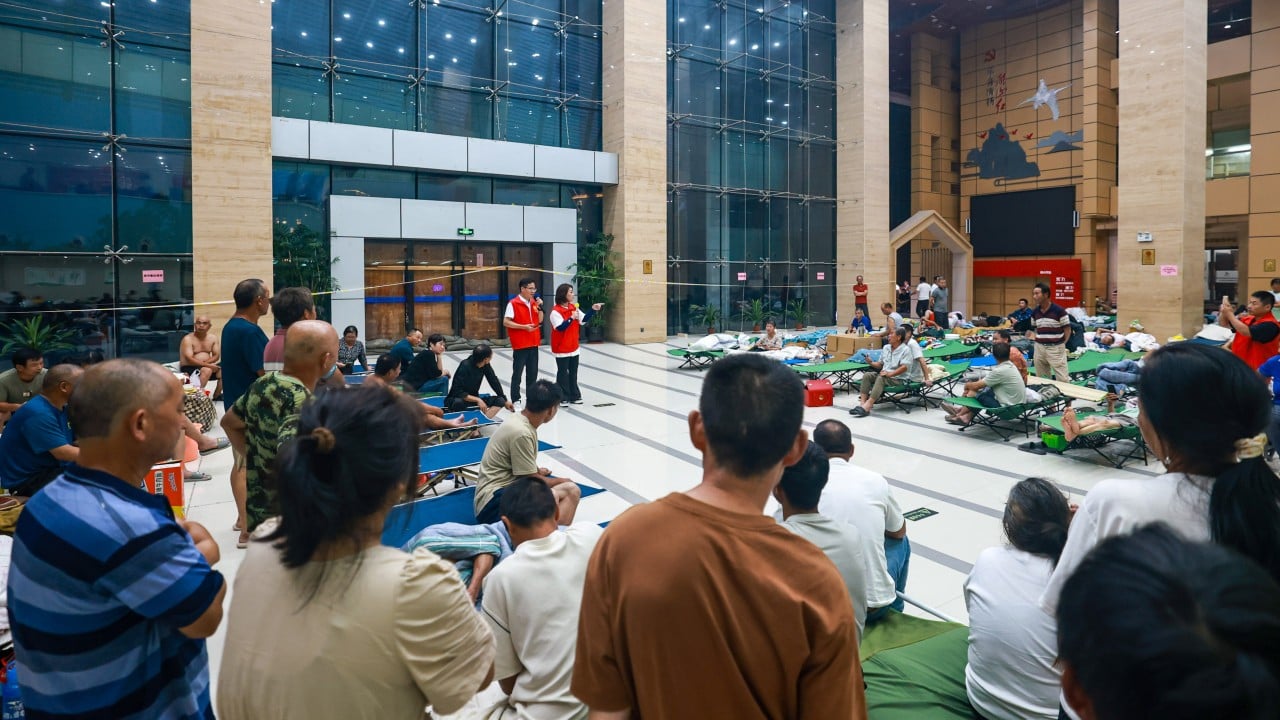
When Typhoon Bavi made landfall in eastern China’s Zhejiang province, the immediate media narrative followed a predictable script. Cable networks flashed images of massive waves battering the coastlines of Wenling and Yuhuan, while headlines focused on the staggering logistics of human flight: over two million people evacuated across Zhejiang, Shanghai, and Fujian, alongside more than 600 flight cancellations at Shanghai’s Pudong and Hongqiao hubs. On the surface, it appeared to be a triumph of state-orchestrated mobilization. The government declared that it spared no expense to guard against the worst-case scenario.
But looking at the raw evacuation numbers ignores a much more dangerous reality. The real story of Typhoon Bavi is not the temporary gridlock at airport terminals or the well-rehearsed mass relocation of coastal villages. It is the unprecedented physical profile of the storm itself, and what it reveals about the vulnerability of modern high-speed infrastructure. For a more detailed analysis into similar topics, we suggest: this related article.
The Illusion of a Weakening Storm
As Bavi crossed the coastline, meteorologists noted that the storm had lost its well-defined eye and weakened to a severe tropical storm, with maximum sustained winds dropping to around 101 kph. To the untrained eye, a downgrade suggests the danger has passed.
That is a critical error. For additional context on this development, extensive analysis can also be found on The New York Times.
What Bavi lost in peak intensity, it gained in sheer, unmanageable mass. The storm expanded to a gargantuan diameter of roughly 1,000 kilometers, with its outer cloud system stretching across 1.4 million square kilometers. Instead of packing its destructive energy into a tight, predictable core, Bavi converted into a massive moisture-delivery system. The Shanghai Association for Science and Technology warned that this structural deformation spreads the risk over a vastly wider geographic footprint, ensuring prolonged, relentless rainfall rather than a brief, violent punch.
This massive scale changes the math for regional transit. Standard emergency protocols are built around the concept of a localized strike zone. When a storm covers an area larger than many European nations, it paralyzes multiple economic corridors simultaneously. The suspension of the Hangzhou-Shenzhen railway line and the newly opened high-speed link between Hangzhou and Wenzhou was not just a precaution for the weekend. It was an emergency admission that modern ballasted high-speed tracks cannot safely operate when a storm system saturates entire provinces for days on end.
The False Security of the High-Speed Network
For the past two decades, East Asia has invested trillions in building the world’s most advanced high-speed rail and highway networks. These systems are marvels of civil engineering, engineered to withstand immense structural stress. Yet, storms like Bavi expose a fundamental design blind spot. The infrastructure itself rarely fails structurally; rather, the periphery of the infrastructure collapses, rendering the core asset useless.
Consider what happened in Yueqing, a coastal city in Zhejiang. The storm toppled more than 1,300 trees, uprooting hundreds of them directly across local roads and power corridors. When the surrounding landscape fails, the high-speed network loses its supporting power grids and drainage networks.
High-speed trains requiring pristine electrical overhead lines cannot run through regions where flying debris or failing local grids threaten power distribution. The system fails by proxy.
Furthermore, Bavi’s massive moisture footprint is moving northwestward, pushing deep into regions completely unequipped for tropical systems. Meteorologists are tracking the storm's remnants as they transport a deep corridor of tropical moisture toward central, northern, and northeastern China. While coastal provinces like Zhejiang have spent decades refining their typhoon defenses, inland regions like Henan, Anhui, and the Bohai Sea basin lack the specialized drainage networks, retaining walls, and civil engineering traditions required to handle sudden, tropical-scale deluges. We have seen this script play out before, notably in 2021 when peripheral typhoon moisture traveled inland to Henan, triggering catastrophic inland flooding that claimed nearly 400 lives.
The Economic Cost of Over-Correction
There is a growing, quiet friction between regional economic planners and meteorology officials regarding the long-term viability of preemptive economic shutdowns. In Taiwan, which experienced severe disruptions as Bavi skirted north of the island, public frustration flared over mandatory business closures. Shelves were cleared, commerce ground to a halt, yet the actual damage in Taipei was largely confined to localized flooding and minor injuries from slick roads.
Total economic paralysis cannot become the default response to every large-scale storm system. The financial toll of shutting down factories, grounding logistics fleets, and halting financial hubs for forty-eight hours runs into the billions of dollars.
When the central government allocates millions of yuan in immediate disaster relief funds, it covers emergency rescue and immediate structural repairs. It does not replace the lost manufacturing output or the broken global supply chains caused by halting operations at major economic hubs.
The challenge is that predictive modeling cannot yet tell a governor exactly which bridge will wash out or which specific hillside will turn into a mudslide. Faced with that uncertainty, officials choose total economic shutdown to ensure zero casualties. It is a politically safe decision, but as these massive, bloated storms become a regular feature of the summer weather pattern, the policy of total closure will face an unsustainable breaking point.
Redesigning for the New Normal
The traditional approach to storm management relies on keeping the water out through sea walls, dikes, and reinforced concrete. Bavi proves that when a storm is large enough, it simply bypasses coastal defenses by dropping a meter of water hundreds of miles inland.
Future infrastructure planning must pivot from absolute resistance to engineered resilience. This means constructing high-speed rail corridors with decoupled power microgrids that can run independently if the main regional grid fails. It means rethinking urban forestry near transit corridors so that high winds do not turn decorative trees into projectiles that halt multi-billion-dollar transit networks.
The travel chaos across eastern China is not an isolated weather event. It is a live-fire demonstration of the limits of modern infrastructure when confronted by a new class of sprawling, moisture-heavy storms. Until design standards catch up to this atmospheric reality, the world's most sophisticated transport networks will remain entirely at the mercy of the sky.