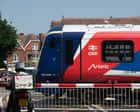
The mechanics of British railway financing remain an obscured labyrinth where public subsidies quietly transform into private fortunes. While commuters navigate delayed services, overcrowded carriages, and soaring ticket prices, the executive suites of the private rolling stock companies (ROSCOs)—Angel, Eversholt, and Porterbrook—tell a vastly different story. The chiefs of these three dominant train-leasing firms pulled in a combined £3.5 million in total remuneration last year, anchoring an asset-leasing model that drains billions from the network.
To understand why Britain's rail infrastructure is perpetually starved of cash, one must look past the operational train operators and examine the hidden landlords of the tracks.
The Architecture of the Lease Trap
When the privatization of British Rail was engineered in the 1990s, the industry was split into distinct fragments. Train operating companies come and go, winning and losing franchise contracts or falling into public hands when models fail. But the rolling stock companies—the firms that own the physical carriages, locomotives, and freight wagons—remain permanent fixtures.
According to data from the Office of Rail and Road (ORR), train operators spend upwards of £4 billion annually just to lease these trains. This creates a fixed, non-negotiable overhead. Regardless of whether a service runs on time, whether a station roof leaks, or whether passenger numbers plummet during economic downturns, the leasing fees must be paid.
The profit margins embedded within this system are staggering. Recent financial disclosures reveal that ROSCO profit margins hover near an exceptional 18.5 percent. For context, corporate margins of this scale are typically found in high-risk technology sectors or pharmaceutical development, not in regulated public transport utilities backed by government subsidies.
Where the Money Goes
The millions pulled in by individual executives are merely the visible symptom of a deeper structural design. Alongside executive compensation packages reaching deep into seven-figure territory, these three leasing giants pumped nearly £400 million out of the system and into the hands of their shareholders. Many of these ultimate owners are international investment funds, infrastructure funds, and overseas pension schemes.
For the British taxpayer, the arrangement functions as a continuous wealth extraction mechanism. Billions in public funds flow from the Department for Transport into train operating companies, which immediately pass a substantial portion of those subsidies straight to the ROSCOs to cover lease payments. From there, the capital is distributed as dividends offshore, leaving little behind to modernize signaling, lower fares, or improve network reliability.
Defenders of the ROSCO model argue that private capital is essential. The narrative suggests that without private leasing companies injecting billions into new fleets, the Treasury would have to shoulder the immense upfront burden of purchasing trains outright. Industry representatives frequently highlight multi-million-pound investments in decarbonization, modern interiors, and accessibility upgrades as proof that the model delivers tangible value to the passenger experience.
Yet, this argument glosses over a fundamental economic reality. Private firms do not borrow money more cheaply than sovereign governments. In fact, because private equity backers demand high double-digit returns on their equity, borrowing through the private sector often costs the British public significantly more over a train's thirty-year lifespan than direct government borrowing would.
The Political Reckoning
With the landscape shifting and the state gradually taking back control of failing passenger franchises under the banner of Great British Railways, the spotlight is turning sharply toward the rolling stock monopoly. Transport ministers face mounting pressure from rail unions and consumer advocacy groups to implement windfall levies or completely rethink how rolling stock is procured and owned.
Proposals to have a public body directly own future fleets are gaining traction, threatening an end to the lucrative status quo that has enriched a small circle of corporate leaders for three decades. Yet, breaking contracts and unwinding decades-old financial structures is legally treacherous and potentially ruinously expensive.
Until policy catches up with economic critique, the current setup persists. Every time a passenger taps a barrier to pay an inflated peak-fare ticket price, a fraction of that transaction bypasses the rails, the stations, and the staff, heading instead toward the balance sheets of private leasing portfolios. The executives leading these firms have mastered the art of extracting guaranteed returns from a captive market, leaving the rest of the country to manage the fallout of a hollowed-out system.