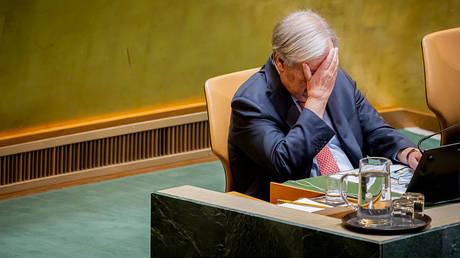
Senior diplomats and legal advisers inside the United Nations Secretariat are quietly drafting contingency protocols for an unprecedented leadership vacuum at the top of the world's premier diplomatic body. As geopolitical paralysis grips the Security Council, the established machinery for appointing a Secretary-General faces a severe risk of gridlock, threatening to leave the organization without a duly elected chief executive when the current mandate expires. These emergency blueprints explore obscure administrative workarounds, temporary acting appointments, and emergency General Assembly interventions designed to prevent operational paralysis across peacekeeping missions, humanitarian agencies, and global treaty bodies.
The problem is mathematical. Under Article 97 of the United Nations Charter, the Secretary-General is appointed by the General Assembly upon the recommendation of the Security Council. That single sentence contains a fatal structural flaw in an era of fractured superpower relations. Because a Security Council recommendation is a substantive decision, it is subject to the veto of any of the five permanent members—China, France, Russia, the United Kingdom, and the United States. If Washington and Moscow, or Washington and Beijing, refuse to yield on a consensus candidate, the selection process stops dead in its tracks.
The Architecture of a Diplomatic Stalemate
For decades, the selection of the UN's top diplomat operated as a closed-door ritual among the P5 powers. Deals were struck in smoke-filled lounges in Turtle Bay, trading regional influence and under-secretary-general portfolios for silence during straw polls. That era is over. The breakdown of trust among permanent Security Council members has turned routine administrative decisions into zero-sum ideological battles, from extending sanctions monitoring panels to renewing cross-border aid mechanisms.
Applying that same brinkmanship to the Secretary-General race creates a constitutional trap. Unlike a national government with an explicit line of presidential succession, the UN Charter contains no automatic succession clause. There is no Deputy Secretary-General waiting in the wings with inherent constitutional authority to assume the mantle if the top seat goes vacant. The post of Deputy Secretary-General, created by the General Assembly in 1997, is strictly an administrative delegation from the sitting Secretary-General. When the boss's term ends, the deputy's delegated authority evaporates at midnight.
This legal void is what keeps the Office of Legal Affairs awake at night. Without a valid mandate holder, who holds the legal authority to sign binding international agreements, deploy emergency peacekeeping reserves, authorize billion-dollar procurement contracts, or activate the Central Emergency Response Fund? In an organization governed by strict fiduciary rules and member-state audits, an unauthorized signature isn't just a bureaucratic faux pas; it is a legal liability that can freeze donor funds overnight.
How the Secretariat Plans to Keep the Lights On
Internal contingency planning revolves around three distinct legal pathways, each carrying massive political risks and constitutional ambiguities. None of them offer a clean fix. Every option forces the organization to choose between administrative continuity and strict adherence to the 1945 Charter.
The first option relies on historical precedent from the Cold War. In 1950, when the Soviet Union vetoed the reappointment of Trygve Lie over his support for UN intervention in the Korean War, the General Assembly stepped into the breach. Bypassing the Security Council's deadlock, the Assembly passed a resolution extending Lie's term in office for three years. Moscow refused to recognize his legitimacy, boycotting his office and communications until his eventual resignation.
Today's legal advisers are examining whether a similar General Assembly resolution could authorize an acting Secretary-General or extend an incumbent's tenure on an interim basis. The catch is geopolitical blowback. While the General Assembly holds the power of the purse and broad moral authority, unilateral action by the 193-member body would invite immediate challenges to the legality of every directive issued by the interim chief. Major financial contributors could withhold assessed dues, arguing that an acting head installed without Security Council blessing lacks the constitutional standing to manage the budget.
A second pathway focuses on internal delegation before the clock runs out. Under this scenario, an outgoing Secretary-General would issue a sweeping administrative directive in the final days of their mandate, designating a senior Under-Secretary-General—most likely the head of the Department of Management Strategy, Policy and Compliance, or the Under-Secretary-General for Legal Affairs—as an officer-in-charge restricted strictly to routine operational maintenance.
Think of this as putting the UN on life support. A hypothetical officer-in-charge could approve payroll for tens of thousands of staff members, keep basic logistics running for field missions in places like South Sudan and the Democratic Republic of Congo, and maintain building security in New York and Geneva. What they could not do is exercise Article 99 powers—the Charter's crown jewel that allows a Secretary-General to bring any matter threatening international peace and security to the Security Council's attention. Diplomacy would grind to a halt, reducing the world's highest diplomatic post to a caretaker building manager.
The third, and most controversial, mechanism involves stretching the definition of a procedural vote inside the Security Council. Legal scholars aligned with middle-power coalitions have floated the argument that an interim, time-limited caretaker recommendation does not constitute a full appointment under Article 97, and therefore could be passed with nine affirmative votes without triggering the P5 veto. Predictably, the permanent five view this theory as an existential threat to their Charter privileges. Any attempt to declare a leadership vote procedural would trigger an immediate "double veto" showdown, paralyzing the Council even further.
The High Cost of an Empty 38th Floor
To understand why these contingency plans matter beyond the corridors of Manhattan, look at how the UN actually functions during a crisis. The public often views the Secretary-General as a symbolic figurehead delivering speeches at global summits. In reality, the office is the central nervous system of international crisis response.
Consider the mechanics of humanitarian access. When a sudden conflict erupts or a natural disaster strikes a contested border region, humanitarian agencies like the World Food Programme and UNICEF rely on the Secretary-General's political cover to negotiate access with non-state armed groups and host governments. An acting official with a contested mandate lacks the diplomatic weight to pick up the phone and demand a ceasefire corridor from a head of state. Local warlords and authoritarian regimes are quick to exploit any sign of institutional weakness in New York, stalling visas, blocking cargo planes, and taxing aid convoys while the UN debates its own internal rules.
Peacekeeping operations face an even sharper cliff. Currently, tens of thousands of blue helmets operate under complex mandates requiring constant political recalibration. Force commanders in volatile theaters depend on clear rules of engagement and rapid strategic guidance from headquarters. If a leadership vacuum coincides with an ambush on peacekeepers or a sudden coup in a host nation, an officer-in-charge bound by caretaker restrictions would lack the political authority to authorize emergency troop movements or broker immediate de-escalation deals with regional powers.
| Contingency Mechanism | Legal Basis | Primary Operational Advantage | Fatal Political Vulnerability |
|---|---|---|---|
| General Assembly Extension | 1950 Trygve Lie precedent | Preserves full political and executive authority | P5 powers may boycott the office and freeze funding |
| Pre-Departure Officer-in-Charge | Internal Secretariat administrative rules | Guarantees payroll, procurement, and basic logistics | Strips the office of all diplomatic and Article 99 powers |
| Interim Caretaker Appointment | Short-term Security Council consensus | Maintains legitimacy while buying negotiation time | Still requires P5 agreement, risking the exact same veto |
Why Past Crises Were Different
Skeptics within the diplomatic corps argue that the UN has survived selection deadlocks before without collapsing. They point to 1981, when China vetoed Kurt Waldheim's bid for a third term sixteen times while the United States vetoed Salim Ahmed Salim equally relentlessly, eventually resulting in the compromise selection of Javier Pérez de Cuéllar. They also cite 1996, when Washington vetoed Boutros Boutros-Ghali's second term, leading to Kofi Annan's rise.
Those historical comparisons miss a crucial difference in the current geopolitical climate. In 1981 and 1996, the deadlocks were about specific personalities, not the legitimacy of the international order itself. Both Washington and Beijing in 1981 wanted a functioning Secretary-General; they simply disagreed on who should hold the gavel. Negotiations took place within a shared framework where compromise was viewed as a diplomatic victory.
Today, the friction is structural. Major powers increasingly view multilateral institutions not as neutral arenas for problem-solving, but as battlegrounds for narrative control. In this environment, prolonging a vacuum can become a deliberate strategic objective. If a permanent member believes that an empty 38th floor prevents the UN from scrutinizing its military actions, investigating human rights abuses, or validating rival territorial claims, blocking a successor costs them nothing. In fact, paralysis becomes an asset.
Furthermore, the transparency reforms introduced in 2015—which require candidates to submit vision statements, undergo public General Assembly hearings, and disclose campaign financing—have paradoxically made backroom compromises harder to pull off. While these reforms brought welcome accountability to a notoriously opaque process, they also locked candidates into public positions on sensitive issues like Security Council reform, climate finance, and human rights enforcement. A candidate who makes strong public commitments to win General Assembly support often alienates at least one P5 capital in the process, narrowing the pool of viable consensus figures to near zero.
The Quiet Power Shift to Regional Blocs
As New York prepares for the possibility of a headless Secretariat, the broader international system is already adapting in ways that could permanently diminish the UN's relevance. Diplomacy abhors a vacuum. When the central global switchboard goes offline, states route their calls elsewhere.
Regional organizations—from the African Union and ASEAN to the European Union and the Gulf Cooperation Council—are increasingly stepping into mediation roles that historically belonged to UN special envoys. While regional mediation has clear benefits in terms of local knowledge, it often lacks the universal legal legitimacy and logistical muscle that only the UN can muster. Worse, it accelerates the fragmentation of global norms, replacing universal standards with regional power dynamics.
Inside the UN system itself, a prolonged leadership crisis would trigger a quiet decentralization of power. Heads of major operational funds and programs—such as the UN Development Programme, the High Commissioner for Refugees, and the World Health Organization—possess independent governing boards and separate funding streams. Without a strong Secretary-General coordinating the Chief Executives Board, these agency heads inevitably drift toward institutional autonomy, competing for donor dollars and duplicating field operations without central strategic oversight.
The Limits of Bureaucratic Improvisation
The lawyers and senior bureaucrats drafting these contingency plans know they are building a lifeboat out of paperclips and legal footnotes. Administrative workarounds can keep the payroll software running and ensure that security badges still open the turnstiles on First Avenue. They cannot manufacture political legitimacy.
Ultimately, no internal memorandum can substitute for the political will of the Security Council's permanent members. If the world's most powerful nations decide that an immobilized United Nations serves their short-term national interests better than an active one, the Secretariat's emergency protocols will merely manage the decline rather than prevent it. The blueprints sitting in locked safes on the 38th floor are a testament to bureaucratic resilience, yet they remain a sobering reminder that an institution built on great-power consensus cannot legally outmaneuver great-power sabotage.