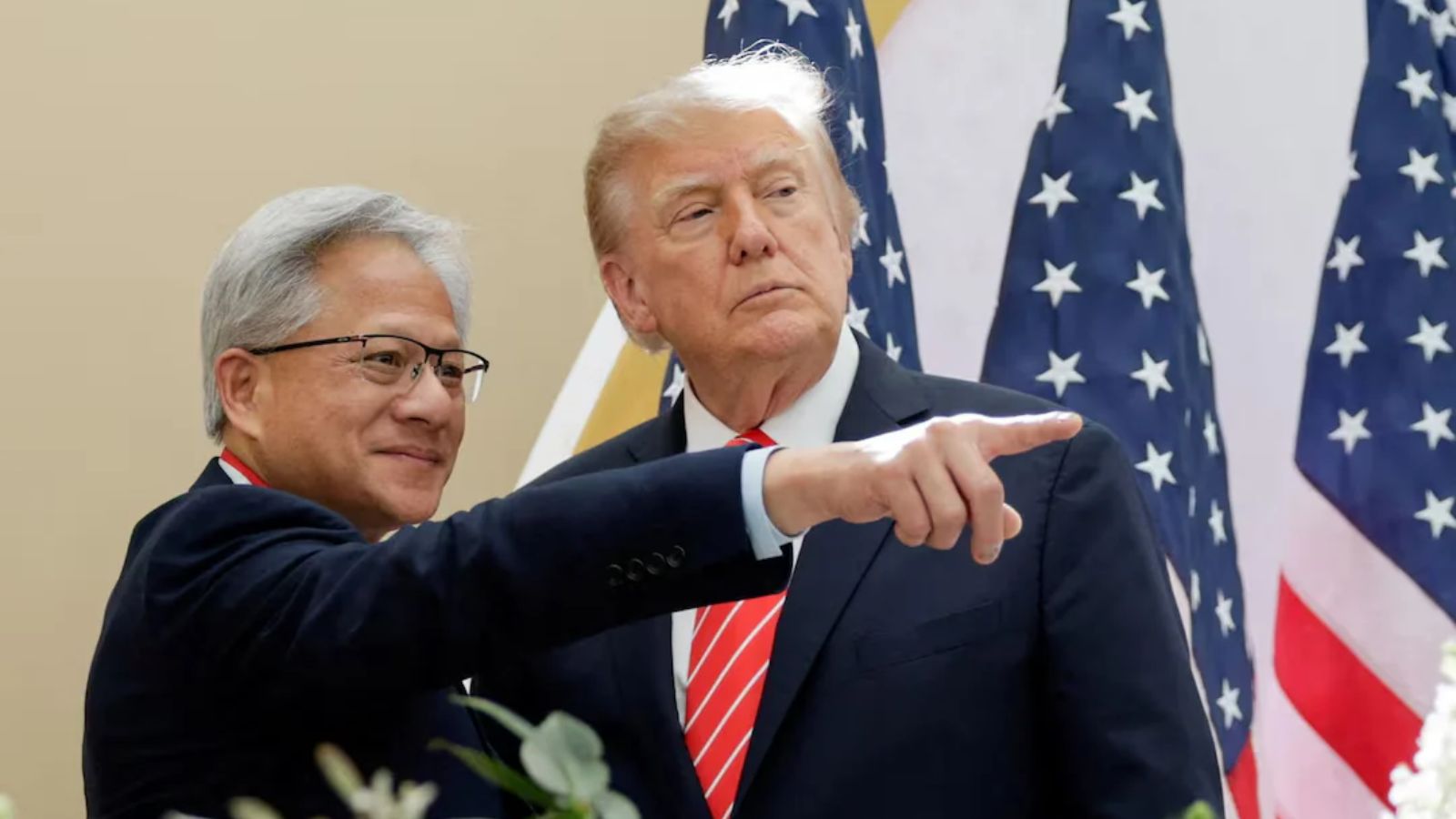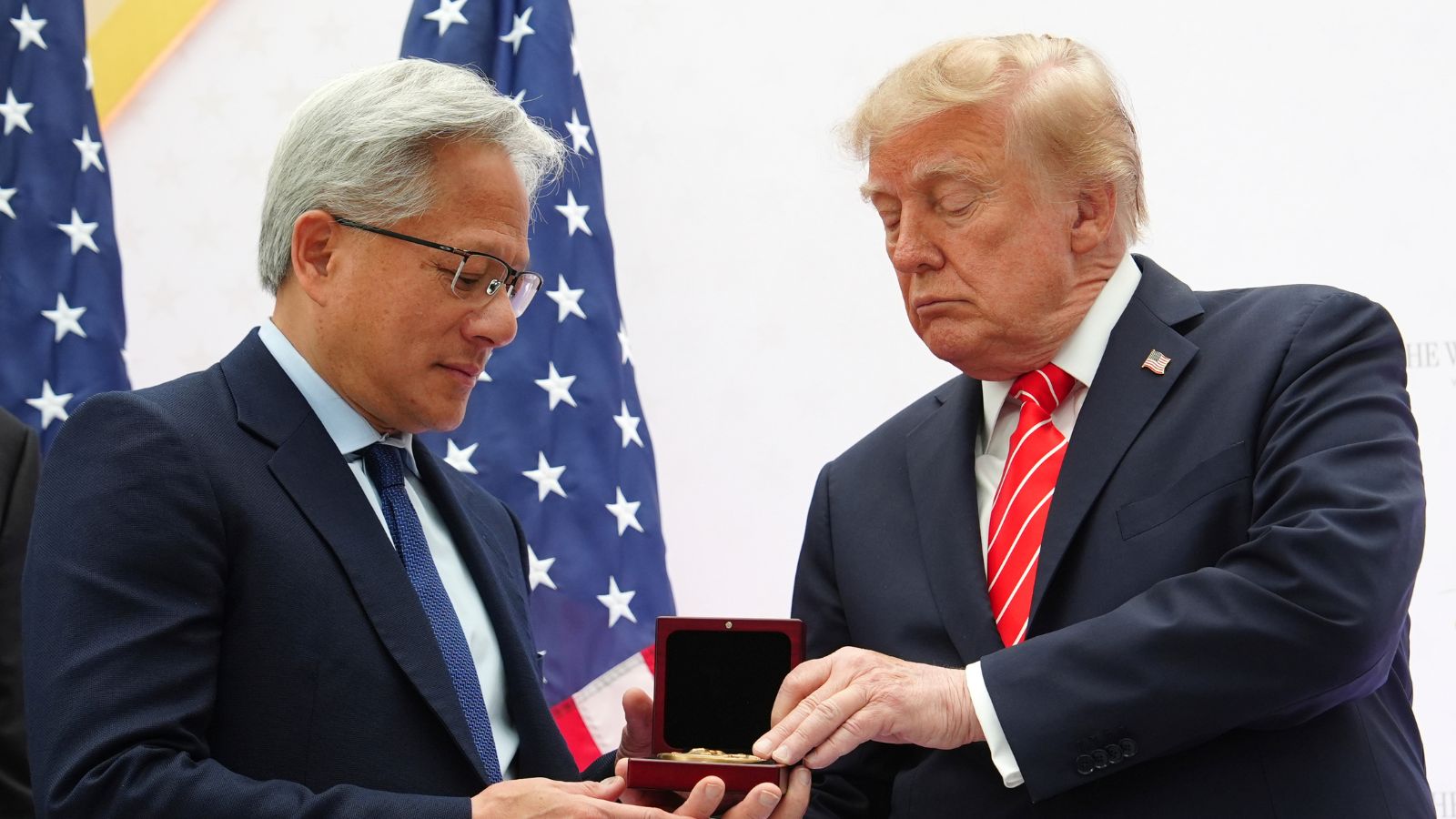
Donald Trump publicly backed Jensen Huang’s efforts to navigate federal export restrictions and keep Nvidia at the center of global artificial intelligence infrastructure, punctuating his remarks with characteristic off-the-cuff commentary about corporate espionage and foreign recruitment tactics. The endorsement signals a critical alignment between the White House and Silicon Valley’s most valuable chipmaker as Washington rewrites the rules of the semiconductor cold war. For investors, policy analysts, and rival tech executives, the message is clear. The administration views Nvidia not merely as a private vendor, but as an indispensable instrument of American industrial power.
This political pivot did not happen in a vacuum. Over the past several years, Nvidia found itself caught in a tightening vise between national security hawks in Washington and massive commercial demand in Asia. Every new round of export controls forced Huang and his engineering teams to redesign flagship processors, stripping down interconnect speeds and compute density just to stay on the right side of Commerce Department thresholds. Each redesign cost hundreds of millions of dollars and ceded ground to domestic Chinese competitors like Huawei.
Trump’s vocal support changes the calculus in Washington. By framing Nvidia’s market dominance as a vital national asset rather than a regulatory target, the administration is signaling a willingness to balance security hawks against the commercial survival of American hardware champions.
The Espionage Rhetoric and the Reality of Tech Transfers
When Trump uses colorful, provocative language about "beautiful women" acting as spies to extract corporate secrets, the headlines write themselves. Veteran observers of Washington politics recognize the rhetorical style immediately. He reduces complex, decade-long counterintelligence battles into vivid, tabloid-ready anecdotes that resonate at campaign rallies and press briefings. Yet beneath the theatrical phrasing lies a well-documented reality that federal law enforcement and corporate security teams deal with every single week.
Industrial espionage in the semiconductor sector rarely looks like a Cold War thriller, though human intelligence operations remain a persistent threat. According to numerous Department of Justice indictments and FBI counterintelligence briefings over the last decade, foreign state-backed entities rely heavily on targeted recruitment, shell companies, and talent acquisition programs to siphon off proprietary designs. Engineers holding high-level clearances or access to electronic design automation software and lithography blueprints are routinely approached through professional networking sites, academic conferences, and lucrative consulting offers.
For a company like Nvidia, the intellectual property at risk is not just a single schematic. It is an entire architecture built over thirty years.
Consider what makes Nvidia’s hardware nearly impossible to replicate overnight:
- CUDA Software Ecosystem: Millions of developers write code specifically optimized for Nvidia’s proprietary parallel computing platform, creating immense switching costs for enterprise customers.
- NVLink Interconnects: High-speed communication protocols allow thousands of individual graphics processing units to act as a single, massive supercomputer without hitting data bottlenecks.
- Supply Chain Orchestration: Deep, decades-long engineering partnerships with foundry giants like Taiwan Semiconductor Manufacturing Company (TSMC) and memory suppliers like SK Hynix secure advanced packaging capacity that rivals cannot easily book.
When politicians talk about spies stealing secrets, they often miss the structural moat protecting companies like Nvidia. You can steal a blueprint for a chip, but you cannot steal the manufacturing yield rates of a multi-billion-dollar fabrication plant or the collective muscle memory of ten thousand software engineers. Still, Trump’s blunt framing serves a specific political purpose. It dramatizes the threat of foreign tech theft to justify aggressive trade policies while simultaneously defending an American CEO who wants the freedom to sell to global markets.
Why Jensen Huang Needed Washington in His Corner
To understand why Huang welcomed—and actively cultivated—a closer relationship with the White House, you have to look at Nvidia’s balance sheet and its geographic exposure. Before the first wave of sweeping export bans hit the semiconductor industry, mainland China and Hong Kong routinely accounted for roughly twenty to twenty-five percent of Nvidia’s data center revenue. Losing unrestricted access to one of the world’s largest buyers of compute infrastructure was a direct hit to top-line growth.
More importantly, Huang has repeatedly warned policymakers about an unintended consequence of total isolation. If American companies are completely barred from selling commercial AI chips into foreign markets, those markets will not simply stop building AI. They will pour billions of state subsidies into local alternatives, accelerating the exact technological independence Washington hopes to prevent.
Huang’s argument is rooted in cold, hard market economics. Once a foreign tech giant builds its entire AI training pipeline around a domestic chip architecture, it will never come back to Nvidia, even if restrictions are eventually lifted. By keeping a foothold in restricted markets through compliant, reduced-spec hardware—and by securing high-level political backing in Washington to prevent an outright total embargo—Huang is fighting to keep the global AI standard anchored to American technology.
The lobbying effort required a delicate touch. Unlike other Silicon Valley leaders who frequently clashed with conservative lawmakers over content moderation, antitrust scrutiny, or social policies, Huang kept his public profile strictly focused on engineering, manufacturing, and American competitiveness. He avoided partisan culture wars entirely. When he stepped onto the stage or walked into the West Wing, he spoke the language of domestic job creation, supply chain resilience, and beating foreign rivals at their own game.
The Structural Vulnerability Nobody Wants to Admit
While the public alignment between Trump and Huang projects strength, industry veterans see a glaring vulnerability sitting right beneath the surface. Nvidia’s comeback—and its multi-trillion-dollar valuation—depends entirely on an extraordinarily fragile geographic choke point.
Nvidia designs the world’s most advanced AI accelerators, but it does not own a single fabrication facility. Every cutting-edge GPU powering modern large language models is etched onto silicon wafers in Taiwan by TSMC, using extreme ultraviolet lithography machines built exclusively by ASML in the Netherlands.
If you trace the physical journey of a single Nvidia server rack, the geopolitical risk becomes obvious:
- Silicon wafers are fabricated in Hsinchu or Tainan, Taiwan.
- High-bandwidth memory modules are manufactured primarily in South Korea.
- Advanced CoWoS (Chip-on-Wafer-on-Substrate) packaging binds those components together in specialized facilities that remain heavily concentrated in East Asia.
- Final server assembly often occurs across facilities in Taiwan, Mexico, or Southeast Asia before reaching data centers in the United States.
Washington has poured tens of billions of dollars into domestic manufacturing incentives through the CHIPS and Science Act to bring leading-edge fabrication back to American soil, particularly in states like Arizona and Ohio. Trump, while frequently criticizing the structure of subsidy programs in favor of punitive tariffs, shares the overarching goal of forcing chipmakers to build factories inside the United States.
Yet fab construction operates on geological timescales compared to software cycles. Building a leading-edge semiconductor plant requires cleanrooms the size of multiple football fields, ultra-pure water supplies, specialized chemical logistics, and thousands of technicians who simply do not exist in sufficient numbers in the American labor market yet. Even under the most optimistic timelines, the United States will remain heavily reliant on Taiwanese manufacturing for the remainder of the decade.
Trump’s backing gives Nvidia political cover in Washington, but no executive order can instantly teleport a high-volume packaging plant across the Pacific Ocean.
The Counter-Argument From National Security Hawks
Not everyone in Washington is celebrating the warm rapport between the president and Nvidia’s chief executive. Inside the Pentagon, the intelligence community, and congressional committees focused on strategic competition, a fierce debate is playing out over where commercial interest ends and national security begins.
Critics of a softer approach toward chip exports argue that advanced artificial intelligence is fundamentally a dual-use technology. The exact same clusters of GPUs used to train a customer-service chatbot or generate marketing copy can be repurposed to accelerate hypersonic missile simulations, break encryption protocols, design biological agents, or coordinate autonomous drone swarms.
From the perspective of national security hardliners, allowing Nvidia to sell modified, slightly slower chips abroad is a dangerous half-measure. They point out that AI labs can compensate for lower chip-to-chip interconnect speeds by linking larger quantities of compliant processors together, using clever software optimization to achieve frontier-level training runs anyway. In their view, every high-end American processor shipped abroad—regardless of whether it meets current Commerce Department performance caps—adds directly to a strategic rival’s military and surveillance capabilities.
There is also deep skepticism regarding how export rules are enforced once hardware leaves the loading dock. A global gray market has emerged, utilizing shell companies in third-party countries across Southeast Asia and the Middle East to acquire restricted server racks and reroute them to prohibited end-users. Tracking the physical location of individual GPUs after they enter international shipping lanes has proven nearly impossible for understaffed export enforcement agencies.
Hawks argue that Trump’s transactional approach to trade risks trading away long-term military superiority for short-term corporate earnings. If export controls become bargaining chips in broader tariff negotiations, the entire regulatory framework loses its deterrence value.
Hyperscalers Are Quietly Building Nvidia’s Replacement
Even if Huang navigates every geopolitical minefield in Washington and Beijing, he faces an equally formidable threat much closer to home. His largest customers are actively working to fire him.
Look at who actually buys the vast majority of Nvidia’s data center hardware. A massive percentage of the company’s revenue comes from a tiny handful of American tech giants: Microsoft, Alphabet, Amazon, and Meta. These hyperscalers are spending tens of billions of dollars every quarter to build out AI compute capacity, and they have zero intention of paying Nvidia’s seventy-five-percent gross margins forever.
Every single one of these tech giants has deployed internal silicon engineering teams to design custom Application-Specific Integrated Circuits (ASICs) tailored specifically to their own AI workloads:
- Google has spent over a decade refining its Tensor Processing Units (TPUs), training massive internal models without relying exclusively on external GPU allocations.
- Amazon Web Services aggressively pushes its custom Trainium and Inferentia chips to cloud customers looking to lower compute bills.
- Microsoft has rolled out its Maia AI accelerators specifically designed to run Azure workloads efficiently.
- Meta continues to scale its custom MTIA (Meta Training and Inference Accelerator) silicon to handle recommendation algorithms and generative AI inference at massive scale.
These custom chips do not need to beat Nvidia’s flagship GPUs across every conceivable benchmark to hurt Nvidia’s bottom line. They only need to handle specific, predictable tasks—like running inference on an already trained model—at a lower total cost per watt. As the AI industry shifts more of its daily compute budget from initial model training toward continuous inference for hundreds of millions of users, custom silicon becomes vastly more attractive.
Huang’s aggressive annual product cadence—releasing new architectures like Hopper, Blackwell, and Rubin on a relentless twelve-month cycle—is designed specifically to outrun these internal efforts. By the time a hyperscaler finishes validating a custom chip designed to compete with last year’s Nvidia GPU, Nvidia is already shipping a faster, more efficient generation. It is an exhausting, capital-intensive arms race that leaves zero room for engineering missteps.
Sovereign AI and the New Geopolitical Sales Pitch
Recognizing both the limits of export-restricted markets and the long-term threat of hyperscaler custom silicon, Huang has pioneered a new revenue pillar that aligns neatly with Trump’s worldview: Sovereign AI.
The pitch is straightforward and deeply appealing to heads of state from Paris to Tokyo to Riyadh. Huang tells foreign leaders that every nation must own its own artificial intelligence infrastructure, trained on its own language, culture, and domestic data, rather than renting intelligence from a handful of American cloud monopolies. To build that sovereign capability, governments must buy Nvidia hardware directly to construct state-backed supercomputing centers.
This strategy accomplishes three critical business objectives at once:
- It diversifies Nvidia’s customer base away from the four or five American tech giants that currently hold immense pricing power over the company.
- It channels billions of dollars in foreign sovereign wealth funds and national infrastructure budgets directly into Nvidia’s revenue stream.
- It cements Nvidia’s hardware and software stack as the foundational layer of national infrastructure across allied nations, making it diplomatic suicide for Washington to undermine the company’s global supply chain.
For the White House, Sovereign AI deals with allied nations offer a clean geopolitical win. When countries in Europe or the Middle East build their national AI infrastructure on American chip architectures rather than foreign alternatives, they lock themselves into the U.S. technological sphere of influence for decades. The administration gets to tout massive export deals and diplomatic alignment, while Nvidia locks in multi-year hardware contracts insulated from the whims of Silicon Valley procurement officers.
The Fragile Balancing Act Ahead
The public camaraderie between Donald Trump and Jensen Huang marks a distinct chapter in the history of American industrial policy. Rarely has a single hardware executive commanded so much simultaneous leverage over Wall Street valuations, Silicon Valley product roadmaps, and White House trade negotiations.
Yet political endorsements are notoriously conditional in Washington. Trump’s support rests on a clear transactional expectation: Nvidia must remain an unmistakable engine of American economic dominance, bring high-value manufacturing back to domestic soil, and avoid looking like it is handing technological advantages to foreign adversaries.
Huang has proven remarkably adept at reading shifting political winds, adjusting his company’s product roadmaps, supply chain commitments, and public rhetoric to keep regulators at bay while competitors scramble to catch up. Whether that delicate balancing act survives the next round of tariff escalations, supply chain shocks, or tightening export rules remains an open question—one that will determine not just the trajectory of Nvidia’s stock price, but who ultimately controls the physical infrastructure of global intelligence.