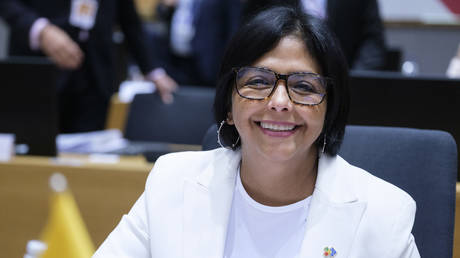
The United States Treasury Department has officially scrubbed Delcy Rodríguez, Venezuela’s acting president, from its sanctions blacklist. This move, finalized on Wednesday, April 1, 2026, represents the most significant diplomatic U-turn in the Western Hemisphere since the Cold War. It effectively validates the leadership of a woman whom Washington once labeled a primary architect of democratic collapse, signaling that the White House is now prioritizing energy security and regional stability over the ideological purity of its allies in Caracas.
By removing Rodríguez from the Office of Foreign Assets Control (OFAC) Specially Designated Nationals list, the U.S. has cleared the legal brush for American executives to sit across the table from the very regime they were told to starve out for nearly a decade.
The Great Caracas Realignment
The decision to delist Rodríguez is not an isolated act of diplomacy. It is the logical conclusion of Operation Absolute Resolve, the January 2026 military raid that saw the abduction and extradition of Nicolás Maduro to New York. With Maduro awaiting trial on narco-terrorism charges, the power vacuum in Caracas was filled not by the fractured opposition, but by his former Vice President.
Washington’s gamble is simple: it is easier to deal with a pragmatist from the old guard than to manage the chaos of a collapsed state. Rodríguez has already signaled her willingness to play ball, overseeing the Hydrocarbons Law reform that rolled back decades of resource nationalism. This legislative shift allows private and foreign firms—most notably Chevron, Shell, and Repsol—to hold majority stakes in oil projects, a concession Maduro never fully granted.
"We value this as a step toward normalizing relations," Rodríguez stated via Telegram shortly after the announcement. Her confidence is grounded in the reality that the U.S. needs Venezuelan heavy crude to stabilize global markets, especially as conflicts in the Middle East continue to squeeze supply lines.
Why the Sanctions Failed to Kill the Inner Circle
The 2018 sanctions against Rodríguez were intended to isolate the Maduro administration. Instead, they forced the regime to build a parallel financial architecture involving Russian and Iranian intermediaries. By 2025, the "blockade" had become a sieve.
The lifting of these measures acknowledges that the "maximum pressure" campaign reached its expiration date. The U.S. Treasury is now pivoting from a policy of total exclusion to one of conditional inclusion. Under the new framework, payments for Venezuelan oil are funneled through Foreign Government Deposit Funds controlled by the U.S. Treasury. Caracas gets enough cash to keep the lights on and prevent a fresh wave of migration, while Washington ensures that not a single petrodollar is diverted to Moscow or Tehran.
The Brutal Truth of the Energy Extraction
For the American voter, this is an exercise in lowering the price at the pump. For the Venezuelan people, it is a bitter pill. The opposition, led by figures like María Corina Machado, now finds itself in a precarious position. While the U.S. State Department maintains a rhetoric of "supporting democratic transitions," its actions suggest a preference for the stability of a reformed autocracy over the unpredictability of a revolutionary change.
The reopening of the U.S. Embassy in Caracas last month was the first flare. The delisting of Rodríguez is the steady flame. American firms are no longer just looking at the oil; they are eying the mining sector, specifically gold and copper deposits that were recently opened to Western conglomerates under General Licenses 51A and 54.
A High Stakes Liquidity Trap
Rebuilding Venezuela’s dilapidated oil infrastructure will cost an estimated $100 billion over the next decade. The removal of Rodríguez from the sanctions list allows her to negotiate directly with the International Monetary Fund (IMF) and private creditors to restructure the country's massive foreign debt.
However, the "normalization" is far from complete. The U.S. still holds the ultimate leverage: the ability to snap these sanctions back into place if the Rodríguez administration pivots back to the East. It is a leash, not a release. The acting president is free to trade, but only within the corridor Washington has paved.
The era of the "interim presidency" of Juan Guaidó is a ghost of a previous strategy. The new reality is a transactional partnership with the survivors of the Chavista era. It is a cold, calculated move that proves, in the world of geopolitics, there are no permanent enemies—only permanent interests.
The next few months will determine if Rodríguez can maintain her grip on the military while satisfying the demands of the U.S. Treasury. If she fails, the "New Chapter" Washington is so eager to write will likely end in the same place as the last one: a stalemate in the mud of the Orinoco Belt.